


Cast-in-place tactile paving construction, cast-in-place diamond tactile paving price, polymer cast-in-place diamond tactile paving
Other Products


Product Advantages: Aesthetic, durable, short construction period, the entire pavement can be formed in one go (cast-in-place tactile paving can be directly laid on the finished pavement, avoiding the hassle of secondary paving typically caused by traditional tactile paving bricks), significantly reducing pavement construction costs and material waste. Various colors and styles are available for flexible matching.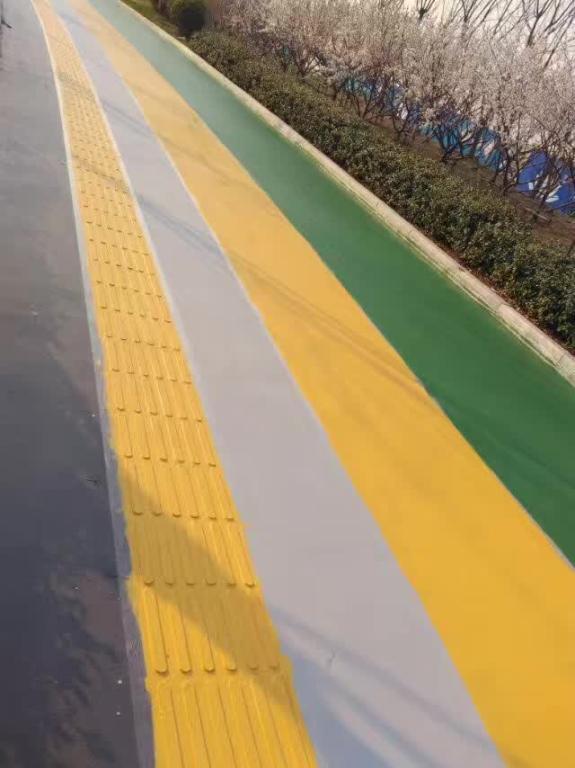
Product Description: Polymer cast-in-place diamond tactile paving is a continuous tactile paving system made from inorganic high-strength polymer materials combined with specialized molds, constructed on existing pavements through cast-in-place methods. It is divided into two types: guidance strips and guidance points. Standard widths include 300mm, 400mm, 500mm, and 600mm, with flexible customization available based on actual needs. It forms a permanent bond with asphalt concrete or cement concrete base layers, offering wear resistance, slip resistance, stain resistance, and synchronous expansion and contraction with asphalt pavement.
II. Construction Process and Operating Methods
Polymer cast-in-place diamond tactile paving is a new tactile paving technology that can be constructed on-site on traditional black asphalt concrete and gray cement concrete pavements.
2.1 Construction Process
Base layer inspection - Base layer cleaning and treatment - Layout marking - Tape application - Base leveling and mortar spreading - Mold placement - Filling with diamond tactile paving mortar - Leveling and finishing - Curing to specified time - Surface cleaning - Application of sealant for surface sealing - Drying and curing - Inspection and acceptance - Opening to traffic - Final acceptance.
2.2 Construction Equipment and Tools
The diamond tactile paving construction process is relatively simple, requiring only the following equipment and tools: one mixer, one disperser, several tactile paving molds, one material transport vehicle, rolling rollers, specialized serrated rubber screeds and flat rubber screeds, one high-power blower, one generator, brooms, and other general equipment and tools.
2.3 Construction Personnel
One team leader and 5-6 construction workers per team.
2.4 Construction Preparation
4.1 Review drawings and layout marking
Carefully review construction drawings and verify positions on-site one by one. Mark points and apply tape if necessary.
4.2 Material inspection
Polymer cast-in-place diamond tactile paving is an on-site, multi-step, multi-material coordinated construction system for ground surfaces. Before construction, material consistency and compatibility must be checked in advance. Emulsion materials should show no significant skinning, clumping, or abnormalities; powder materials should be free of clumps. 2.4.3 Trial mixing and sample preparation
Different base layers and environments can affect the curing time of polymer diamond tactile paving. Therefore, before formal construction, on-site trials must be conducted strictly according to the mix ratio and methods set for batch operations. Batch operations can proceed only after ensuring no significant defects in curing.
2.4.4 Base layer conditions and treatment
The base layer should be solid and clean. Asphalt concrete pavement should be free of bleeding, loose dust, delamination, or aggregate loss.
For cement concrete pavement, if the strength is below C25, the surface should be treated by milling, scabbling, grinding, sandblasting, or roughening (for newly poured concrete), preferably exposing the aggregate over a large area. Additionally, 1-2 applications of PM-101 penetrating sealant are required for sealing treatment.
Clean, dry asphalt pavement in good functional condition does not require sealing treatment.
| Industry Category | Chemicals/Chemical Intermediates/Intermediate Compounds |
|---|---|
| Product Category | |
| Brand: | |
| Spec: | 110 |
| Stock: | 888888 |
| Origin: | 113113 |


