


Price of materials for building a rabbit breeding shed
Other Products


When building a rabbit house, choose a location that is high, dry, flat, sheltered from the wind, sunny, with a low water table, good drainage, and a spacious area. There should be a water source with sufficient volume and good quality. It should be far from slaughterhouses, livestock markets, animal product processing plants, and busy intersections frequented by livestock, as well as main roads with heavy traffic and noise. Build it in a relatively quiet place, at least 200 meters away from major transportation routes and 100 meters away from general roads.
Rabbit houses should be built according to local conditions and use locally available materials, adhering to the principles of economy, heat prevention, moisture resistance, rain protection, cold protection, pollution prevention, protection from predators, and convenience for temperature control, humidity control, light control, and management. Types of rabbit houses include shed-style, semi-open, enclosed, indoor open, group-raised with fences, cave-style, cellar-style, and mountain-dug cave-style rabbit houses.
When constructing a rabbit house, pay attention to the following five points:
1. The density of cages inside the house should be moderate. When building two or more rows of cages inside the house, if the span is short (generally within 10 meters), the width of the aisle between the cages should be 1-1.2 meters. The aisle along the wall should be 0.8-1 meter wide. Additionally, the distance between two back-to-back rows of cages should be maintained at 0.7-0.8 meters. Each row of cages should ideally have 2-3 layers, with a total height not exceeding 1.8 meters.
2. The specifications of the rabbit cages should be appropriate. In rural areas, large and medium-sized meat rabbits are commonly raised. The cage dimensions can be set at a width of 60-65 cm, depth of 50-55 cm, with a front height of 40 cm and a rear height of 33 cm.
3. The cage floor should be meticulously crafted. Before nailing, each bamboo strip must have its nodes and edges shaved off and be smoothed flat. The bamboo strips should be 2-2.5 cm wide, with evenly spaced gaps (1.2-1.5 cm). Additionally, they should be made removable for easy cleaning.
4. Install a hay rack. The hay rack is attached to the cage door (the cage door is made of wire mesh or thin bamboo poles). The hay rack can be made of wire mesh, shaped like a wedge, and its size should be determined based on the type and quantity of feed. 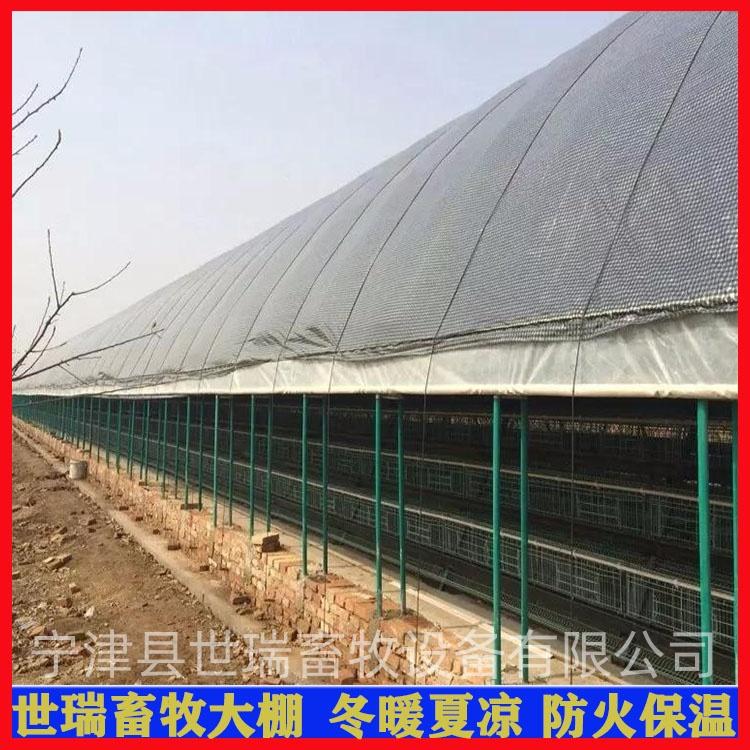
| Industry Category | Others |
|---|---|
| Product Category | |
| Brand: | 世瑞 |
| Spec: | 30*85 |
| Manufacturer: | 宁津县世瑞畜牧设备有限公司 |
| Origin: | 113714 |


