


Distilled water equipment for large-volume infusion production
Contact Info
- Add:No. 318 Zhenxing Road, Che Dun Town, Dan Lai Shang Chuang Yuan, Building D, Zip:
- Contact: 胡先生
- Tel:18721141386
- Email:411243788@qq.com
Other Products


Large Volume Parenteral Production Distilled Water Equipment: Core Processes and Technological Innovation Analysis
In the medical and pharmaceutical fields, the quality of large volume parenteral (LVP) products is directly related to patient safety. As one of the core pieces of equipment in the production process, distilled water equipment bears the critical responsibility of preparing high-purity process water. This article will explore from multiple dimensions including technical principles, equipment composition, and industry applications, providing an in-depth analysis of how modern distilled water equipment offers stable and reliable high-quality water assurance for pharmaceutical companies.
Chapter 1: The Core Role of Distilled Water Equipment in LVP Production
As sterile preparations directly injected into human veins, LVPs have extremely stringent water quality requirements during production. According to the Chinese Pharmacopoeia, water used in LVP preparation must meet the standards for Water for Injection (WFI), with key indicators including conductivity, microbial limits, and endotoxin content. While traditional purified water preparation processes (such as reverse osmosis and ion exchange) can remove most impurities, they have limitations in pyrogen control. In contrast, the distillation method, based on phase separation principles, can completely remove pyrogenic substances, making it the preferred solution for preparing WFI in the pharmaceutical industry.
Modern distilled water equipment adopts a modular design, typically consisting of a pretreatment system, distillation unit, cooling device, storage tank, and circulation system. Taking the combined process of three-stage reverse osmosis and multi-effect distillation as an example, the pretreatment unit removes suspended solids, residual chlorine, and calcium/magnesium ions from the feed water through sand filtration, activated carbon adsorption, and softening devices. The distillation unit achieves phase change of purified water through multi-stage evaporation and condensation, effectively separating volatile impurities. The terminal configuration includes UV sterilization and precision filtration equipment to ensure that the produced water meets pharmacopoeia standards for microbial indicators.
Compared to traditional single-effect distillation equipment, the new generation of multi-effect distillation machines reduces steam consumption by over 60% through energy cascade utilization technology. Test data from a six-effect distillation unit show that, with feed water at 25°C, only 0.15 tons of raw steam is required per ton of product water, achieving a thermal energy recovery efficiency of 92%. This energy-saving feature provides significant cost advantages in large-scale pharmaceutical continuous production.
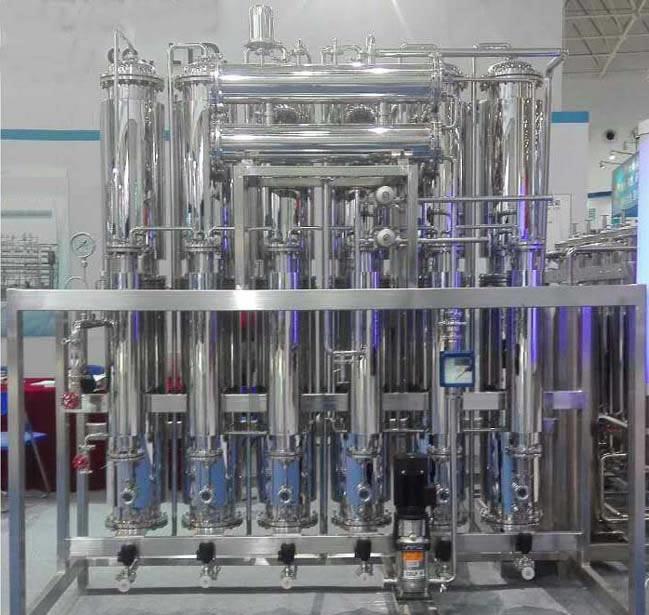
Chapter 2: Mainstream Distilled Water Equipment Types and Technological Breakthroughs
Currently, the mainstream distilled water equipment on the market can be categorized into three technological routes: Multi-Effect Distillers (MED), Thermal Vapor Compression (TVS), and Mechanical Vapor Recompression (MVC). Multi-effect distillation equipment connects multiple evaporators in series, using the secondary steam from the previous effect as the heat source for the next. Typical configurations include falling film evaporators and spiral plate heat exchangers. A seven-effect unit from a certain brand can achieve a production capacity of 10 tons/hour at an operating temperature of 80°C, with conductivity consistently below 0.5 μS/cm.
Thermal vapor compression equipment innovatively adopts steam compression technology, using mechanical pressurization to increase the temperature of secondary steam, enabling efficient single-effect operation. Test data from a TVS model show that, at the same capacity, it occupies 40% less space than multi-effect equipment, and the startup time is reduced from the traditional 4 hours to 30 minutes, making it particularly suitable for the flexible production needs of small and medium-sized pharmaceutical plants. Its core component, the titanium alloy compressor, undergoes special surface treatment to withstand high chloride environments, with a service life exceeding 50,000 hours.
In recent years, intelligent control systems have become a key direction for equipment upgrades. The i-Distill 4.0 system developed by a certain company integrates PLC control modules and online monitoring sensors, enabling real-time tracking of 12 key parameters, including conductivity, TOC, and temperature. When fluctuations in water quality are detected, the system automatically switches to backup evaporators and initiates online cleaning procedures to ensure uninterrupted continuous production. This adaptive control capability reduces equipment failure rates to less than 0.8 instances per year on average.
Chapter 3: Analysis of Key Technical Indicators for Equipment Selection
When selecting equipment, companies need to focus on three main dimensions: water quality, energy efficiency, and system stability. According to ISO 22519 standards, the key indicators for Water for Injection include:
- Conductivity: ≤1.1 μS/cm (at 25°C)
- TOC content: ≤500 ppb
- Bacterial endotoxins: <0.25 EU/ml
- Microbial limits: ≤10 CFU/100ml
Under full load operation, the MED-6000 model maintains product water conductivity within the range of 0.3–0.8 μS/cm, with an endotoxin removal rate ≥99.9998%. Its 316L stainless steel evaporation chamber features an electrolytically polished inner surface with a roughness Ra ≤0.5 μm, effectively preventing biofilm formation.
In terms of energy efficiency, comprehensive evaluation of steam consumption, electricity usage, and cooling water consumption is required. Test data from a six-effect distillation unit indicate that when feed water temperature increases from 20°C to 80°C, steam consumption decreases from 0.25 t/h to 0.12 t/h. The accompanying waste heat recovery system increases cooling water reuse rates to 85%, achieving a comprehensive energy consumption of <15 kW·h per ton of water.
System stability involves material corrosion resistance, component lifespan, and maintenance cycles. An imported brand’s evaporator uses duplex stainless steel, which offers better corrosion resistance than standard 316L steel within a pH range of 2–11. Its patented anti-vortex device prevents steam from carrying droplets, keeping conductivity fluctuations within ±5%. The standard CIP (Clean-in-Place) system completes the entire acid-alkaline-passivation cleaning process within 2 hours, tripling the efficiency compared to traditional manual cleaning.
Chapter 4: Industry Transformations Driven by Innovative Technologies
As the pharmaceutical industry’s requirements for process water continue to rise, distilled water equipment has achieved breakthrough innovations in the following areas:
Energy-saving and Consumption-reduction Technologies:
A "dual-effect thermal coupling" technology developed by a certain company, which adds a steam recompression device between the third and fifth effects, increases system thermal efficiency to 72%. Annual operational data from a 2000 L/h unit show steam savings of 1800 tons/year compared to traditional six-effect units, equivalent to a reduction of 420 tons of carbon emissions.Intelligent Monitoring Systems:
Predictive maintenance modules integrated with AI algorithms can analyze vibration spectra, temperature gradients, and pressure waveforms to provide early warnings of mechanical seal failures up to 14 days in advance. A case study from a pharmaceutical plant shows that this technology reduced unplanned downtime by 82% and increased spare parts inventory turnover by 60%.Modular Design Concepts:
New quick-install distillation units adopt standard container-sized designs, reducing on-site installation time from 45 days to just 7 days. Their unique flange quick-connect structures and prefabricated piping systems improve equipment relocation and reassembly efficiency by 90%. Through modular transformation, a CMO (Contract Manufacturing Organization) achieved flexible production capacity adjustments ranging from 50% to 120%, perfectly adapting to multi-product production needs.
In the biopharmaceutical sector, synergistic innovation between ultra-pure water preparation systems and distillation equipment is becoming a trend. A project case demonstrates that combining EDI (Electrodeionization) technology with multi-effect distillation can achieve product water resistivity of 18.2 MΩ·cm, meeting the requirements of specialized processes such as cell culture. The system’s online TOC detector has a sensitivity of 1 ppb, far exceeding pharmacopoeia standards.
Chapter 5: Equipment Maintenance and Full Lifecycle Management
Standardized operational management is key to ensuring the long-term stable operation of distilled water equipment. Companies are advised to establish a three-tier maintenance system:
- Daily Inspections: Check pressure gauges and temperature sensor readings daily, and record conductivity fluctuation curves.
- Preventive Maintenance: Replace mechanical seals quarterly and perform acid cleaning of heat exchangers annually.
- Performance Validation: Conduct PQ (Performance Qualification) validation every six months to test equipment stability under maximum and minimum loads.
A maintenance case from a GMP-certified pharmaceutical plant shows that implementing TPM (Total Productive Maintenance) increased overall equipment effectiveness (OEE) from 78% to 92%. Their standardized operating procedures include:
- Evaporator vacuum calibration (allowed deviation ±5 kPa)
- Steam trap response time testing (≤3 seconds)
- Pure steam quality testing (non-condensable gas content <3.5%)
For equipment upgrades and renovations, older units can be revitalized through the following solutions:
- Retrofitting plate heat exchangers to replace shell-and-tube structures, improving heat transfer efficiency by 40%
- Upgrading to touchscreen HMI (Human-Machine Interface) supporting SCADA system integration
- Installing energy-saving variable frequency pumps, reducing electricity consumption by 25–30%
A case study from a medium-sized pharmaceutical plant shows that after an 8-year-old distillation unit underwent intelligent upgrades, validation data fully complied with the 2020 edition of GMP Appendix "Pharmaceutical Water Systems." The renovation cost was only 35% of purchasing new equipment, with a payback period shortened to 1.8 years.
Through technological innovation and refined management, modern distilled water equipment is rapidly advancing towards high efficiency, energy savings, and intelligent controllability. For pharmaceutical companies, selecting appropriate distilled water solutions not only ensures product quality compliance but also provides sustained competitiveness in cost reduction, efficiency improvement, and green production. With the advancement of the "Smart Manufacturing 2025" strategy, the next generation of distilled water equipment integrated with IoT and big data analytics will undoubtedly inject stronger momentum into the high-quality development of the pharmaceutical industry.
| Industry Category | Chemicals/Separation Equipment/Distillation Equipment |
|---|---|
| Product Category | |
| Brand: | 奥力原 |
| Spec: | ALY-ZLS-100L |
| Stock: | 99 |
| Manufacturer: | 上海奥力原环境科技有限公司 |
| Origin: | 113117 |


