


Purified Water Equipment for Lyophilized Powder Injection Production
Contact Info
- Add:No. 318 Zhenxing Road, Che Dun Town, Dan Lai Shang Chuang Yuan, Building D, Zip:
- Contact: 胡先生
- Tel:18721141386
- Email:411243788@qq.com
Other Products


Purified Water Equipment for Lyophilized Powder Injection Production: The Core Guarantee of Pharmaceutical Processes
In the production process of lyophilized powder injections, the quality of purified water directly impacts the safety, stability, and efficacy of pharmaceutical products. As an indispensable part of pharmaceutical manufacturing, the technical level of purified water equipment directly determines production efficiency and product quality. This article provides an in-depth analysis of the working principles, technical advantages, and key selection points of purified water equipment for lyophilized powder injection production, helping pharmaceutical companies gain a comprehensive understanding of this critical equipment.
Chapter 1: The Importance of Purified Water in Lyophilized Powder Injection Production
1.1 Definition and Standards of Purified Water
Purified water refers to pharmaceutical water produced through distillation, ion exchange, reverse osmosis, or other suitable methods, with water quality meeting the physicochemical indicators and microbial limits specified in the Chinese Pharmacopoeia. For sterile preparations like lyophilized powder injections, purified water not only serves as a solvent in the formulation process but must also adhere to stringent standards, including a conductivity of ≤5.1 μS/cm (25°C) and a microbial content of ≤10 CFU/100mL.
1.2 Correlation Between Purified Water and Drug Quality
Lyophilized powder injections undergo multiple processes, including solution preparation, filtration, filling, and lyophilization. If purified water contains excessive ions, organic matter, or microorganisms, it may lead to the following risks:
- Chemical Contamination: Residual ions such as calcium and magnesium may alter the drug's pH value, affecting stability;
- Biological Contamination: Microbial growth can directly lead to product contamination, compromising patient safety;
- Particulate Contamination: Particles may clog lyophilizer pipelines or affect product appearance.
1.3 Regulatory Mandatory Requirements for Purified Water Systems
According to GMP (Good Manufacturing Practice) requirements, purified water equipment must achieve the following functions:
- Fully enclosed circulation design to avoid secondary contamination;
- Real-time online monitoring of key parameters such as conductivity, temperature, and flow rate;
- Capability for disinfection and sterilization (e.g., pasteurization, ozone, or UV sterilization).
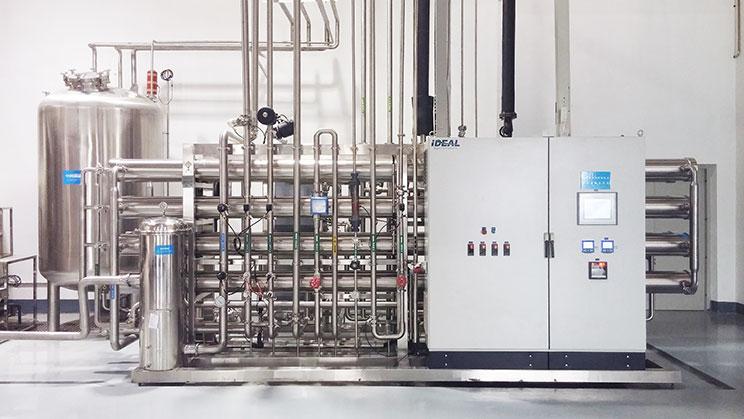
Chapter 2: Core Components and Working Principles of Purified Water Equipment for Lyophilized Powder Injections
2.1 Detailed Equipment Process Flow
Typical high-end purified water equipment adopts a "multi-stage treatment + circulation disinfection" model, with specific processes including:
Pretreatment System:
- Multi-media filter: Removes suspended solids and colloids from raw water;
- Activated carbon adsorption: Eliminates residual chlorine and organic matter;
- Softening device: Reduces hardness through sodium ion exchange to prevent scaling of reverse osmosis membranes.
Core Purification Unit:
- Reverse Osmosis (RO) System: Uses high-pressure pumps to drive water molecules through a semi-permeable membrane, removing over 98% of dissolved salts and microorganisms;
- Electrodeionization (EDI) Module: Combines ion exchange resins and electric field action to achieve continuous deionization, producing water with a resistivity of 15-18 MΩ·cm.
Storage and Distribution System:
- Aseptic storage tank: Made of 316L stainless steel with an electrolytically polished inner surface (Ra ≤ 0.5 μm);
- Circulation pump set: Maintains water flow velocity in pipelines >1.5 m/s to prevent biofilm formation;
- UV sterilizer and ozone generator: Dual safeguards for microbial control.
2.2 Key Technological Innovations
- Modular Design: Flexible expansion of water production capacity (0.5-20 T/H) to adapt to different production scales;
- Intelligent Control System: PLC + touch screen for real-time display of operational status, supporting data recording and audit trails;
- Energy-Saving Technology: Concentrated water recycling design increases RO system recovery rate to over 75%.
Chapter 3: Performance Advantages of Pharmaceutical-Grade Purified Water Equipment
3.1 Materials and Structure Compliant with International Certifications
The equipment body is made of 316L stainless steel, with pipeline connections using sanitary clamp fittings. All welds undergo endoscopic inspection to ensure no dead corners and easy cleaning. Some high-end models are certified by ASME BPE, meeting international standards such as FDA and EU GMP.
3.2 Fully Automated Operation and Fault Warning
- Automatic Backwashing: Triggers cleaning of pretreatment units based on pressure differential or time settings;
- Membrane Protection Mechanism: Automatically flushes RO membrane components during shutdown to extend service life to 3-5 years;
- Multi-Level Alarm System: Provides real-time alerts and records for issues such as water quality exceedances and pressure abnormalities.
3.3 Validation Documents and After-Sales Service
Compliant purified water equipment suppliers must provide complete documentation packages for DQ (Design Qualification), IQ (Installation Qualification), OQ (Operational Qualification), and PQ (Performance Qualification), along with a commitment to at least two preventive maintenance services annually to ensure continuous compliance with GMP requirements.
Chapter 4: How to Scientifically Select Purified Water Equipment
4.1 Clarify Production Requirements
- Capacity Calculation: Based on daily water consumption for lyophilized powder injections (including preparation, cleaning, sterilization, etc.), typically requiring a 20% redundancy;
- Water Quality Analysis: Test raw water for hardness, TOC (Total Organic Carbon), and microbial load to determine pretreatment process intensity.
4.2 Comparison of Equipment Configuration Options
| Configuration Level | Applicable Scenarios | Core Components | Investment Cost (Reference) |
|---|---|---|---|
| Basic Type | Small-batch production | RO + ion exchange resin | 200,000 - 500,000 RMB |
| Standard Type | Medium-scale lyophilization production lines | RO + EDI + UV sterilization | 800,000 - 1,500,000 RMB |
| High-End Type | Export pharmaceuticals or biologics | Dual-stage RO + EDI + ozone + online TOC monitoring | 2,000,000 - 5,000,000 RMB |
4.3 Key Points for Supplier Evaluation
- Whether they have successful cases in the pharmaceutical industry (e.g., projects pre-qualified by WHO);
- Ability to provide 3D layout diagrams and URS (User Requirement Specification) customization services;
- Use of international brands for key components (e.g., RO membranes from Dow, EDI modules from Siemens).
Chapter 5: Equipment Maintenance and Long-Term Performance Assurance
5.1 Daily Operation Standards
- Pretreatment Unit: Monthly inspection of pressure differentials in sand filters and activated carbon; softening resins require periodic regeneration;
- RO Membrane Cleaning: When water production decreases by 10% or desalination rate drops by 5%, chemical cleaning with citric acid (pH=3) or EDTA tetrasodium solution is required;
- Microbial Control: Weekly testing of water samples from storage tank outlets; circulation pipelines must undergo moist heat sterilization at 121°C at least once a year.
5.2 Common Troubleshooting Guide
| Fault Phenomenon | Possible Cause | Solution |
|---|---|---|
| Increased product water conductivity | RO membrane damage or seal aging | Replace membrane elements or O-rings |
| Abnormal system pressure | Pump cavitation or filter clogging | Vent or clean pretreatment unit |
| Exceeded microbial detection limits | UV lamp failure | Replace lamp and verify sterilization efficiency |
5.3 Upgrades and Compliance Adaptation
With the anticipated revision of the 2025 Chinese Pharmacopoeia, companies are advised to proactively assess the compliance of existing equipment in areas such as online TOC monitoring and data integrity. If necessary, technical upgrades can be achieved by installing PAT (Process Analytical Technology) sensors.
Conclusion
Purified water equipment for lyophilized powder injection production is not only the "water source center" of pharmaceutical workshops but also the lifeline of drug quality. By selecting technically mature and service-complete equipment suppliers and establishing scientific operation and maintenance management systems, pharmaceutical companies can effectively reduce quality risks, enhance compliance levels, and provide patients with safe and reliable lyophilized preparations. For customized solutions or technical white papers, further consultation through professional channels is recommended.
| Industry Category | Others |
|---|---|
| Product Category | |
| Brand: | 奥力原 |
| Spec: | ALY-CHS-1T |
| Stock: | 99 |
| Manufacturer: | 上海奥力原环境科技有限公司 |
| Origin: | 113117 |


