


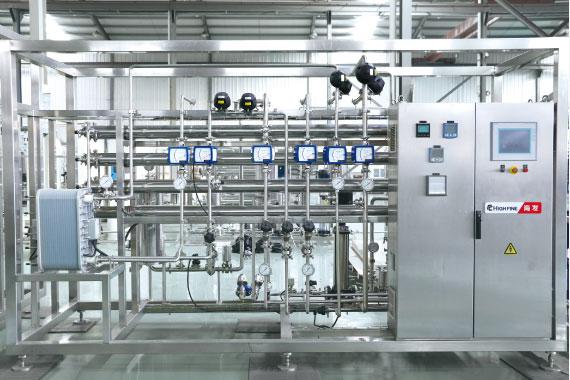
Purified water equipment for medical and healthcare product production
Contact Info
- Add:No. 318 Zhenxing Road, Che Dun Town, Dan Lai Shang Chuang Yuan, Building D, Zip:
- Contact: 胡先生
- Tel:18721141386
- Email:411243788@qq.com
Other Products


Purified Water Equipment for Medical and Health Product Production: Technical Analysis and Industry Application Guide
Chapter 1: Rigid Demand and Standard Analysis of Purified Water in the Medical and Health Product Industry
1.1 Core Role of Purified Water in Medical and Health Product Production
In the production process of medical and health products, purified water serves as a fundamental raw material throughout the entire workflow. From ingredient preparation and equipment cleaning to formulation processing, the quality of purified water directly impacts microbial control, ingredient stability, and final product safety. For injectable health products, for example, purified water must meet the water for injection standards specified in the Chinese Pharmacopoeia, with conductivity controlled within 1.3 μS/cm (at 20°C) and bacterial endotoxin content not exceeding 0.25 EU/mL.
1.2 Mandatory Requirements for Purified Water Systems by Domestic and International Regulations
Major global regulatory agencies impose strict standards for water used in medical and health products. The U.S. FDA 21 CFR Part 211 explicitly requires pharmaceutical water systems to undergo validation and continuous monitoring; the EU GMP Annex 1 stipulates that purified water systems must be equipped with real-time monitoring devices such as online conductivity meters and TOC detection modules. Domestically, the NMPA's "Good Manufacturing Practice for Pharmaceutical Products" emphasizes that purified water equipment must use 316L stainless steel, with pipeline welding meeting ASME BPE standards to ensure dead-leg-free design.
1.3 Limitations of Traditional Water Purification Processes
Early methods such as distillation and ion exchange suffer from high energy consumption (approximately 15 kWh per ton of water), low water yield (≤60%), and unstable microbial control. Modern medical and health product manufacturers increasingly favor integrated systems with modular designs, such as "RO + EDI + Multi-Effect Distillation," which ensure water quality while reducing comprehensive energy consumption to below 5 kWh per ton.
Chapter 2: Core Technological Breakthroughs in New-Generation Purified Water Equipment
2.1 Innovative Design of Three-Stage Pretreatment Systems
- Multi-Media Filtration Unit: Utilizes a composite filter layer of graded quartz sand and activated carbon to effectively remove particles larger than 50 μm from raw water.
- Softening Resin Regeneration Optimization: Equipped with dual-tank alternating operation devices, controlled by PLC to achieve zero waiting time for resin regeneration, improving hard water softening efficiency by 40%.
- Ultrafiltration Membrane Pretreatment: Employs PVDF hollow fiber membranes with a 10 kDa molecular weight cutoff, removing 99% of colloids and macromolecular organic matter.
2.2 Upgrades and Iterations in Reverse Osmosis (RO) Membrane Technology
- Uses anti-fouling spiral-wound RO membrane elements with a single membrane salt rejection rate ≥99.5%.
- Innovative wide-flow channel design (channel height 0.8 mm) reduces membrane fouling risks.
- Equipped with energy recovery devices that increase concentrated water pressure energy conversion efficiency to 95%.
2.3 Technological Innovations in Electrodeionization (EDI) Modules
- Three-compartment EDI devices enable continuous regeneration without chemical agents.
- Integrated voltage regulation systems (0-600 V adjustable) adapt to varying water quality fluctuations.
- Modular design supports online thermal disinfection (80°C hot water circulation).
2.4 Safety Assurance of Sterilization and Supply Systems
- Ozone-UV combined sterilization device: 0.1 ppm ozone concentration + 40 mJ/cm² UV dosage.
- Circulating pipeline design: Maintains water temperature >70°C or <4°C to inhibit microbial growth.
- Online TOC monitor: Detection sensitivity up to 5 ppb, response time <3 minutes.
Chapter 3: Functional Features of Intelligent Purified Water Systems
3.1 Fully Automated Control System for the Entire Process
- SCADA-based central monitoring platform integrates 200+ monitoring points.
- Automatic activation of audible and visual alarms for abnormal key parameters (conductivity, TOC, temperature, etc.).
- Historical data storage period ≥5 years, compliant with FDA 21 CFR Part 11 electronic record standards.
3.2 Highlights of Energy-Saving and Consumption-Reduction Technologies
- Thermally coupled multi-effect distiller: Reduces steam consumption by 65% compared to traditional equipment.
- Variable frequency water supply pump sets: Automatically adjust speed based on water demand, saving 30% energy.
- Concentrated water recovery system: Reuses RO concentrate for cooling tower makeup, achieving 85% comprehensive utilization rate.
3.3 Validation Services and Compliance Assurance
- Provides complete DQ/IQ/OQ/PQ validation documentation packages.
- 3D modeling software generates pipeline slope validation reports (slope ≥1%).
- Microbial sampling point layout complies with ISPE GPG standards.
Chapter 4: Typical Application Scenarios and Selection Strategies
4.1 Equipment Configuration Recommendations for Different Dosage Forms
- Oral Liquid Preparations: RO + UV system, water production capacity 2-5 m³/h.
- Lyophilized Powder Injections: RO + EDI + multi-effect distillation system, conductivity ≤1.0 μS/cm.
- Medical Device Cleaning: Dual-stage RO + ozone disinfection system, endotoxin control ≤0.03 EU/mL.
4.2 Key Considerations for Enterprise Selection
- Water Quality Requirement Analysis: Choose purified water or water for injection grades based on product categories.
- Production Capacity Matching Calculation: Consider peak water demand periods ×1.2 safety factor.
- Site Planning Recommendations: Equipment footprint typically equals water production capacity (m³/h) ×15 m².
4.3 Cost-Benefit Analysis Model
- Initial investment composition: Equipment procurement (55%), installation and commissioning (20%), validation services (15%).
- Operational cost calculation: For a 10 m³/h system, comprehensive cost per ton of water is approximately ¥8-12.
- Investment return period: Typically 2-3 years for conventional projects (40% energy savings compared to traditional processes).
Chapter 5: Operation, Maintenance, and Technology Development Trends
5.1 Preventive Maintenance System
- Daily Monitoring Items: Pre-membrane pressure fluctuation ≤10%, EDI resistivity ≥15 MΩ·cm.
- Regular Maintenance Tasks: RO membrane chemical cleaning (every 3-6 months), seal replacement (annually).
- Key Spare Parts List: Precision filter cartridges, UV lamps, pressure sensors.
5.2 Fault Diagnosis and Emergency Handling
- Troubleshooting Guide for Common Issues:
- 20% decrease in water production: Check differential pressure of pre-filters.
- Abnormal increase in conductivity: Verify EDI module current output.
- Microbial exceedance: Evaluate effectiveness of disinfection procedures.
5.3 Industry Technology Development Outlook
- AI-based predictive maintenance: Analyzes membrane fouling trends using big data.
- Application of graphene membrane materials: Increases salt rejection rate to over 99.9%.
- Zero Liquid Discharge (ZLD) technology: Achieves 100% wastewater reuse.
This article systematically analyzes the technical characteristics and selection criteria of purified water equipment for medical and health products, from fundamental principles to practical applications. By understanding core technical parameters and industry regulatory requirements, enterprises can establish reliable water systems compliant with GMP standards, providing a solid foundation for product quality control. It is recommended to focus on full lifecycle management of equipment and select appropriate configuration solutions based on production process characteristics.
| Industry Category | Others |
|---|---|
| Product Category | |
| Brand: | 奥力原 |
| Spec: | ALY-CHS-1T |
| Stock: | 99 |
| Manufacturer: | 上海奥力原环境科技有限公司 |
| Origin: | 113117 |


