


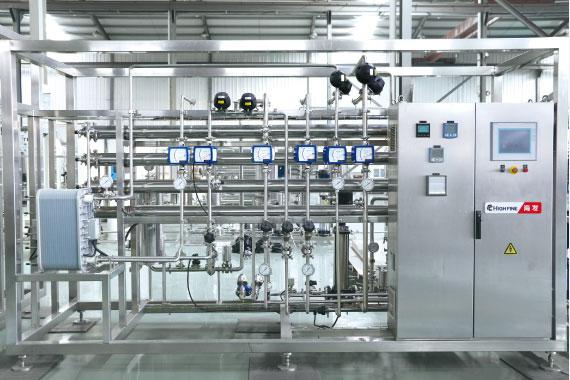
Purified Water Equipment for Hospital Central Water Supply Room
Contact Info
- Add:No. 318 Zhenxing Road, Che Dun Town, Dan Lai Shang Chuang Yuan, Building D, Zip:
- Contact: 胡先生
- Tel:18721141386
- Email:411243788@qq.com
Other Products


Medical Purified Water Equipment: How to Provide Safe and Reliable Medical Water Solutions for Hospitals
Chapter 1: Core Value and Industry Demand of Medical Purified Water Equipment
1.1 Importance of Medical Water Safety
In modern medical systems, water quality directly impacts medical safety and treatment outcomes. According to standards such as the Chinese Pharmacopoeia and the Medical Purified Water Standard for Healthcare Institutions, purified water meeting strict criteria must be used in hospital surgical instrument cleaning, hemodialysis, and pharmaceutical preparation. Ordinary municipal tap water contains over 300 potential risk components, including microorganisms, electrolytes, and organic matter. If used directly in medical processes, it may lead to adverse effects such as instrument residue and pyrogen reactions.
The central water supply room, serving as the hospital's "water treatment hub," has the core mission of converting raw water into purified water that meets medical standards through professional water treatment systems. A qualified purified water system must simultaneously meet the water quality requirements of various medical scenarios: pharmaceutical water with conductivity ≤1.3 μS/cm, dialysis water with total bacterial count <100 CFU/ml, and water for injection requiring high-temperature sterilization. These stringent parameter requirements necessitate precise multi-stage treatment capabilities in medical water treatment equipment.
1.2 Industry Status and Equipment Selection Criteria
China's medical water treatment industry is undergoing a critical period of technological iteration. Issues with traditional methods, such as high energy consumption, unstable water quality, and complex maintenance, are driving the rapid adoption of new-generation intelligent equipment. Healthcare institutions must pay special attention to four key factors when selecting equipment:
- Process Advancement: Multi-stage reverse osmosis systems + EDI electro-deionization technology are becoming mainstream configurations.
- Material Safety: Pipeline systems must use 316L medical-grade stainless steel to avoid ion leaching.
- Intelligence Level: Equipped with online monitoring systems to track 12 core indicators, including TOC and conductivity, in real time.
- Operational Economy: Modular design reduces downtime, and energy-saving modes can lower operating costs by over 40%.
Notably, current national standards for medical water microbial indicators are stricter than those of the European Pharmacopoeia. For example, in a case study of a tertiary hospital upgrade, the adoption of a new combined process reduced disinfection frequency from three times per week to once per quarter, saving annual maintenance costs by 280,000 RMB. (Specific case details on process improvements can be elaborated.)
Chapter 2: Analysis of Core Technologies in Modern Medical Purified Water Equipment
2.1 Synergistic Effects of Five-Stage Purification Processes
Medical-grade purified water systems employ a progressive treatment process, with key quality control points at each stage:
Pretreatment Unit: Multi-media filtration + activated carbon adsorption + softening resin to remove suspended solids, residual chlorine, and calcium/magnesium ions.
Reverse Osmosis System: Series-connected RO membrane groups intercept over 98% of inorganic salts and microorganisms.
EDI Fine Treatment: Removes residual ions through electric field action, ensuring stable conductivity compliance.
Circulating Disinfection System: Uses combined pasteurization + ozone technology to effectively inhibit biofilm formation.
Terminal Control Unit: UV-ultrafiltration combination design for instant sterilization of water.
Engineering test data from an equipment supplier show that after five-stage treatment, endotoxin levels in raw water decreased from >0.25 EU/ml to undetectable levels, meeting the Grade A water standard of the 2020 edition of the Technical Operation Standard for Cleaning, Disinfection, and Sterilization of Medical Devices.
2.2 Technological Breakthroughs in Intelligent Control Systems
New-generation equipment achieves full-process digital management through IoT technology:
- Online Monitoring Platform: Equipped with a four-level alarm system (warning - primary alarm - severe alarm - automatic shutdown).
- Data Traceability Function: All operating parameters automatically generate electronic logs, complying with GMP requirements.
- Remote Maintenance Support: Device status diagnosis and program upgrades via 5G modules.
- Intelligent Adjustment System: Automatically adjusts water production based on usage load (night mode reduces consumption by 50%).
Data from a provincial hospital show that after intelligent upgrades, equipment failure response time shortened to within 2 hours, and water quality parameter fluctuations narrowed to within ±0.5%. (Specific control interface diagrams or real-time monitoring parameter curves can be added.)
Chapter 3: Water Solutions for Typical Medical Scenarios
3.1 Applications in Operating Rooms and Sterile Supply Departments
To meet the specific needs of final rinsing for surgical instruments, purified water systems must be configured with:
- Constant Temperature Water Supply Unit: Water temperature controlled within 35±2°C.
- Pulse Flushing Technology: Improves cleaning pass rates for lumen instruments.
- Online TOC Monitoring: Organic carbon content controlled at <500 ppb.
- Anti-Siphon Design: Eliminates cross-contamination risks.
A case study of a CSSD (Central Sterile Supply Department) upgrade showed that after using dedicated purified water, the pass rate for instrument ATP biofluorescence detection increased from 87% to 99.6%, and the re-cleaning rate decreased by 72%.
3.2 Key System Configurations for Hemodialysis Centers
Purified water for hemodialysis must meet the following requirements:
- Dual-Stage Reverse Osmosis System: Ensures water quality safety redundancy.
- Endotoxin-Specific Treatment: Uses ultrafiltration membranes + high-temperature discombination technology.
- Anti-Bacterial Design: Pipelines use sanitary clamps for connections, with dead volume ≤3D standard.
- Bypass Emergency System: Ensures continuous water supply during equipment maintenance.
After equipment upgrades at a hemodialysis center, the incidence of dialysis-related fever reactions in patients decreased from 1.2% to 0.15%, and equipment failure rates dropped by 60%. (A comparison table of water quality parameters before and after upgrades can be added.)
Chapter 4: Five Key Factors in Equipment Selection and Project Implementation
4.1 Scientific Planning in Engineering Design
- Water Volume Calculation: Determine system production capacity based on bed scale (typically calculated as 300L daily water consumption per bed).
- Pipeline Layout: Use dual-loop circulation systems to ensure terminal water quality.
- Space Optimization: Integrated unit design reduces footprint (standard configuration requires approximately 50 m²).
- Emergency Backup: Recommend configuring 15% redundant capacity and backup power systems.
A case study of a new general hospital showed that preliminary hydraulic modeling analysis helped save 23% on pipeline investment and reduced operational energy consumption by 18%.
4.2 Equipment Validation and Quality Control
A complete validation process includes:
- DQ Design Qualification: Verify technical specifications against URS requirements.
- IQ Installation Qualification: On-site installation quality checks.
- OQ Operational Qualification: 72-hour continuous operation test.
- PQ Performance Qualification: Three-phase water quality monitoring (3/6/12 months).
Key validation items should cover:
- Water Production Stability Test (sampling at 1-hour intervals for 24 hours).
- Disinfection Efficacy Validation (biological indicator challenge test).
- Fault Simulation Test (power outages, water interruptions, and other abnormal conditions).
Chapter 5: Industry Development Trends and Technological Innovation Directions
5.1 Deep Application of Energy-Saving and Environmental Technologies
- Waste Heat Recovery System: Uses reverse osmosis concentrate heat for pretreatment unit heating.
- Zero Discharge Design: Concentrate reuse rate can reach over 75%.
- Photovoltaic Energy Storage Integration: Reduces equipment carbon footprint.
- Green Disinfection Technology: UV-LED replaces traditional mercury lamps, reducing heavy metal pollution.
A demonstration project showed that through energy recovery devices, annual electricity costs were reduced by 120,000 RMB, equivalent to a carbon dioxide reduction of 48 tons.
5.2 Integrated Innovation in Smart Water Systems
Medical water treatment is transitioning toward "digitalization + servitization":
- Digital Twin Technology: Establishes virtual simulation systems to optimize operational parameters.
- Predictive Maintenance: Parts lifespan prediction based on big data analysis.
- Blockchain Certification: Ensures water quality data is tamper-proof, meeting regulatory audit requirements.
- AI-Assisted Decision-Making: Intelligently provides solutions for water quality abnormalities.
In an application case within a regional healthcare group, the smart water platform reduced maintenance costs by 35% and improved overall equipment effectiveness (OEE) by 28 percentage points.
| Industry Category | Others |
|---|---|
| Product Category | |
| Brand: | 奥力原 |
| Spec: | ALY-CHS-1T |
| Stock: | 99 |
| Manufacturer: | 上海奥力原环境科技有限公司 |
| Origin: | 113117 |


