


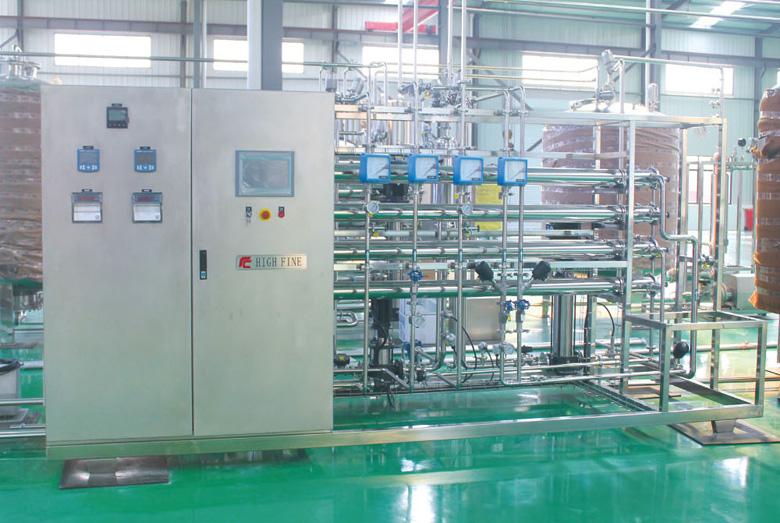
Purified Water Equipment for In Vitro Diagnostic Reagents
Contact Info
- Add:No. 318 Zhenxing Road, Che Dun Town, Dan Lai Shang Chuang Yuan, Building D, Zip:
- Contact: 胡先生
- Tel:18721141386
- Email:411243788@qq.com
Other Products


Purified Water Equipment for In Vitro Diagnostic Reagents: Technical Analysis and Application Value
Chapter 1: Why Does In Vitro Diagnostic Reagent Production Require Specialized Purified Water Equipment?
As critical tools in medical testing, the production quality of in vitro diagnostic reagents directly impacts the accuracy and reliability of clinical test results. During reagent production, water serves not only as a solvent and reaction medium but also as a core factor influencing reagent stability and sensitivity. Ordinary tap water or distilled water, containing impurities, microorganisms, ions, and other components, cannot meet the production requirements for high-precision reagents. Therefore, specialized purified water equipment has become an indispensable infrastructure in the production of in vitro diagnostic reagents.
1.1 The Core Role of Purified Water in Reagent Production
The production process of in vitro diagnostic reagents includes raw material dissolution, formulation mixing, filling, sterilization, and other steps, each requiring extremely strict water quality standards. For example:
- ELISA Reagents: Residual metal ions in water may inhibit enzyme activity, leading to abnormal color development reactions.
- Molecular Diagnostic Reagents: DNA polymerase is highly sensitive to endotoxins in water; excessive levels can cause false-negative results.
- Biochemical Reagents: Ions such as calcium and magnesium may interfere with colorimetric detection, affecting the accuracy of absorbance readings.
Specialized purified water equipment, through multi-stage filtration processes, can increase water resistivity to 18.2 MΩ·cm (25°C) and reduce microbial content to below 1 CFU/mL, fully complying with the dual standards for water for injection and purified water as specified in the Chinese Pharmacopoeia.
1.2 Limitations of Traditional Water Purification Methods
Some manufacturers have attempted to obtain purified water using the following methods:
- Distilled Water Machines: High energy consumption (0.8–1.2 kWh per liter of water), slow production speed (5 L/h), and inability to remove volatile organic compounds.
- Ion Exchange Columns: Require frequent regeneration treatments; resin breakage can cause particle contamination, with high operational and maintenance costs.
- Simple Reverse Osmosis Systems: Desalination rate is only 90–95%, with produced water resistivity typically below 1 MΩ·cm.
These traditional methods have significant shortcomings in microbial control and water quality stability, making it difficult to meet the continuous water supply demands of large-scale in vitro diagnostic reagent production.
1.3 Validation of the Necessity for Specialized Equipment
Comparative experimental data show that ELISA reagents produced using professional purified water equipment have an intra-batch coefficient of variation (CV) controlled within 3%, while reagents produced using ordinary deionized water exhibit a CV as high as 8–12%. In accelerated stability tests, reagents prepared with specialized purified water maintained over 95% activity after 28 days of storage at 37°C, significantly outperforming the control group.
Chapter 2: Technical Implementation Pathways for Professional Purified Water Equipment
Modern purified water equipment for in vitro diagnostic reagents adopts a modular design concept, combining physical filtration, membrane separation, electrochemical treatment, and other technologies to establish a four-level protection system, ensuring water quality meets ultra-pure standards.
2.1 Precision Filtration in the Pretreatment System
The front-end pretreatment unit includes:
- Multi-Media Filter: A three-layer filter bed composed of quartz sand, activated carbon, and manganese sand, capable of removing suspended particles ≥20 μm and adsorbing residual chlorine and organic matter.
- Softening Resin Tank: Reduces water hardness to <1.5 mg/L through sodium ion exchange reactions, preventing scaling in subsequent membrane systems.
- Precision Safety Filter: A 5 μm polypropylene melt-blown filter cartridge serves as the final defense, ensuring the SDI value of water entering the RO membrane is <4.
The pretreatment stage effectively extends the service life of reverse osmosis membranes. Clinical data show that with optimized pretreatment, the RO membrane replacement cycle can be extended from 12 months to 22 months.
2.2 Innovative Application of Reverse Osmosis Membrane Technology
Using spiral-wound composite membrane elements at an operating pressure of 1.2–1.6 MPa:
- Single-stage desalination rate ≥99.5%, dual-stage series system up to 99.8%
- Water recovery rate increased to 65–75% (traditional equipment only 50%)
- Equipped with variable frequency control technology, water production fluctuation range ±2%
In actual operation, a certain brand of equipment reduced raw water conductivity from 500 μS/cm to below 5 μS/cm, with total organic carbon (TOC) <50 ppb.
2.3 Deep Purification via Electrodeionization (EDI)
The EDI module achieves continuous deionization through the following mechanisms:
- Ion exchange resins adsorb residual ions in water
- Direct current electric field drives ions to migrate directionally to the concentrate chamber
- Water molecules dissociate under the electric field to produce H+ and OH-, enabling in-situ resin regeneration
Typical operating parameters:
- Produced water resistivity: 15–18.2 MΩ·cm
- No chemical regeneration agents required
- Microbial growth rate reduced by 80%
2.4 Safeguard Measures in Terminal Treatment Units
To ensure water quality at points of use, the equipment is configured with:
- UV Sterilizer: 254 nm ultraviolet light, dose ≥30,000 μW·s/cm²
- Ultrafiltration Membrane: Molecular weight cutoff 3000 Dalton, removes pyrogens
- Nitrogen-Sealed Storage Tank: 316L stainless steel material, prevents CO₂ dissolution
A case study from a tertiary hospital laboratory showed that the system's bacterial endotoxin test values remained stable at <0.03 EU/mL, surpassing the pharmacopoeia standard of 0.25 EU/mL.
Chapter 3: Six Core Dimensions for Equipment Selection
3.1 Water Quality Specifications and Process Compatibility
Select water quality grades according to reagent types:
| Reagent Category | Resistivity Requirement (MΩ·cm) | TOC (ppb) | Microorganisms (CFU/mL) |
|---|---|---|---|
| Immunoturbidimetric Reagents | ≥1 | ≤500 | ≤10 |
| PCR Reaction Systems | ≥10 | ≤200 | ≤5 |
| Chemiluminescence Reagents | ≥15 | ≤50 | ≤1 |
It is recommended to choose equipment with adjustable water quality specifications, such as models supporting stepless adjustment from 1 to 18.2 MΩ·cm to adapt to different production needs.
3.2 Scientific Planning of System Capacity
Calculation formula:
Daily Water Demand (L) = Water Usage per Batch × Daily Batch Count × Safety Factor (1.2–1.5)
For example, a company producing:
- 200 L of purified water per batch
- 4 batches daily
- Equipment selection should be 200 × 4 × 1.3 = 1040 L/day
It is advisable to choose equipment with adjustable production capacities, such as 500 L/h, 1000 L/h, 2000 L/h, etc.
3.3 Material Verification of Key Components
- Piping System: 316L stainless steel (EP-grade polished), Ra ≤0.6 μm
- Storage Tank: Fully automatic argon arc welding, electrolytically polished inner wall
- Sealing Materials: EPDM or PTFE, temperature resistance -20°C to 121°C
A third-party test report showed that high-quality materials can reduce metal ion leaching by up to 90%, with chromium and nickel migration <0.1 ppb.
3.4 Functionality of Intelligent Control Systems
Advanced equipment should include:
- 7-inch color touchscreen, real-time display of over 20 parameters including conductivity, flow rate, and pressure
- Data storage function, recording cycle ≥3 years
- Remote monitoring interface (RS485/Ethernet)
- Hierarchical password access management
After integrating with an MES system, one company reduced equipment failure response time from 4 hours to 15 minutes.
3.5 Energy Consumption and Operating Cost Comparison
Energy efficiency comparison of a certain brand's equipment:
| Parameter | Traditional Equipment | New Equipment | Reduction |
|---|---|---|---|
| Power Consumption per Ton (kWh) | 8.5 | 3.2 | 62.3% |
| Annual Maintenance Cost (10,000 CNY) | 4.8 | 1.6 | 66.7% |
| Water Utilization Rate | 50% | 78% | +56% |
Based on an annual production of 1000 tons of reagents, annual cost savings are approximately 230,000 CNY.
3.6 Completeness of Compliance Certifications
Essential qualifications include:
- ISO 13485 Medical Device Quality Management System Certification
- CE Certification (EN 285 Sterilizer Standard)
- Third-Party Test Report (CMA/CNAS Accredited)
During an FDA on-site audit, a certified equipment received a documentation completeness score of 98.5 out of 100.
Chapter 4: Typical Application Scenarios and Benefit Analysis
4.1 Immunoassay Reagent Production Line
After introducing purified water equipment, a chemiluminescence reagent manufacturer achieved:
- Inter-batch variation reduced from 7.8% to 2.3%
- Product shelf life extended from 12 months to 18 months
- Customer complaint rate decreased by 82%
Equipment configuration:
- Dual-stage RO + EDI + UF system
- Production capacity: 2000 L/h
- Fully automatic CIP cleaning program
4.2 Molecular Diagnostic Core Raw Material Preparation
Case study of a nucleic acid extraction reagent manufacturer:
- Endotoxin levels: Reduced from 5 EU/mg to 0.05 EU/mg
- RNase residue: Not detected (detection limit 0.01 U/mL)
- Nucleic acid preservation solution stability: No degradation after 12 months at -20°C
Key technical points:
- Nitrogen-sealed circulation system (dissolved oxygen <10 ppb)
- Red copper piping (inhibits biofilm formation)
- Dual-wavelength UV sterilization (185 nm + 254 nm)
4.3 Point-of-Care Testing (POCT) Strip Production
Transformation results at a blood glucose test strip factory:
- Color uniformity CV: Improved from 9.7% to 2.1%
- Environmental humidity tolerance range: Expanded from 30–80% to 20–85%
- Defect rate: Reduced from 3.2% to 0.7%
Process improvement measures:
- Installed online TOC monitor (0–500 ppb range)
- Added heat exchange module (water temperature control ±0.5°C)
- Adopted dead-leg-free piping design
Chapter 5: Full Lifecycle Management Plan for Equipment
5.1 Installation and Commissioning Considerations
Key on-site implementation points:
- Foundation load-bearing capacity ≥800 kg/m², maintenance access width ≥80 cm
- Inlet water pressure requirement 0.2–0.4 MPa, hardness <3 mmol/L
- Initial startup requires 72 hours of continuous flushing
One company failed to pre-treat inlet water as required, resulting in RO membrane damage within 3 months and direct losses exceeding 100,000 CNY.
5.2 Standard Procedures for Routine Maintenance
Recommended maintenance schedule:
| Item | Frequency | Key Operations |
|---|---|---|
| Pre-filter Replacement | 1–3 months | Replace immediately when pressure differential >0.1 MPa |
| RO Membrane Cleaning | 6–12 months | Use citric acid solution at pH 2–3 |
| EDI Module Inspection | Quarterly | Measure operating current fluctuation range ±5% |
| UV Lamp Replacement | 9000 hours | Replace when 254 nm intensity decays to 70% |
Through regular maintenance, one user achieved continuous operation for 5 years without major repairs, with an average annual failure rate of <0.5.
5.3 Fault Diagnosis and Emergency Handling
Common issue handling guide:
- Reduced Water Production: Check pre-filter cartridges, RO membrane fouling, high-pressure pump pressure
- Low Resistivity: Calibrate probes, check EDI voltage, inspect pipeline contamination
- Microbial Exceedance: Check UV intensity, ozone generator efficiency, storage tank sealing
In one case, by analyzing historical data curves, an EDI module failure was predicted 2 weeks in advance, avoiding production shutdown losses.
5.4 Technical Upgrade and Retrofit Suggestions
Intelligent upgrade directions:
- Install AI predictive maintenance system (accuracy ≥85%)
- IoT integration (supports 4G/5G remote diagnostics)
- Energy recovery devices (use RO concentrate for cooling tower makeup water)
Investment payback period calculation for a retrofit project:
- Upgrade cost: 280,000 CNY
- Annual energy savings: 96,000 CNY
- Reduced downtime losses: 150,000 CNY
- Payback period: 280,000 / (96,000 + 150,000) = 1.14 years
Through systematic technical analysis and case studies, it is evident that professional purified water equipment plays a foundational role in the production of in vitro diagnostic reagents. By scientifically selecting equipment and implementing meticulous management, enterprises can not only ensure product quality but also achieve sustainable development goals of cost reduction and efficiency improvement. As the era of precision medicine advances, requirements for purified water systems will become more stringent. Choosing proven, mature equipment will become one of the core competencies of in vitro diagnostic enterprises.
| Industry Category | Others |
|---|---|
| Product Category | |
| Brand: | 奥力原 |
| Spec: | ALY-CHS-1T |
| Stock: | 99 |
| Manufacturer: | 上海奥力原环境科技有限公司 |
| Origin: | 113117 |


