


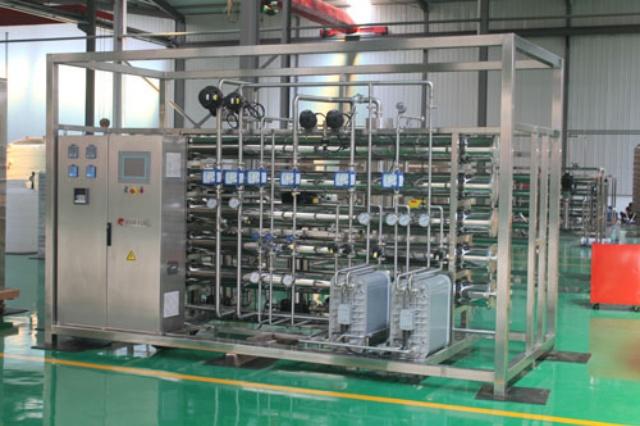
Purified Water Equipment for Daily Chemical Production
Contact Info
- Add:No. 318 Zhenxing Road, Che Dun Town, Dan Lai Shang Chuang Yuan, Building D, Zip:
- Contact: 胡先生
- Tel:18721141386
- Email:411243788@qq.com
Other Products


Purified Water Equipment for Daily Chemical Production: Technical Analysis and Industry Application Guide
Chapter 1: Core Requirements for Purified Water in the Daily Chemical Industry
The production of daily chemical products (such as skincare products, shampoos, detergents, etc.) imposes extremely stringent requirements on water quality. Impurities in ordinary tap water or groundwater (such as microorganisms, inorganic salts, heavy metal ions, etc.) may affect product stability, efficacy, and even safety. For example, calcium and magnesium ions in water can cause creams to clump, excessive microorganisms may lead to product spoilage, and heavy metal residues directly impact consumer health. Therefore, purified water equipment has become an indispensable core component in the daily chemical production chain.
The standards for purified water must comply with regulations such as the "Chinese Pharmacopoeia" or the "Hygienic Standard for Water Used in Cosmetic Production," with conductivity typically required to be ≤5 μS/cm (25°C) and microbial indicators ≤100 CFU/mL. To meet these requirements, purified water equipment must employ multi-stage processes to transform raw water into high-purity water.
For daily chemical enterprises, equipment stability, water production efficiency, and long-term operational costs are core concerns. A scientifically designed purified water system not only ensures product quality but also reduces production costs through water and energy savings, enhancing corporate competitiveness.
Chapter 2: Analysis of Core Technologies in Purified Water Equipment
The technical approach of purified water equipment typically includes four major modules: pretreatment, reverse osmosis (RO), electrodeionization (EDI), and post-treatment, all working together to achieve water purification.
Pretreatment System
Pretreatment is the foundation for stable equipment operation. Through multi-media filters, activated carbon adsorption, softening resins, and other devices, suspended solids, colloids, residual chlorine, and partial hardness ions in raw water are removed. For example, activated carbon adsorbs residual chlorine (preventing oxidative damage to RO membranes), while softening resins reduce water hardness through ion exchange.Reverse Osmosis (RO) Technology
The reverse osmosis membrane is the core component of the equipment, with a pore size of only 0.1 nanometers, capable of retaining over 98% of dissolved salts, organic matter, and microorganisms. The desalination efficiency of the RO system directly affects the load on subsequent processes. To improve water production rates, modern equipment often adopts a "primary RO + secondary RO" series design, with secondary concentrate water recycled to the primary inlet, enabling water resource recycling.Electrodeionization (EDI) Module
EDI technology combines ion exchange resins with a direct current electric field to continuously remove residual ions without the need for chemical regeneration. Compared to traditional mixed-bed processes, EDI requires no acid or alkali regeneration, produces no wastewater, and can operate continuously for 24 hours, reducing operational costs by over 60%.Post-Treatment and Circulation Disinfection
Purified water storage and distribution must avoid secondary contamination. The equipment employs ultraviolet (UV) sterilizers and ozone generators for dual protection, combined with 316L stainless steel circulation pipelines (with inner walls electrolytically polished to Ra ≤ 0.6 μm), ensuring the final effluent meets sterile requirements.
Chapter 3: Equipment Design Highlights and Industry-Specific Solutions
To address the diverse needs of daily chemical enterprises, modern purified water equipment has achieved multiple innovations in design and functionality:
Modular Design for Flexible Expansion
The equipment adopts standardized modular assembly, allowing for phased expansion based on production requirements. For example, startups can initially configure a basic system of 2 tons/hour and later expand to 10 tons/hour by adding RO membrane sets or EDI modules, avoiding excessive initial investment.Intelligent Control System
A PLC + touchscreen control center monitors water quality parameters (such as conductivity, pH, flow rate, etc.) in real time, automatically alerts for abnormal data, and generates maintenance logs. Some high-end models support remote maintenance, enabling engineers to diagnose faults via cloud platforms, reducing downtime.Energy-Saving and Consumption-Reduction Technologies
Energy recovery devices (such as PX booster pumps) convert RO concentrate pressure into electrical energy, reducing system energy consumption; wastewater recovery rates can exceed 75%, meeting environmental policy requirements.Industry-Specific Customization Services
Different daily chemical categories have varying water quality requirements:
- Cream-Based Products: Require strict control of calcium and magnesium ions to prevent crystallization in the cream;
- Liquid Detergents: Focus on organic residue to prevent product discoloration;
- High-End Skincare Products: Demand near-sterile microbial indicators, necessitating enhanced UV and ozone combination.
Equipment manufacturers can adjust process parameters accordingly to provide tailored solutions.
Chapter 4: Equipment Selection, Installation, and Maintenance Guide
When selecting purified water equipment, enterprises must comprehensively evaluate water quality, production capacity, and cost:
Raw Water Quality Analysis
Commission third-party testing agencies to conduct a full analysis of water sources (including pH, TDS, COD, hardness, etc.) to determine pretreatment processes based on the results. For example, groundwater in northern regions has high hardness, requiring secondary softening; surface water in southern regions has high organic content, necessitating enhanced activated carbon adsorption.Production Capacity Matching Principle
The equipment's rated water production capacity should be 1.2 times the peak water consumption of the daily chemical production line. For instance, if an enterprise requires 3 tons of purified water per hour for production, a 4-ton/hour system is recommended to avoid shortening membrane life due to full-load operation.Lifecycle Cost Calculation
Equipment procurement costs account for only 30% of total lifecycle expenses. Key focus areas include:
- Consumable Replacement Cycles: RO membrane lifespan is typically 2-3 years, while EDI modules can last over 5 years;
- Energy and Wastewater Costs: Inefficient equipment may consume 20%-40% more water and electricity than industry standards;
- Maintenance Response Time: Choose local service teams to ensure emergency response within 4 hours.
- Installation and Validation Key Points
Equipment installation must comply with GMP clean room standards, with pipeline layouts avoiding dead ends and blind pipes. The debugging phase must complete IQ (Installation Qualification), OQ (Operational Qualification), and PQ (Performance Qualification) validations, with full records retained for review.
Chapter 5: Industry Trends and Equipment Upgrade Directions
As daily chemical industry regulations tighten and smart manufacturing advances, purified water equipment is evolving towards green and digital directions:
Zero-Discharge Processes
Combining high-pressure reverse osmosis (HPRO) with evaporation crystallization technology, salts in wastewater are concentrated into solid waste, achieving zero wastewater discharge. This technology helps daily chemical enterprises pass environmental inspections and avoid production shutdown risks.AI Predictive Maintenance
Using machine learning algorithms to analyze equipment operation data (such as membrane pressure differential changes and pump vibration frequencies), fault risks are predicted 7-15 days in advance, reducing maintenance costs by 30%.IoT Integration
Equipment is integrated into the enterprise MES system, synchronizing water quality data and production batch information in real time, meeting the data traceability requirements of the "Cosmetic Production Quality Management规范".New Material Applications
Graphene-modified RO membranes increase desalination rates to 99.9% and improve anti-fouling performance by 50%; ceramic membrane pretreatment technology replaces traditional sand filtration, extending service life to 10 years.
Conclusion
Purified water equipment is a core infrastructure in the quality control system of daily chemical enterprises. Choosing a technically mature and reliable equipment supplier not only ensures product compliance but also creates long-term economic benefits through water and energy savings. Enterprises are advised to thoroughly evaluate manufacturers' engineering cases and technical capabilities before procurement, prioritizing partners with ISO 13485 Medical Device Quality Management System certification to ensure efficient and stable operation throughout the equipment's lifecycle.
| Industry Category | Others |
|---|---|
| Product Category | |
| Brand: | 奥力原 |
| Spec: | ALY-CHS-1T |
| Stock: | 99 |
| Manufacturer: | 上海奥力原环境科技有限公司 |
| Origin: | 113117 |


