


Purified Water Equipment for Clean Rooms
Contact Info
- Add:No. 318 Zhenxing Road, Che Dun Town, Dan Lai Shang Chuang Yuan, Building D, Zip:
- Contact: 胡先生
- Tel:18721141386
- Email:411243788@qq.com
Other Products


Chapter 1 Overview of Purified Water Equipment in Clean Rooms: The "Lifeline" of Industrial Production
In high-end manufacturing sectors such as pharmaceuticals, electronics, and medical devices, clean rooms impose extremely stringent requirements on water quality. A single drop of water containing trace impurities can lead to the rejection of an entire batch of products or even trigger quality and safety incidents. As a fundamental support system ensuring production safety, purified water equipment utilizes multiple technological combinations to transform ordinary raw water into ultrapure water that meets industry standards, making it an indispensable "water purification expert" in modern industry.
Core Components and Technical Principles
A typical system consists of five major parts: pretreatment module, reverse osmosis host, EDI (electrodeionization) unit, water storage and distribution system, and circulation disinfection unit. The pretreatment system removes suspended particles, residual chlorine, and hardness ions through processes such as quartz sand filtration, activated carbon adsorption, and softener resin exchange. Reverse osmosis membranes achieve 97%-99% ion rejection rates under high pressure. The subsequent EDI module further desalinates the water through electric field action, ultimately producing ultrapure water with a resistivity of 18.2 MΩ·cm. The entire system adopts a fully enclosed circulation design to eliminate the risk of secondary contamination.
Industry Standards and Certification Systems
Equipment manufacturing must comply with regulatory requirements such as the Chinese Pharmacopoeia (ChP), United States Pharmacopeia (USP), and EU GMP. Key components, including 316L stainless steel pipelines, sanitary diaphragm valves, and online conductivity meters, must be certified according to international sanitary standards such as ASME BPE and EHEDG. Some high-end models are equipped with data tracking systems that meet FDA 21 CFR Part11 electronic record standards.
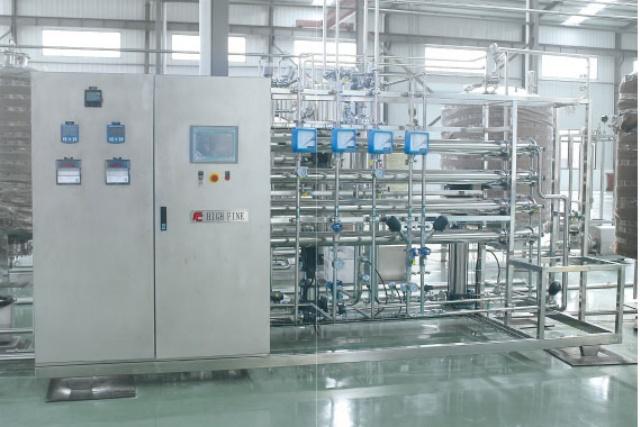
Chapter 2 RO + EDI Dual-Core Technology: The Golden Combination for Water Purification
Reverse Osmosis Technology Breaks Traditional Filtration Limits
Using polyamide composite membranes with pores as small as 0.0001 microns—equivalent to one five-hundred-thousandth of a human hair—reverse osmosis systems create turbulent flow effects on the membrane surface under 6-8 bar operating pressure, effectively blocking bacteria, viruses, pyrogens, and other contaminants. A well-known brand's equipment has achieved a measured desalination rate of 99.7% and a maximum water production capacity of 20 m³/h, making it suitable for large-scale biopharmaceutical clean rooms.
EDI Technology Enables Zero-Consumable Purification
Unlike traditional mixed-bed ion exchange, which requires periodic resin replacement, EDI (electrodeionization) technology drives ion migration via a direct current electric field and achieves dynamic regeneration with specialized ion exchange membranes. An industrial case study showed that using EDI modules reduced annual maintenance costs by 62%, eliminated the need for acid and alkali regeneration, and completely resolved hazardous waste disposal challenges. The equipment's effluent silica content can be controlled to <3 ppb, fully meeting water-for-injection standards.
Intelligent Integrated Control System
Equipped with a PLC + touchscreen interface, the system monitors key indicators in real time, such as TOC <50 ppb and microbial counts <1 CFU/100 ml. When water quality fluctuates, the system automatically adjusts the concentrate discharge ratio, initiates pasteurization procedures, and sends alert messages to management via a 4G module. In an electronics company case study, the system operated continuously for 380 days without failure, maintaining a 100% water quality compliance rate.
Chapter 3 Industry-Wide Solutions: Precision Adaptation from Chip Manufacturing to Vaccine Production
Applications in Biopharmaceuticals
Meeting the stringent GMP requirement that "water for injection must circulate at temperatures above 70°C," systems are configured with dual plate heat exchangers and ozone generators. A COVID-19 vaccine manufacturer adopted a three-stage RO + dual EDI setup, ensuring endotoxin levels <0.001 EU/ml and supporting annual production of 500 million vaccine doses.
Practices in Semiconductor and Electronics Industries
To achieve ultra-low particulate water quality for wafer cleaning, equipment integrates 0.1 μm terminal filters and nitrogen-sealed storage tanks, controlling particles to <5 counts/mL (≥0.1 μm). Data from an 8-inch wafer fab showed total metal ions in the product water <0.1 ppb, fully compliant with ISO Class 4 cleanroom standards.
Innovative Solutions for Food and Beverage Industry
Using all-stainless-steel frames and food-grade epoxy coatings, the systems achieve sterile conditions without dead zones through online CIP cleaning. A dairy company reported a 98% reduction in microbial indicators and a 30% extension in product shelf life after upgrading their equipment.
Chapter 4 Equipment Selection and Operation Guide: Avoiding 90% of Common Pitfalls
Four-Dimensional Evaluation Method for Selection
- Water Quality Requirements: Choose purified water (≤0.1 μS/cm) or ultrapure water (≥15 MΩ·cm) based on end products.
- Capacity Calculation: Select equipment with 1.2 times the maximum instantaneous water demand, e.g., accounting for peak water usage during cleaning in lyophilization lines.
- Space Planning: Modular equipment can reduce footprint to 60% of traditional designs, with ceiling height requirements >2.5 m.
- Expansion Needs: Reserve 10%-15% power margin to support future capacity increases.
Lifecycle Cost Control
• Energy Optimization: Use reverse osmosis units with energy recovery devices, achieving up to 35% energy savings.
• Consumables Management: Extend pre-filter replacement cycles to 6-8 months (depending on raw water turbidity).
• Preventive Maintenance: Quarterly testing of membrane flux decline rates; chemical cleaning required if annual decline exceeds 15%.
Strategies for Common Failures
- Reduced Water Production: Check differential pressure across safety filters (>0.1 MPa requires cartridge replacement) and fouling of reverse osmosis membranes.
- Increased Conductivity: Investigate O-ring seals and current stability in EDI modules.
- Microbial Exceedance: Verify UV sterilizer intensity (>30,000 μW·s/cm²) and ozone concentration maintenance.
Chapter 5 Technological Evolution and Industry Outlook: The Emergence of Next-Generation Purified Water Systems
Breakthroughs in Green Energy-Saving Technologies
Novel forward osmosis (FO) technology utilizes osmotic pressure differences to drive water molecules through membranes, reducing energy consumption by 40% compared to RO. Experimental data show that coupling with nanobubble generators increases system recovery rates to over 85%, particularly suitable for regions with high-salinity raw water.
Intelligent Operation and Maintenance Systems
Using digital twin technology, 3D operation models are built to diagnose equipment status in real time via vibration sensors and infrared thermography. A pilot project employing AI prediction systems issued warnings 14 days in advance of reverse osmosis membrane failures, preventing unplanned downtime losses exceeding 2 million RMB.
Prospects for New Material Applications
Graphene-modified membrane materials demonstrate revolutionary performance: threefold increase in flux and 50% enhancement in antifouling capability. Lab-stage products have achieved >99.9% virus rejection rates, with potential initial deployment in specialized settings such as biosafety laboratories.
Conclusion
As the "invisible guardian" of clean rooms, the technological innovation of purified water equipment consistently aligns with industrial development. From basic filtration to smart IoT integration, and from high energy consumption to green benchmarks, each advancement redefines the quality standards of industrial water. Choosing compliant, reliable, and sustainable water treatment solutions is a critical strategy for modern enterprises to build core competitiveness.
| Industry Category | Machinery & Equipment/Welding & Cutting Equipment/Energy Storage Welders |
|---|---|
| Product Category | |
| Brand: | 奥力原 |
| Spec: | ALY-CHS-1T |
| Stock: | 99 |
| Manufacturer: | 上海奥力原环境科技有限公司 |
| Origin: | 113117 |


