


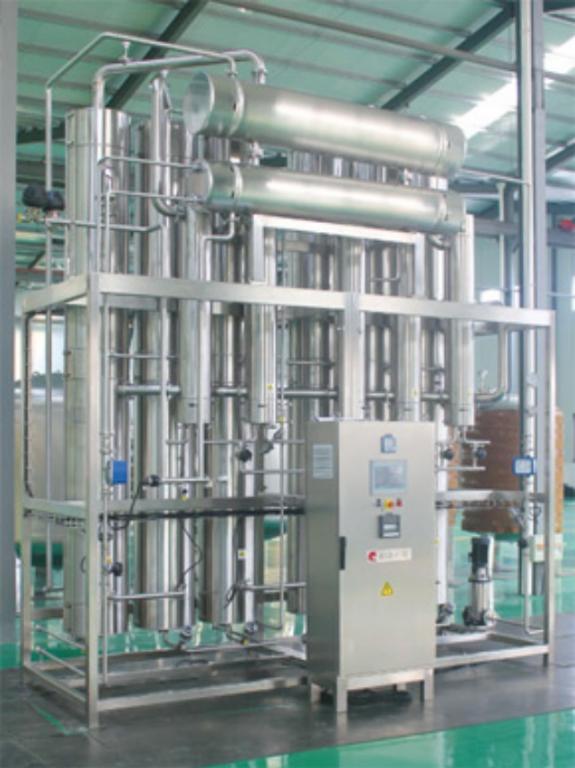
Multi-effect Distilled Water Equipment
Contact Info
- Add:No. 318 Zhenxing Road, Che Dun Town, Dan Lai Shang Chuang Yuan, Building D, Zip:
- Contact: 胡先生
- Tel:18721141386
- Email:411243788@qq.com
Other Products


Multi-Effect Distillation Water Equipment: Core Principles and Application Scenarios of Efficient Water Production Technology
Chapter 1: Basic Principles and Workflow of Multi-Effect Distillation Water Equipment
1.1 What is Multi-Effect Distillation Technology?
Multi-effect distillation water equipment is an industrial device that achieves high-efficiency pure water preparation through multi-stage thermal energy circulation. Its core principle lies in the repeated utilization of secondary steam energy generated during the evaporation process. By connecting multiple evaporators in series (typically 3-8 effects), the operating pressure of each effect is gradually reduced, allowing the steam produced in the previous effect to serve as the heat source for the next effect, significantly improving energy utilization.
Taking the six-effect distillation equipment commonly used in the pharmaceutical industry as an example: raw water first enters the preheating system, is preheated to 80-90°C, and then enters the first-effect evaporator. Under vacuum and negative pressure conditions, the boiling point of water is reduced to about 70°C, causing it to boil. The generated steam enters the second effect as a heat source, and this process continues sequentially to the sixth effect. The final water purity can meet the standards for water for injection as specified in the Chinese Pharmacopoeia.
1.2 Core Components of the Equipment
A complete multi-effect distillation system consists of five core units:
- Pretreatment Unit: Includes multi-media filters and reverse osmosis devices, which can reduce the raw water conductivity from 500 μS/cm to below 5 μS/cm.
- Heat Exchange System: A combination of plate/tube heat exchangers, achieving a heat recovery rate of over 90%.
- Distillation Tower Group: Vertical/horizontal tube evaporators made of 316L stainless steel.
- Control System: PLC automatic control system equipped with an HMI human-machine interface.
- Water Storage Unit: 316L stainless steel storage tank with insulation layer, equipped with ultraviolet sterilization devices.
1.3 Detailed Workflow
Taking a typical device with a processing capacity of 2 tons/hour as an example:
- Raw water is pretreated with a 5 μm precision filter.
- It enters the heat exchanger via a high-pressure pump and is preheated to 85°C.
- The first-effect evaporator operates under a vacuum of -0.08 MPa.
- Secondary steam enters the next effect through a gas-liquid separator.
- The final-effect steam is cooled to below 25°C by a condenser.
- Product water conductivity is monitored in real time, and qualified water enters the storage tank.
The entire system achieves a thermal energy utilization rate 6-8 times that of traditional single-effect distillation, reducing operating costs by approximately 65%.
Chapter 2: Analysis of Core Technical Advantages of the Equipment
2.1 Breakthrough Improvement in Energy Efficiency
Thermodynamic simulation experimental data show:
- Single-effect distillation energy consumption ratio is approximately 1:1.2 (steam/water produced).
- Six-effect system energy consumption ratio can be reduced to 1:0.18.
- Annual operating cost comparison (based on 10 tons/day):
- Traditional boiler: approximately 280,000 RMB/year.
- Multi-effect equipment: approximately 95,000 RMB/year.
2.2 Water Quality Assurance System
The equipment adopts a three-level water quality monitoring system:
- Online Conductivity Meter: Range 0-20 μS/cm, accuracy ±0.1 μS.
- TOC Detection Module: Complies with USP<643> standard, detection limit 50 ppb.
- Microbial Retention Device: 0.22 μm sterilizing filter.
Actual operation data show key product water indicators:
- Bacterial endotoxins: <0.01 EU/ml.
- Non-volatile substances: <1 mg/L.
- Heavy metals: Complies with EP 8.0 standard.
2.3 Intelligent Control System
Equipped with Siemens S7-1200 PLC control system, featuring:
- Fault self-diagnosis function (23 common fault codes).
- Real-time energy consumption monitoring (accurate to 0.1 kW·h).
- Mobile remote monitoring (supports 4G/5G access).
- Electronic batch record system (compliant with FDA 21 CFR Part 11).
A case study from a biopharmaceutical company shows that automated control reduced manual operation time by 80% and decreased batch-to-batch variation from ±5% to ±0.8%.
Chapter 3: Typical Application Scenarios and Industry Solutions
3.1 Applications in the Pharmaceutical Industry
Water for injection systems meeting GMP requirements must include:
- Full pipeline made of 316L stainless steel.
- Circulation pipeline network with a slope of 0.5-1%.
- Online sterilization function (SIP).
- Temperature maintenance above 80°C during circulation.
Data from a listed pharmaceutical company project:
- Equipment specification: 3000 L/h.
- Validation items: 3Q certification (IQ/OQ/PQ).
- Water quality standards: Complies with ChP, USP, and EP requirements.
- System cost: Approximately 2.8 million RMB.
3.2 Applications in the Electronics Industry
Requirements for semiconductor-grade ultrapure water preparation:
- Resistivity ≥18.2 MΩ·cm.
- Particles <5 particles/ml (≥0.1 μm).
- TOC <3 ppb.
A wafer fab uses a "multi-effect distillation + EDI + polishing mixed bed" process, with key equipment parameters:
- Final product water output: 50 m³/h.
- UPW system recovery rate: 82%.
- Operating pressure: 0.3-0.5 MPa.
3.3 Special Requirements for Laboratories
Customized solutions for research institutions:
- Small benchtop equipment (5-20 L/h).
- Modular design for easy upgrades.
- Equipped with three-level laboratory water standard switching function.
- Consumable replacement reminder system.
Feedback from a national key laboratory shows that the equipment ran continuously for 3000 hours without failure, with water quality stability exceeding GB/T 6682 Grade 1 water standards.
Chapter 4: Equipment Selection Guide and Technical Parameter Analysis
4.1 Key Selection Factors
It is recommended to evaluate equipment based on five dimensions:
- Material Certification: Check ASME BPE certificates and material proof.
- Energy Efficiency Level: Compare steam consumption per ton of water for different effect numbers.
- Control System: Whether it has audit trail functionality.
- Validation Services: Whether the supplier provides DQ/IQ/OQ documents.
- Expansion Capability: Reserve 10-20% capacity redundancy.
4.2 Technical Parameter Comparison Table
| Parameter | Economy (3-effect) | Standard (6-effect) | Premium (8-effect) |
|---|---|---|---|
| Water Output | 0.5-5 T/H | 2-20 T/H | 10-50 T/H |
| Steam Consumption | 0.35 T/T | 0.18 T/T | 0.12 T/T |
| Installed Power | 15 kW | 45 kW | 110 kW |
| Floor Area | 8 m² | 25 m² | 60 m² |
| Initial Investment Cost | 450,000-800,000 RMB | 1.2-3 million RMB | 4.5-8 million RMB |
4.3 Frequently Asked Questions
Q: Does the equipment require special equipment registration?
A: Pressure vessel registration is required when the design pressure >0.1 MPa or volume ≥30 L.
Q: What constitutes daily operating and maintenance costs?
A: Typical breakdown: electricity 42%, steam 35%, consumables 15%, labor 8%.
Q: What is the equipment lifecycle?
A: Main structure 15-20 years, control system requires upgrades every 8-10 years.
Chapter 5: Equipment Maintenance and After-Sales Service
5.1 Preventive Maintenance Plan
It is recommended to implement a three-level maintenance system:
- Daily Inspection: Check pressure gauge fluctuations (within ±0.02 MPa).
- Monthly Maintenance: Clean sight glasses, calibrate temperature sensors.
- Annual Overhaul: Replace mechanical seals, calibrate PLC modules.
Maintenance records from a chemical company show that regular maintenance increased the mean time between failures from 1800 hours to 4200 hours.
5.2 Common Fault Handling Guide
| Symptom | Possible Cause | Solution |
|---|---|---|
| 20% drop in water output | Heat exchanger scaling | Citric acid circulation cleaning |
| Abnormal conductivity increase | Gas-liquid separator failure | Replace drain valve filter |
| Insufficient vacuum | Aging seals | Apply high-temperature sealant |
5.3 After-Sales Service Support System
Leading suppliers typically provide:
- 72-hour emergency response mechanism.
- 10-year warranty on key components.
- Free operator training (≥16 hours).
- Lifetime technical drawing support.
One equipment manufacturer's service network covers 32 provincial-level regions in China, with a spare parts inventory of 3000+ categories, enabling on-site service within 48 hours.
Through the systematic analysis of the above five chapters, we have comprehensively demonstrated the technical characteristics, application value, and selection points of multi-effect distillation water equipment. With its significant energy-saving advantages and stable water quality output, this equipment is becoming the preferred solution for purified water preparation in industries such as pharmaceuticals, electronics, and chemicals. When selecting equipment, users are advised to choose reputable manufacturers with comprehensive service systems based on actual production capacity needs, water quality standards, and budget constraints to ensure stable operation throughout the equipment's lifecycle.
| Industry Category | Chemicals/Separation Equipment/Distillation Equipment |
|---|---|
| Product Category | |
| Brand: | 奥力原 |
| Spec: | ALY-ZLS-100L |
| Stock: | 99 |
| Manufacturer: | 上海奥力原环境科技有限公司 |
| Origin: | 113117 |


