


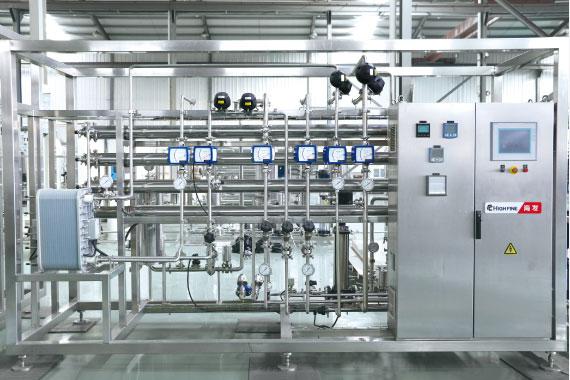
Purified water equipment for pesticide production
Contact Info
- Add:No. 318 Zhenxing Road, Che Dun Town, Dan Lai Shang Chuang Yuan, Building D, Zip:
- Contact: 胡先生
- Tel:18721141386
- Email:411243788@qq.com
Other Products


Chapter 1: Why Do Pesticide Production Require Dedicated Purified Water Equipment?
In the pesticide production process, water, as one of the core raw materials, is directly involved in formulation dissolution, equipment cleaning, and finished product processing. Ordinary tap water or simply filtered water may contain impurities, microorganisms, and ionic components, which can affect the stability of pharmaceutical ingredients and even lead to product contamination. Therefore, purified water that meets pharmacopoeia standards becomes an essential requirement in the production process.
1.1 The Core Role of Purified Water in Pharmaceutical Production
Purified water must comply with the strict regulations of the Chinese Pharmacopoeia or international standards (such as USP and EP) regarding conductivity, microbial limits, endotoxins, and other indicators. For example, the preparation of pesticide suspensions requires water free of particulate residues, while the formulation of veterinary injections must ensure sterility and absence of pyrogens. Ordinary water treatment equipment cannot meet these requirements, whereas dedicated purified water equipment can elevate water quality to pharmacopoeia levels through multi-stage filtration and disinfection processes.
1.2 Mandatory Regulatory and Quality Control Requirements
Domestic and international regulatory agencies have clear specifications for water standards in pesticide and veterinary drug production. For instance, GMP (Good Manufacturing Practice) requires companies to equip themselves with purified water systems that meet standards and conduct regular water quality monitoring. Substandard water usage may lead to product recalls, fines, or even production shutdown risks. Therefore, investing in professional purified water equipment is not only a technical necessity but also a crucial guarantee for compliant operations.
1.3 Differences Between Dedicated Equipment and Ordinary Water Treatment Systems
Compared to traditional water treatment equipment, purified water equipment for pesticide and veterinary drug production must possess the following characteristics:
- Multi-stage Purification Process: Includes pretreatment, reverse osmosis, EDI electro-deionization, and other steps;
- Microbial Control Capability: Equipped with ultraviolet sterilization, ozone disinfection, or pasteurization modules;
- Data Traceability: Supports real-time monitoring of water quality parameters and generates records to meet audit requirements.
Chapter 2: Analysis of Core Technologies in Pesticide Purified Water Equipment
2.1 Pretreatment System: Ensuring Water Source Stability
Pretreatment is the first line of defense in purified water equipment, primarily addressing suspended solids, residual chlorine, hardness, and other issues in the raw water. Typical configurations include:
- Sand Filter: Removes large particulate impurities such as sediment and rust;
- Activated Carbon Filter: Adsorbs organic matter and residual chlorine;
- Softener: Reduces water hardness through ion exchange, preventing scaling in subsequent membrane components.
2.2 Reverse Osmosis (RO) Technology: Key Step with Up to 99% Desalination Rate
The reverse osmosis membrane is the core component of purified water equipment, with a pore size of only 0.0001 microns, capable of intercepting bacteria, viruses, heavy metal ions, and most dissolved salts. High-quality RO systems feature:
- Low-Pressure High-Desalination Membrane: Reduces energy consumption while improving water production efficiency;
- Automatic Flushing Function: Extends the lifespan of membrane components;
- Online Water Quality Monitoring: Displays key parameters such as conductivity and pH in real time.
2.3 EDI Electro-Deionization Technology: Achieving "Zero Chemicals" Purification
EDI technology uses an electric field to directionally migrate ions in water into wastewater, eliminating the need for acid and alkali regeneration chemicals. It is particularly suitable for companies with high environmental requirements. Its advantages include:
- Continuous Water Production: No need for shutdown regeneration, ensuring production continuity;
- Ultra-Low Conductivity: Water purity can reach above 15 MΩ·cm;
- Low Maintenance Costs: Reduces chemical reagent procurement and wastewater treatment expenses.
2.4 Disinfection and Sterilization Modules: Eliminating Microbial Contamination Risks
Pesticide and veterinary drug production impose strict microbial control requirements. Purified water equipment typically integrates multiple disinfection methods:
- Ultraviolet Sterilizer (UV): 254nm wavelength destroys microbial DNA;
- Ozone Generator: Inactivates bacteria and viruses through strong oxidation;
- Pasteurization Circulation System: High-temperature circulation above 80°C kills microorganisms.
Chapter 3: Application Scenarios and Case Studies of Pesticide Purified Water Equipment
3.1 Purified Water Requirements in Pesticide Production
- Liquid Formulation Production: Low-conductivity purified water is required for formulations such as herbicides and insecticides;
- Equipment Cleaning: Prevents residual impurities in pipelines from affecting the quality of the next batch of products;
- Laboratory Water: Analytical instruments (e.g., HPLC) have extremely high water quality requirements.
3.2 Applications of Purified Water in Veterinary Drug Production
- Water for Injection (WFI) Preparation: Must meet sterile and pyrogen-free standards;
- Oral Solution Formulation: Prevents precipitation caused by calcium and magnesium ions interacting with drug ingredients;
- Biological Fermentation Cultivation: Microbial cultures are sensitive to nutrient residues in water.
3.3 Case Study: Purified Water System Upgrade for a Veterinary Drug Company
A well-known veterinary drug company originally used traditional distilled water equipment, which suffered from high energy consumption and slow water production rates. After switching to a purified water system integrating RO and EDI technologies, water production efficiency increased by 40%, annual steam costs were reduced by over 500,000 RMB, and water quality consistently passed GMP certification.
Chapter 4: Daily Maintenance and Common Issues of Purified Water Equipment
4.1 Key Points for Daily Maintenance
- Regular Filter Replacement: Establish replacement cycles based on water quality monitoring data;
- Membrane Component Cleaning: Use acid and alkaline cleaning agents to restore membrane flux;
- Disinfection Procedure Validation: Conduct quarterly tests on ozone or pasteurization disinfection effectiveness.
4.2 Troubleshooting Common Faults
- Increased Conductivity: Check for RO membrane damage or aging seals;
- Reduced Water Production: May be due to membrane clogging caused by pretreatment failure;
- Microbial Exceedance: Investigate faults in disinfection modules or storage tank vents.
4.3 How to Extend Equipment Lifespan?
- Install raw water softening devices;
- Avoid prolonged overload operation of equipment;
- Select corrosion-resistant materials (e.g., 316L stainless steel) for pipelines and storage tanks.
Chapter 5: How to Choose Suitable Pesticide Purified Water Equipment?
5.1 Clarify Requirements: Quantifiable Indicators from Water Quality to Production Capacity
- Raw Water Quality: Determine parameters such as TDS, hardness, and COD through testing;
- Water Consumption: Calculate hourly water production needs based on production line scale;
- Water Quality Standards: Refer to pharmacopoeia or customer-specified acceptance criteria.
5.2 Key Parameters for Equipment Selection
- Water Production Flow Rate: 1-100 tons/hour (selected based on company size);
- Conductivity Range: Conventional purified water ≤5 μS/cm, water for injection ≤1.3 μS/cm;
- System Recovery Rate: Reverse osmosis systems must achieve 60%-75% or higher.
5.3 Five Dimensions for Supplier Evaluation
- Technical Qualifications: Possession of pressure vessel manufacturing licenses and ISO certifications;
- Case Experience: Successful cases with similar pesticide or veterinary drug companies;
- After-Sales Service: Ability to provide remote monitoring, spare parts inventory, and rapid response;
- Scalability: System support for future production capacity upgrades;
- Cost-Effectiveness: Comprehensive evaluation of equipment costs, energy consumption, and maintenance expenses.
Conclusion
Purified water equipment for pesticide and veterinary drug production is a critical infrastructure for ensuring product quality and meeting compliance requirements. Companies must select appropriate purification technologies based on their specific process characteristics while emphasizing daily equipment maintenance and supplier service capabilities. Through scientific selection and operational management, purified water systems can reduce costs and improve efficiency, helping products gain a competitive advantage in the international market.
| Industry Category | Chemicals/Pesticides/Insecticides |
|---|---|
| Product Category | |
| Brand: | 奥力原 |
| Spec: | ALY-CHS-1T |
| Stock: | 99 |
| Manufacturer: | 上海奥力原环境科技有限公司 |
| Origin: | 113117 |


