


Purified water equipment for biopharmaceutical plants
Contact Info
- Add:No. 318 Zhenxing Road, Che Dun Town, Dan Lai Shang Chuang Yuan, Building D, Zip:
- Contact: 胡先生
- Tel:18721141386
- Email:411243788@qq.com
Other Products


Chapter 1: Importance and Industry Standards of Biopharmaceutical Purified Water Equipment
1.1 The Core Role of Purified Water in Biopharmaceuticals
In the biopharmaceutical production process, purified water serves as a critical medium throughout R&D, production, cleaning, and sterilization. Water quality directly impacts the safety, efficacy, and stability of pharmaceutical products. For instance, the preparation of injectable drugs must meet the Water for Injection (WFI) standards specified in the Chinese Pharmacopoeia, while media preparation and equipment cleaning require purified water (PW) that meets physicochemical indicators. Substandard water quality can lead to microbial contamination, residual impurities, and other issues, potentially resulting in batch failures or even endangering patient safety.
1.2 Industry Regulations and Equipment Compliance Requirements
The design and operation of biopharmaceutical purified water equipment must strictly adhere to numerous international and domestic standards:
- GMP Standards: Equipment materials must comply with 316L stainless steel standards to prevent metal ion leaching; systems require traceable validation documents (DQ/IQ/OQ/PQ).
- Pharmacopoeia Standards: The Chinese Pharmacopoeia (ChP), United States Pharmacopoeia (USP), and European Pharmacopoeia (EP) specify clear limits for parameters such as conductivity, microbial limits, and endotoxins in purified water.
- ISPE Guidelines: The International Society for Pharmaceutical Engineering (ISPE) promotes the "Quality by Design" (QbD) concept, requiring risk control and process stability considerations from the design phase.
1.3 Long-Term Value of Equipment Investment
While a compliant purified water system requires a high initial investment, its long-term value is reflected in:
- Reduced Quality Risks: Avoiding product recalls or regulatory penalties due to water quality issues.
- Enhanced Production Efficiency: Fully automated operation reduces manual intervention and shortens production cycles.
- Lower Operating Costs: High-efficiency recovery technologies can achieve water utilization rates of over 75%, reducing wastewater treatment expenses.
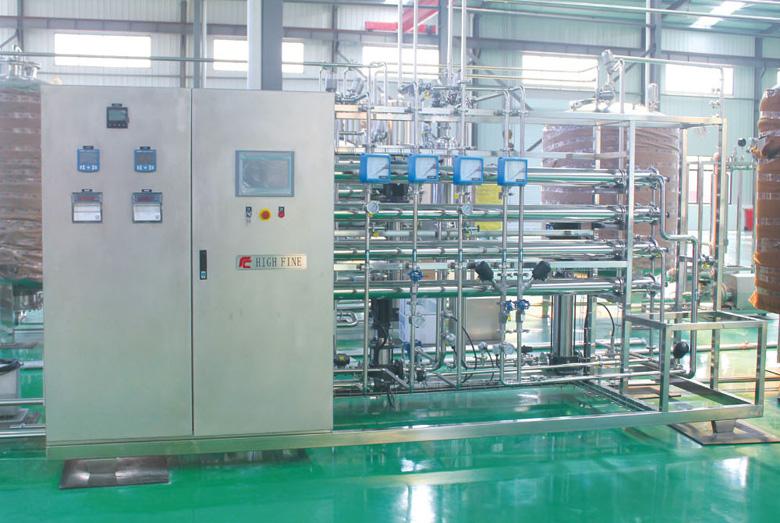
Chapter 2: Core Technologies of Purified Water Equipment
2.1 Multi-Stage Pretreatment System: Ensuring Water Source Stability
A typical pretreatment process includes:
- Multi-Media Filter: Removes suspended solids, residual chlorine, and organic matter using filter media such as quartz sand and activated carbon.
- Softening Unit: Utilizes sodium ion exchange resin to reduce water hardness and prevent scaling in subsequent membrane systems.
- Precision Filter: Employs a 5μm filter cartridge to remove fine particles, protecting high-pressure pumps and reverse osmosis membranes.
Intelligent control during the pretreatment stage is particularly critical. For example, some equipment is equipped with online turbidity monitors that automatically initiate backwashing procedures when raw water turbidity exceeds 1 NTU, preventing filter media clogging.
2.2 Reverse Osmosis (RO) and Electrodeionization (EDI) Technologies
- RO Membrane Technology: Uses spiral-wound polyamide composite membranes with a desalination rate of over 99%. High-pressure pumps pressurize raw water to 15-20 bar, forcing water molecules through the membrane while retaining ions and organic matter.
- EDI Module: Combines ion exchange resin with a direct current electric field to produce water continuously without chemical regeneration. The produced water conductivity can be stably maintained below 0.1 μS/cm, with operating costs 30% lower than traditional mixed-bed systems.
Innovative technologies, such as the three-stage "RO+EDI+Polishing Mixed-Bed" combination, can elevate water quality to ultrapure levels (resistivity ≥18.2 MΩ·cm), meeting the demands of high-end applications like cell culture.
2.3 Disinfection and Microbial Control Technologies
- Pasteurization: Periodic sterilization of storage tanks and pipelines using 80°C circulating hot water, suitable for high-temperature-resistant systems.
- Ozone Disinfection: Inhibits biofilm formation via ozone generators (concentration 0.1-0.2 ppm), ideal for ambient temperature circulation systems.
- UV Sterilization: Destroys microbial DNA using 254nm wavelength UV lamps, often employed as a terminal safeguard measure.
Leading equipment adopts a "multi-barrier control strategy," such as installing 0.22μm sterilizing filters in distribution systems and integrating online TOC analyzers (detection limit ≤50 ppb) for dual monitoring of microbes and organic matter.
Chapter 3: Equipment Selection and Customized Solutions
3.1 Capacity Matching and System Design Principles
Biopharmaceutical companies must select equipment specifications based on production scale:
- Small to Medium-Sized Production Lines: Recommend modular integrated units with a production capacity of 0.5-2 m³/h and a footprint of less than 10 m².
- Large Production Bases: Require multiple parallel systems, with single-unit production capacity up to 10 m³/h, and redundant pump sets to ensure continuous operation.
Examples of special process requirements:
- Vaccine Production: Requires endotoxin levels ≤0.25 EU/mL, necessitating the addition of ultrafiltration (UF) or nanofiltration (NF) units.
- Gene Therapy: Requires integration of nitrogen blanketing in distribution systems to prevent dissolved oxygen from affecting vector stability.
3.2 Key Component Selection Guide
- High-Pressure Pumps: Variable frequency control models can save 15%-20% energy; recommended brands include Grundfos and Wilo.
- Membrane Elements: Dow FilmTec™ series RO membranes excel in desalination rates and fouling resistance.
- Instrumentation Sensors: Mettler Toledo online conductivity meters and HACH TOC analyzers are industry mainstream choices.
3.3 Validation Services and Full Lifecycle Management
Compliant equipment suppliers should provide:
- 4Q Validation Package: Covers Design Qualification (DQ), Installation Qualification (IQ), Operational Qualification (OQ), and Performance Qualification (PQ).
- Remote Monitoring System: Real-time viewing of water production data, equipment status, and alarm records via SCADA platforms.
- Preventive Maintenance Plans: Standardized services including annual replacement of precision filter cartridges and triennial replacement of RO membranes.
Chapter 4: Typical Application Scenarios and Customer Cases
4.1 Purified Water Solutions for Antibody Drug Production
An international biopharmaceutical company required its new monoclonal antibody production line’s purified water system to meet:
- Production Capacity: 5 m³/h (24-hour continuous operation)
- Water Quality Standards: USP Purified Water + WFI dual system
- Special Requirements: CIP online cleaning functionality
Implementation Plan:
- Pretreatment utilized dual softeners operating alternately to ensure uninterrupted water supply.
- Main process employed a "Two-Stage RO+EDI+Multi-Effect Distillation" combination, with the WFI system complying with ASTM E2196 standards.
- The distribution system achieved 4D dead leg design (branch length/pipe diameter ≤3), maintaining flow velocity above 1.5 m/s.
Operational Results:
- System recovery rate increased from 65% to 78%, saving approximately 120,000 tons of water annually.
- Microbial testing remained below 10 CFU/100mL for 12 consecutive months.
4.2 Equipment Upgrade Case for an API Manufacturer
A traditional API manufacturer upgraded its outdated purified water system to pass FDA inspection:
- Problem Diagnosis: The original system had issues such as dead legs, substandard materials (304 stainless steel), and excessive manual operations.
- Upgrade Solution:
- Replaced pipelines with 316L stainless steel EP-grade polished pipes, achieving 100% pass rate in endoscopic welding inspections.
- Added ozone + UV dual disinfection units, improving microbial control to <1 CFU/mL.
- Deployed an MES system for electronic batch records and audit trail functionality.
Post-upgrade, the company passed the FDA on-site inspection, with product export value increasing by 40% year-on-year.
Chapter 5: Future Trends and Technological Prospects
5.1 Green Manufacturing and Energy-Saving Technologies
- Energy Recovery Devices: Utilize PX pressure exchangers to recover concentrate pressure to the RO feed end, reducing energy consumption by 30%-40%.
- Zero Liquid Discharge Design: Employ MVR evaporators to concentrate brine into solid salts, achieving zero wastewater discharge.
5.2 Digitalization and Intelligent Upgrades
- Digital Twin Systems: Use 3D modeling to simulate equipment operation, providing early warnings for membrane fouling and pump efficiency decline.
- AI Algorithm Optimization: Machine learning models dynamically adjust parameters such as chemical dosing and flushing frequency based on raw water quality.
5.3 Breakthroughs in New Materials and Processes
- Graphene Membrane Technology: Laboratory data show water permeability 10 times that of traditional RO membranes, with desalination rates exceeding 99.9%.
- Plasma Disinfection: Low-temperature plasma can kill heat-resistant bacteria without temperature increase, extending membrane module lifespan.
Conclusion
As the "invisible guardian" of drug quality, biopharmaceutical purified water equipment continuously evolves in sync with regulatory upgrades and process innovation needs. When selecting equipment, companies must comprehensively consider compliance, reliability, and full lifecycle costs, choosing suppliers with complete qualifications, successful case studies, and ongoing service capabilities. With the advancement of "smart manufacturing" and "dual-carbon goals," efficient, intelligent, and green purified water systems will become a core competitive advantage for biopharmaceutical enterprises.
| Industry Category | Others |
|---|---|
| Product Category | |
| Brand: | 奥力原 |
| Spec: | ALY-CHS-1T |
| Stock: | 99 |
| Manufacturer: | 上海奥力原环境科技有限公司 |
| Origin: | 113117 |


