


GMP Certified Purified Water Equipment
Contact Info
- Add:No. 318 Zhenxing Road, Che Dun Town, Dan Lai Shang Chuang Yuan, Building D, Zip:
- Contact: 胡先生
- Tel:18721141386
- Email:411243788@qq.com
Other Products


GMP Certified Purified Water Systems: Scientific Solutions for Ensuring Water Quality Safety in the Pharmaceutical Industry
In industries with extremely high water quality requirements such as pharmaceuticals, bioengineering, and medical devices, the quality of purified water is directly related to product safety and compliance. GMP (Good Manufacturing Practice) certified purified water systems, as core production tools in the industry, must not only meet strict process standards but also ensure consistent and stable water quality through systematic design. This article provides a comprehensive analysis of the technical features, application scenarios, and key selection points of GMP certified purified water systems, offering scientific reference for industry users.
Chapter 1: Core Value and Industry Requirements of GMP Certified Purified Water Systems
1.1 The Critical Role of Purified Water in Pharmaceutical Production
Purified water is an indispensable raw material in pharmaceutical production, widely used in injection preparation, equipment cleaning, laboratory testing, and other processes. According to the Chinese Pharmacopoeia, purified water must meet stringent criteria such as conductivity ≤5.1 μS/cm (25°C) and microbial limit ≤100 CFU/mL. Any fluctuation in water quality may lead to issues such as microbial超标 or inactivation of active ingredients, directly impacting drug safety and corporate compliance.
1.2 Mandatory Requirements of GMP Certification for Purified Water Systems
The GMP certification system imposes three core requirements for purified water systems:
- Full Process Traceability: From raw water pretreatment to terminal output, each stage must be equipped with real-time monitoring instruments (e.g., conductivity meters, TOC analyzers), with data automatically recorded in compliance with FDA 21 CFR Part 11 electronic record standards.
- Dead-Leg Free Design: Use 316L stainless steel pipelines with internal weld surface roughness Ra ≤0.6 μm, and maintain a flow velocity ≥1.5 m/s in the circulation system to prevent microbial growth.
- Integrity of the Validation System: Complete the four-stage validation process—DQ (Design Qualification), IQ (Installation Qualification), OQ (Operational Qualification), and PQ (Performance Qualification)—to ensure system stability under extreme operating conditions.
1.3 Industry Status and Equipment Upgrade Trends
Data from the 2023 unannounced inspections by the National Medical Products Administration show that 12% of pharmaceutical companies were required to rectify issues due to non-compliant purified water systems. With the implementation of the 2020 edition of the "Drug Production Supervision and Management Measures," second-generation GMP purified water systems featuring modular design and IoT remote monitoring have become the mainstream upgrade direction.
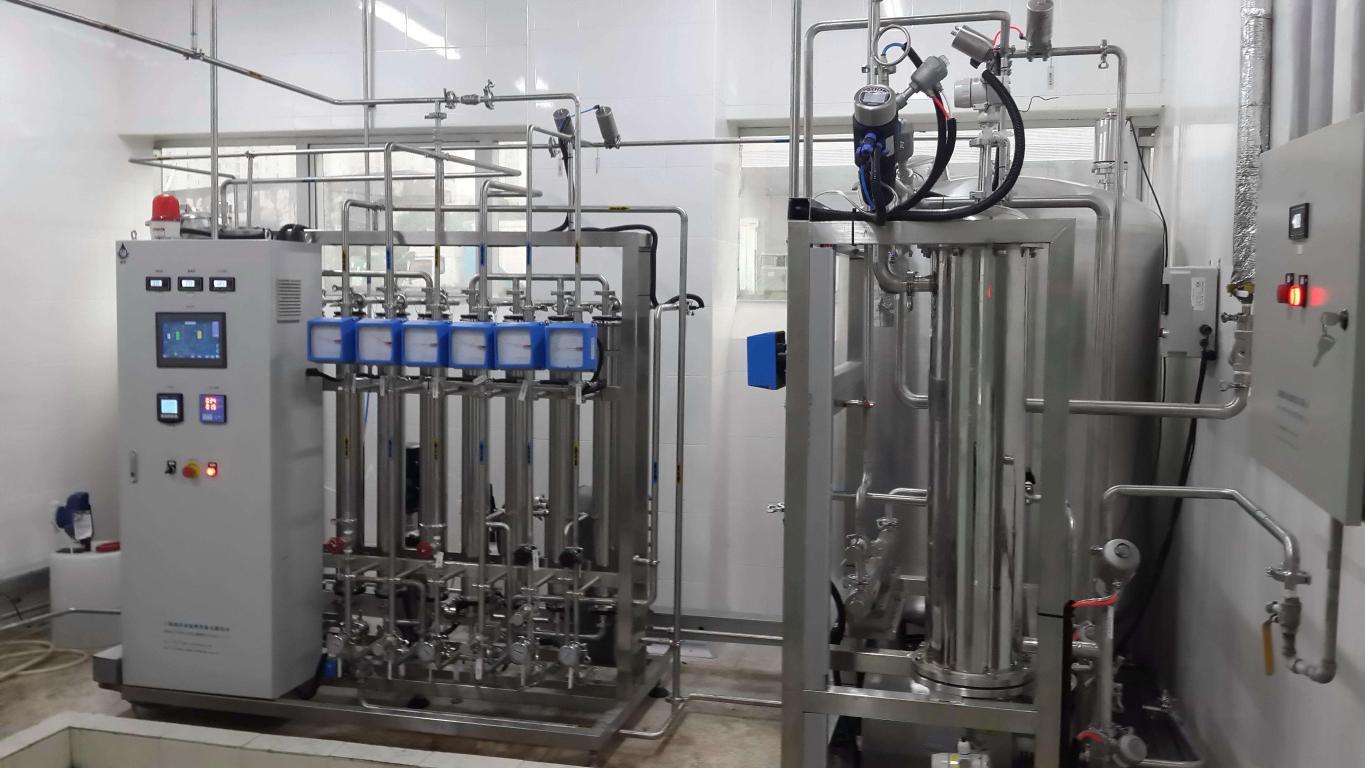
Chapter 2: Technical Architecture and Innovative Design of GMP Purified Water Systems
2.1 System Composition and Process Flow
Typical GMP certified purified water systems employ a four-stage treatment process:
- Pretreatment Unit: Multi-media filter + activated carbon adsorption + softener to remove suspended solids, residual chlorine, and hardness ions, with SDI (Silt Density Index) controlled at <3.
- Core Desalination Unit: Two-stage RO reverse osmosis system equipped with inter-stage booster pumps, achieving a recovery rate ≥75% and desalination rate >98%.
- Deep Purification Unit: Continuous electrodeionization (EDI) module, producing water with resistivity ≥16 MΩ·cm.
- Storage and Distribution System: 316L stainless steel storage tank with nitrogen blanket, paired with a double tube-sheet heat exchanger for pasteurization消毒 at temperatures above 80°C.
2.2 Analysis of Breakthrough Technological Innovations
- Fully Automated CIP/SIP System: Integrates online chemical cleaning (CIP) and steam sterilization (SIP) functions, reducing the sterilization cycle from the traditional 8 hours to 3 hours and saving 30% energy consumption.
- Anti-Siphon Design: Installation of air gap valves at use points to prevent back-siphonage of contaminants due to negative pressure.
- Redundant Control System: Dual control architecture with main PLC and local touchscreen, redundant configuration of critical sensors (e.g., pH probes), reducing system failure rate to below 0.5%.
2.3 Material Selection and Surface Treatment Processes
- Pipeline System: ASTM A270 standard 316L stainless steel, internal surface electrolytically polished (EP) to roughness Ra ≤0.5 μm.
- Sealing Materials: EPDM or PTFE materials, with temperature resistance range -20°C to 130°C, compliant with USP Class VI biocompatibility certification.
- Welding Process: Automatic orbital TIG welding, 100% endoscopic inspection to ensure no lack of fusion defects.
Chapter 3: Key Points for Equipment Selection and Customized Solution Design
3.1 Capacity Calculation and System Matching Principles
Taking a lyophilized powder injection manufacturer as an example:
- Maximum Water Consumption Calculation: 2000L mixing tank volume × 3 batches per day + 500L cleaning water = 6500L/day.
- Design Margin: Considering a 20% safety factor, the equipment rated capacity must be ≥8 m³/h.
- Distribution System: Dual-pump dual-loop circulation design to ensure return water conductivity fluctuation <0.1 μS/cm.
3.2 Guidelines for Key Component Selection
- RO Membrane Selection: Pharmaceutical-grade polyamide composite membranes (e.g., DOW Filmtec LC-4040) with single membrane desalination rate >99.5%.
- EDI Module: Choose concentrate recirculation structure (e.g., Evoqua Ionpure LX) with current efficiency increased to 95%.
- Disinfection Method: Overheated water disinfection system is safer than ozone, avoiding bromate residue risks.
3.3 Solutions for Special Application Scenarios
- High Hardness Water Source Treatment: Add weak acid cation bed pretreatment unit to reduce inlet hardness to <1 mg/L.
- Biological Product Production: Configure terminal sterilizing filters (0.22 μm PVDF membrane) with microbial retention efficiency >7 log.
- Low-Temperature Environment Operation: Pipeline trace heating system + storage tank insulation layer to ensure water temperature >20°C in winter.
Chapter 4: Validation System and Daily Operation and Maintenance Management
4.1 Implementation of the Complete 4Q Validation Process
- DQ Phase: Review P&ID drawings for compliance with ASME BPE standards, confirm instrument accuracy等级 (e.g., conductivity meter requires ±0.1 μS/cm).
- OQ Testing: Conduct 72-hour continuous operation test to verify system stability at 85% and 115% load.
- PQ Standards: 21-day continuous monitoring requiring 100% pass rate for microbial testing points and ≥99.8% pass rate for conductivity.
4.2 Intelligent Operation and Maintenance Management System
- Predictive Maintenance: Monitor pump bearing conditions through vibration analysis modules, providing mechanical failure warnings two weeks in advance.
- Consumable Life Management: Automatic alerts for RO membrane replacement when differential pressure >1.5 MPa or desalination rate decreases by 5%.
- Electronic Batch Records: Compliant with ALCOA+ principles (Attributable, Legible, Contemporaneous, Original, Accurate, Complete).
4.3 Diagnosis and Resolution of Common Issues
- Abnormal Conductivity Increase: Check for damaged RO membrane seals, regenerate EDI module.
- Microbial超标: Validate pasteurization temperature curve, inspect storage tank integrity.
- Decreased Water Production: Clean pretreatment filters, adjust high-pressure pump operating frequency.
Chapter 5: Industry Development Trends and Technological Innovation Outlook
5.1 Directions for Intelligent Upgrades
- Digital Twin Systems: Real-time simulation of water quality changes through 3D modeling, predicting key component lifespan.
- AI Algorithm Optimization: Automatically adjust RO system recovery rate based on historical data, achieving 15%-20% energy savings.
- AR Remote Maintenance: Enable expert remote guidance for equipment repairs via smart glasses.
5.2 Breakthroughs in Green Manufacturing Technologies
- Concentrate Recovery Technology: Increase wastewater recovery rate to 90% using DTRO membranes.
- Photovoltaic Direct Drive Systems: Utilize rooftop solar power to supply purified water systems, reducing carbon emissions.
- Chemical-Free Cleaning Solutions: Develop ultrasonic cavitation cleaning technology to replace acid and alkali cleaning agents.
5.3 Convergence of Global Regulatory Standards
- Harmonization of Chinese GMP with FDA/USP Standards: Develop integrated equipment compliant with Chinese, US, and European certifications.
- Enhanced Data Integrity: Apply blockchain technology for water quality data notarization to prevent record tampering.
- Emergency Response Standards: Establish a business continuity management system for purified water systems based on ISO 22301.
Conclusion: Strategic Value of Choosing GMP Certified Equipment
Against the backdrop of centralized procurement policies driving industry consolidation, adopting compliant GMP certified purified water systems has become a critical component for pharmaceutical companies to build competitive barriers. Through modular design, intelligent control, and full lifecycle services, the new generation of systems can help enterprises reduce comprehensive water costs by 30% while proactively managing quality risks. It is recommended that companies focus on evaluating suppliers' engineering implementation capabilities and local service networks during equipment selection to ensure full compliance from validation to operation and maintenance.
| Industry Category | Others |
|---|---|
| Product Category | |
| Brand: | 奥力原 |
| Spec: | ALY-CHS-1T |
| Stock: | 99 |
| Manufacturer: | 上海奥力原环境科技有限公司 |
| Origin: | 113117 |


