


Medical Device Cleaning Purified Water Equipment
Contact Info
- Add:No. 318 Zhenxing Road, Che Dun Town, Dan Lai Shang Chuang Yuan, Building D, Zip:
- Contact: 胡先生
- Tel:18721141386
- Email:411243788@qq.com
Other Products


Chapter 1: Why Must Purified Water Equipment Be Used for Medical Device Cleaning?
The Core Impact of Water Quality on Medical Safety
In the daily operations of medical institutions, instrument cleaning is the first line of defense against infection control. Impurities in ordinary tap water (such as calcium and magnesium ions, microorganisms, particulate matter, etc.) remaining on the surface of instruments may lead to the following risks:
- Chemical Residues: Scale or dissolved salts reacting with cleaning agents, forming difficult-to-remove deposits;
- Biofilm Risk: Bacteria breeding in instrument pipelines, increasing the probability of cross-infection;
- Instrument Corrosion: Components like chloride ions accelerating the oxidation of metal instruments, shortening their service life.
Purified water equipment controls water conductivity to ≤5 μS/cm (complying with the "Chinese Pharmacopoeia" standards) through multi-stage filtration processes, eliminating the impact of water quality contamination on cleaning effectiveness at the source.
Requirements of Regulations and Industry Standards
Both domestic and international medical regulations (such as WS 310-2016 "Management Standards for Hospital Sterile Supply Centers") explicitly require that the final rinse of instruments must use purified water. Non-compliant cleaning water may lead to:
- Bearing the risk of non-compliance in the traceability of hospital-acquired infection incidents;
- Failure to pass third-party audits (such as JCI certification);
- Medical disputes resulting from substandard cleaning quality.
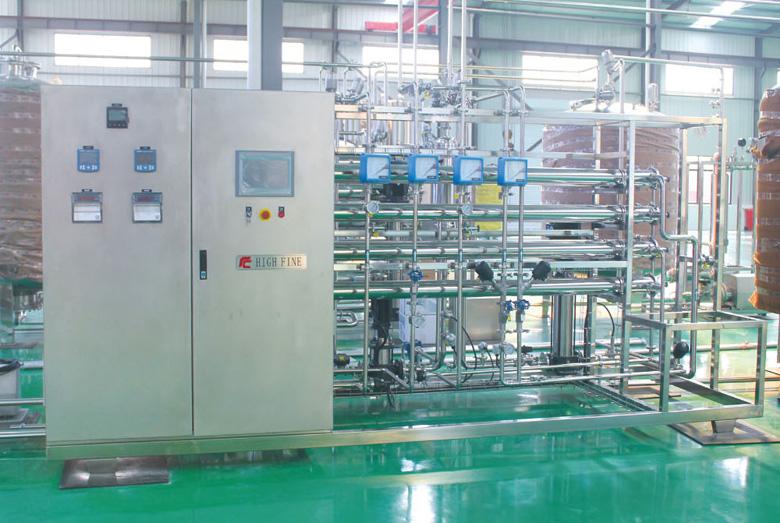
Chapter 2: Analysis of Core Technologies in Purified Water Equipment
Modular Design: From Pretreatment to Refined Filtration
Typical equipment consists of five functional units:
- Multi-Media Filter: Quartz sand and activated carbon layers adsorb suspended solids and residual chlorine;
- Softening System: Ion exchange resin removes calcium and magnesium ions to prevent scale formation;
- Reverse Osmosis (RO) Membrane: Filters out 99% of dissolved salts and microorganisms through 0.0001-micron pores;
- Electrodeionization (EDI) Module: Utilizes electric field force to continuously produce ultrapure water without chemical regeneration;
- Circulating Disinfection System: UV sterilization + Pasteurization thermal cycling to inhibit microbial growth in pipelines.
Key Advantages of Intelligent Control
- Real-Time Monitoring: Dynamic display of parameters such as TOC (Total Organic Carbon), conductivity, and flow rate;
- Self-Diagnosis: Proactive protection features like membrane clogging warnings and pump pressure anomaly alerts;
- Data Traceability: Storage of operational logs for at least one year, meeting medical quality traceability requirements.
Chapter 3: How to Choose Suitable Purified Water Equipment?
Clarifying Needs: From Hospital Scale to Water Usage Scenarios
- Bed Capacity Matching: Hospitals with fewer than 200 beds are recommended to choose 1-2 tons/hour models; those with over 500 beds require 3-5 tons/hour systems;
- Department Specificity: Operating room instrument cleaning requires higher water quality (e.g., ≤0.1 μS/cm), while general wards can be more lenient;
- Space Constraints: Compact equipment (footprint <5 m²) is suitable for primary medical institutions.
Five Evaluation Dimensions for Equipment Selection
- Water Production Stability: Water quality fluctuation after 72 hours of continuous operation must be <±5%;
- Energy Consumption Comparison: EDI technology saves over 30% more water than traditional mixed-bed processes;
- Maintenance Costs: Filter replacement cycles and membrane lifespan (typically 3-5 years) directly impact long-term expenses;
- Supplier Qualifications: Check for medical device registration certificates (e.g., NMPA approval numbers);
- Case References: Request installation examples from hospitals of similar scale.
Chapter 4: Practical Guide to Equipment Installation and Maintenance
Three Key Points for Scientific Installation
- Pipeline Material: Prefer 316L stainless steel or PVDF pipelines to avoid secondary contamination;
- Backflow Prevention Design: Install check valves at purified water outlets to prevent contamination backflow;
- Environmental Requirements: Equipment rooms must maintain a constant temperature of 5-35°C and humidity <80%.
Daily Maintenance Methods to Reduce Failure Rates
- Daily Checks: Record inlet water conductivity and purified water production volume;
- Monthly Maintenance: Clean pretreatment filter media and test UV lamp intensity;
- Annual Deep Maintenance: Replace RO membranes, calibrate sensors, and update control software.
Chapter 5: Industry Trends and Technological Innovation Outlook
Directions of Technological Iteration
- Low-Carbon Initiatives: Photovoltaic-driven purified water equipment is being piloted in some tertiary hospitals;
- IoT Integration: Remote operation and maintenance via 5G modules, with real-time water quality reporting;
- Miniaturization: Integrated equipment (e.g., vehicle-mounted types) supports the construction of medical consortium sterile supply centers.
Dual Drivers: Policy and Market
With the deepening implementation of the "Management Measures for Medical Consumables in Healthcare Institutions," the coverage rate of purified water equipment in secondary and above hospitals is expected to exceed 90% by 2025. The rise of regional sterile supply centers will further drive the demand for high-flow (≥10 tons/hour) equipment.
Conclusion: Solutions Balancing Compliance and Efficiency
Purified water equipment for medical device cleaning has transitioned from an "optional configuration" to a "mandatory requirement for medical quality control." Choosing equipment suppliers with mature technology and comprehensive services not only meets hospital infection control compliance requirements but also reduces operational costs through water and energy-saving designs. It is recommended that medical institutions conduct water quality testing simulations before procurement and select suitable solutions based on their budgets.
| Industry Category | Others |
|---|---|
| Product Category | |
| Brand: | 奥力原 |
| Spec: | ALY-CHS-1T |
| Stock: | 99 |
| Manufacturer: | 上海奥力原环境科技有限公司 |
| Origin: | 113117 |


