


Purified water equipment for medical precision instrument production
Contact Info
- Add:No. 318 Zhenxing Road, Che Dun Town, Dan Lai Shang Chuang Yuan, Building D, Zip:
- Contact: 胡先生
- Tel:18721141386
- Email:411243788@qq.com
Other Products


Medical Precision Instrument Production Purified Water Equipment: Technical Analysis and Industry Application Guide
Chapter 1: Why is Purified Water Equipment Needed for Medical Precision Instrument Production?
1.1 Special Water Quality Requirements for Medical Precision Instruments
In the medical device manufacturing sector, water quality in the production environment directly impacts product quality. Medical precision instruments, such as surgical robot components, high-precision sensors, and in vitro diagnostic reagent reaction chambers, require water quality standards far exceeding those of ordinary industrial water during production. These instruments come into contact with human tissues or participate in precise chemical reactions, necessitating the use of purified water that complies with the Chinese Pharmacopoeia standards, with conductivity strictly controlled at ≤1.3μS/cm (25°C) and microbial indicators reaching <10 CFU/100ml.
A quality report from a well-known medical device company revealed that using substandard water sources reduces product qualification rates by 12%, primarily due to metal component oxidation, biofilm formation, and reagent reaction deviations. Therefore, professional purified water equipment has become a standard feature in medical production lines.
1.2 Limitations of Traditional Water Treatment Solutions
Conventional distilled water machines have low preparation efficiency (typically producing less than 200L per hour) and exhibit significant water quality fluctuations. A comparative test by a tertiary hospital’s equipment department showed that the conductivity of purified water produced by traditional equipment rises to 3.5μS/cm after 8 hours of continuous operation, failing to meet the cleaning requirements of precision instruments. In contrast, professional purified water systems, through multi-stage treatment processes, can consistently and stably output production water that complies with ISO 13485 standards.
1.3 Analysis of Regulatory Compliance Requirements
According to the National Medical Products Administration’s "Medical Device Production Quality Management规范," purified water systems for medical device manufacturers must obtain GMP certification. Data from a 2022 spot check by a drug regulatory authority in East China showed that 23% of non-compliance cases were due to incomplete water system validation documents or missing water quality monitoring records. Professional purified water equipment must be equipped with comprehensive validation service packages, including full sets of documents for IQ (Installation Qualification), OQ (Operational Qualification), and PQ (Performance Qualification).
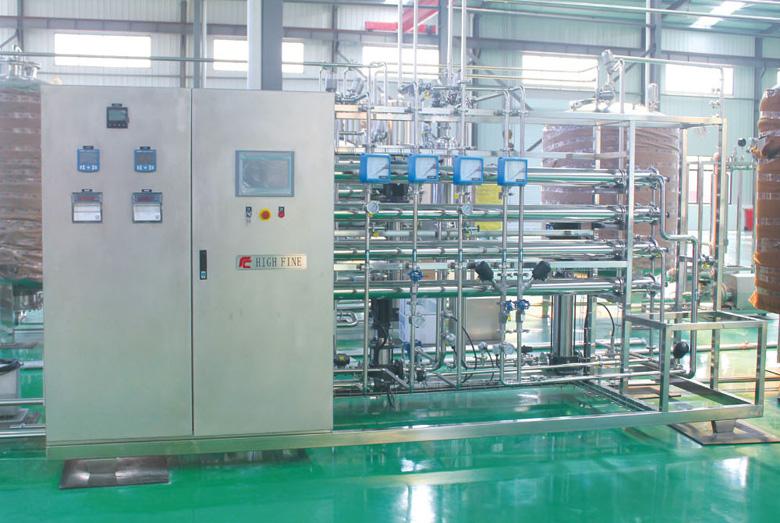
Chapter 2: Core Technology Analysis of Medical-Grade Purified Water Equipment
2.1 Multi-Stage Pretreatment System Design
The pretreatment unit employs a three-stage filtration system of "quartz sand + activated carbon + softening resin," effectively removing suspended solids (filtration accuracy up to 5μm), residual chlorine (removal rate >99%), and calcium and magnesium ions (hardness <0.03mmol/L) from the raw water. An engineering case from an equipment manufacturer demonstrated that, under high-hardness water source conditions in the Yangtze River Basin (raw water hardness of 4.2mmol/L), the output water hardness could be stabilized at 0.01mmol/L after pretreatment.
2.2 Breakthrough in Dual-Stage Reverse Osmosis (RO) Technology
Medical-grade equipment utilizes anti-fouling RO membranes with cross-flow filtration design, coupled with high-pressure pumps (operating pressure 1.5-2.5MPa), achieving a desalination rate of over 98%. Test data from a listed medical company showed that a dual-stage RO system could reduce conductivity from 580μS/cm in raw water to 2μS/cm, increasing water production efficiency to 75% (compared to only 55% for traditional single-stage systems).
2.3 Advanced Treatment with EDI Electrodeionization Technology
The continuous electrodeionization module (EDI) removes residual ions continuously without chemical regeneration through the synergistic action of ion-exchange membranes and a direct current electric field. Operational data from a branded device indicated that the EDI unit further purifies RO output water to 0.1μS/cm, with operating costs reduced by 40% compared to traditional mixed-bed systems.
2.4 Intelligent Circulation Disinfection System
Utilizing a combined "ozone + ultraviolet" disinfection solution alongside 316L stainless steel circulation pipelines ensures microbial indicators in the distribution system meet standards. Monitoring records from a medical device factory in South China revealed that the intelligent disinfection system extended the biofilm formation cycle on pipeline inner walls from 3 months to 12 months and prolonged the purified water storage period from 24 hours to 72 hours.
Chapter 3: Detailed Explanation of Key Components of Medical Purified Water Equipment
3.1 Technical Parameters of Core Processing Units
- High-pressure pump: Vertical multi-stage centrifugal pump, adjustable power 5.5-15kW, equipped with frequency conversion control system
- RO membrane element: Anti-fouling composite membrane, single membrane flux 0.8-1.2m³/h, desalination rate ≥99%
- EDI module: Plate structure, water production capacity 0.5-5m³/h, resistivity ≥15MΩ·cm
3.2 Configuration of Intelligent Control System
Siemens S7-1200 PLC paired with a 10-inch touchscreen enables the following functions:
- Real-time monitoring of 12 parameters including conductivity, pH value, and flow rate
- Automatic recording of operational data (storage period ≥5 years)
- Remote alarm (SMS/APP push) and fault self-diagnosis
- Password hierarchical management (engineer/operator/visitor three-level permissions)
3.3 Material Certification and Process Standards
- Pipeline system: 316L stainless steel, inner wall electrolytically polished (Ra≤0.5μm)
- Storage tank: Mirror polished, argon arc welding process, weld smoothness ≤0.25mm
- Sealing materials: EPDM ternary ethylene-propylene rubber, compliant with USP Class VI standards
Chapter 4: Equipment Selection Guide for Medical Scenarios
4.1 Water Standards for Different Production Processes
| Application Scenario | Water Quality Requirements | Recommended Equipment Configuration |
|---|---|---|
| Instrument cleaning | Conductivity ≤5μS/cm | Single-stage RO + storage system |
| Reagent preparation | Resistivity ≥5MΩ·cm | Dual-stage RO + EDI system |
| Sterilization equipment cooling water | Microbial <10 CFU/100ml | RO + UV disinfection system |
| Cell culture instrument production | TOC <500ppb | RO + EDI + ultrafiltration system |
4.2 Equipment Selection Calculation Formula
Recommended capacity = Maximum hourly water consumption × 1.2 (safety factor)
Case study of an orthopedic device manufacturer:
Daily water consumption: 12m³, production duration: 8 hours
Equipment selection = 12 ÷ 8 × 1.2 = 1.8m³/h
Actual configuration: 2m³/h dual-stage RO + EDI system
4.3 Key Points for Site Planning
- Equipment room area: Main unit occupies approximately 6-15㎡ (depending on capacity)
- Ceiling height requirement: ≥2.8m (including overhead pipeline space)
- Drainage slope: Floor drainage trench slope ≥2%
- Power configuration: 380V three-phase power supply, reserve 10%-20% power margin
Chapter 5: Full Lifecycle Management Solutions for Equipment
5.1 Validation and Qualification Services
Professional manufacturers provide comprehensive validation services from DQ (Design Qualification) to PQ:
- DQ phase: 3D modeling to confirm equipment layout rationality
- IQ phase: Verification of 60+ installation parameters
- OQ phase: 72-hour continuous operation test
- PQ phase: 2-week water quality monitoring (sampling frequency 4 times/day)
5.2 Preventive Maintenance System
Recommended maintenance intervals:
- Quartz sand filter media: Annual replenishment of 10%-15%
- RO membrane chemical cleaning: Every 3-6 months (depending on water quality)
- EDI module electrode water replacement: Every 2000 operating hours
- UV lamp replacement: Every 8000 hours
Maintenance data from a North China equipment manufacturer indicates that strict adherence to preventive maintenance can reduce equipment failure rates by 65% and extend membrane element lifespan to 5 years.
5.3 Water Quality Monitoring and Risk Control
Recommended testing frequency:
- Online monitoring: Real-time display of conductivity and flow rate
- Offline testing: Weekly testing for microbes, TOC, and endotoxins
- Third-party verification: Annual submission to CMA-certified laboratories
An early warning mechanism established by a listed medical company showed that when conductivity fluctuations exceed ±10%, an investigation procedure is immediately initiated, reducing water quality incident response time to within 2 hours.
Conclusion
As a core component of the quality system, purified water equipment for medical precision instrument production directly influences product qualification rates and corporate compliance. This article systematically elaborates on the key selection points and management solutions for professional equipment, from technical principles to practical applications, providing actionable solutions for medical device manufacturers. With the implementation of the new GMP standards, it is recommended that enterprises prioritize equipment suppliers with comprehensive validation service capabilities to ensure compliant operation throughout the entire lifecycle of the water system.
| Industry Category | Others |
|---|---|
| Product Category | |
| Brand: | 奥力原 |
| Spec: | ALY-CHS-1T |
| Stock: | 99 |
| Manufacturer: | 上海奥力原环境科技有限公司 |
| Origin: | 113117 |


