


Purified Water Equipment for Biomedical Research Institute
Contact Info
- Add:No. 318 Zhenxing Road, Che Dun Town, Dan Lai Shang Chuang Yuan, Building D, Zip:
- Contact: 胡先生
- Tel:18721141386
- Email:411243788@qq.com
Other Products


Biomedical Research Institute Purified Water Equipment: Technical Analysis and Selection Guide
In the field of biomedical research, purified water is known as the "blood of experiments." From cell culture to reagent preparation, from instrument cleaning to pharmaceutical production, the quality of purified water directly determines the accuracy of experimental results and product safety. This article provides an in-depth analysis of the technical principles, core components, and key selection points of specialized purified water equipment for biomedical applications, offering comprehensive reference for laboratory decision-makers.
Chapter 1: Why Biomedical Research Requires Professional Purified Water Systems
1.1 Stringent Water Quality Standards
Water used in biomedical laboratories must meet standards such as the Chinese Pharmacopoeia (ChP), United States Pharmacopeia (USP), and ISO 3696. Taking the USP standard as an example, ultrapure water must meet Type I water standards: resistivity ≥18.2 MΩ·cm (25°C), total organic carbon (TOC) ≤5 ppb, and microbial content <1 CFU/ml. Ordinary distilled water or reverse osmosis water cannot meet the requirements of high-precision experiments such as gene sequencing and chromatography analysis.
1.2 Water Quality Requirements for Typical Application Scenarios
- Cell Culture: Requires removal of endotoxins (<0.001 EU/ml) and microorganisms to avoid cell contamination.
- HPLC Analysis: Demands TOC ≤3 ppb to prevent column clogging.
- Molecular Biology Experiments: Requires absence of RNase/DNase residues to ensure PCR reaction specificity.
- Pharmaceutical Production: Must comply with GMP standards, with online monitoring of key parameters such as conductivity and pH.
1.3 Limitations of Conventional Water Treatment Systems
A provincial laboratory once experienced widespread cell culture contamination due to the use of a simple reverse osmosis device. Subsequent testing revealed the system lacked a UV sterilization module, allowing bacterial biofilm to grow in the water storage tank. Professional equipment, through multi-barrier design, can completely eliminate such risks.
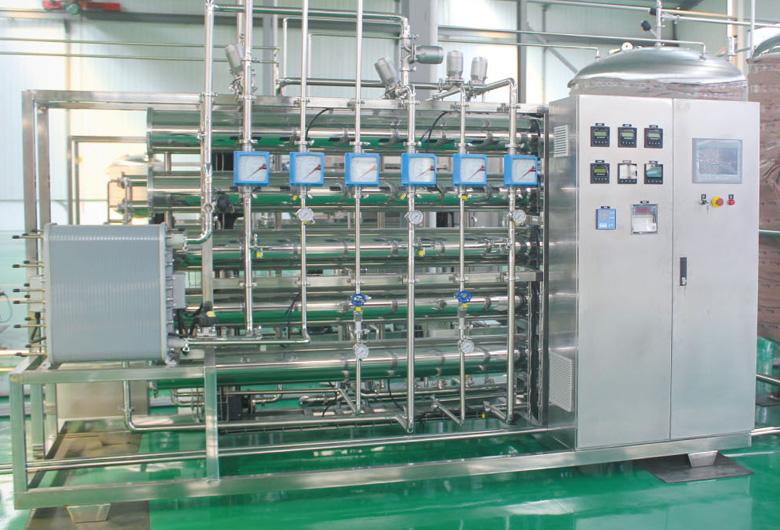
Chapter 2: Core Technologies and Working Principles of Purified Water Equipment
2.1 Analysis of the Five-Stage Purification Process
(Diagram: Complete process of pretreatment → reverse osmosis → electrodeionization → UV sterilization → terminal filtration)
Pretreatment Stage:
- Multi-media filter: Removes suspended particles (accuracy 5μm).
- Activated carbon adsorption: Eliminates residual chlorine and organic matter (adsorption capacity ≥800 mg/g).
- Softening device: Replaces calcium and magnesium ions to prevent scaling on RO membranes.
Main Treatment Unit:
- Reverse Osmosis System: Uses spiral-wound RO membranes with salt rejection >98%, equipped with high-pressure pumps (pressure range 1-1.5 MPa).
- Electrodeionization (EDI): Achieves continuous deionization through ion-exchange membranes and electric fields, with product water resistivity stable at 15-18 MΩ·cm.
Polishing Stage:
- 254nm UV lamp: Sterilization rate >99.99%, with power dynamically adjusted based on flow rate.
- Terminal filtration: 0.22μm sterilizing filter cartridge, equipped with integrity test ports.
2.2 Intelligent Control System
Advanced equipment features a 7-inch touch screen integrated with the following functions:
- Real-time monitoring: Simultaneous display of four parameters—conductivity, TOC, flow rate, and pressure.
- Alarm system: Tiered alerts (audible/visual alarms + mobile notifications), e.g., automatic water production initiation when tank level drops below 20%.
- Data traceability: Stores 2000 sets of operational data, supports USB export and GAMP5 compliance auditing.
2.3 Energy-Saving Technologies
Certain models reduce operational costs through the following designs:
- Concentrate water recycling technology: Increases reverse osmosis recovery rate to 75%.
- Variable frequency constant pressure water supply: Saves 30% electricity compared to traditional equipment.
- Night water-saving mode: Automatically switches to a small circulation loop during non-operational hours to prevent water quality degradation.
Chapter 3: Key Component Selection and Technical Parameter Interpretation
3.1 Comparison of Reverse Osmosis Membrane Modules
| Brand | Model | Salt Rejection | Water Production (L/h) | Lifespan (Years) |
|---|---|---|---|---|
| Dow Filmtec | BW30-4040 | 99.5% | 1200 | 3-5 |
| Toray | TMG20D-440 | 99.2% | 1100 | 2-4 |
| Domestic Membrane | RO-4040 | 98.0% | 1000 | 1-3 |
Note: Actual performance is influenced by feed water quality; regular membrane flux testing is recommended.
3.2 Key Design Points for Water Storage Systems
- Material selection: 316L stainless steel tank with electrolytically polished inner surface (Ra ≤0.5μm).
- Vent filter: Equipped with 0.2μm hydrophobic PTFE membrane, air flow >30 L/min.
- Circulation piping: Uses double tube sheet design with slope >1% to ensure complete drainage.
3.3 Recommended Configurations for Online Monitoring Modules
- Basic: Conductivity meter + temperature compensation (accuracy ±0.1 μS/cm).
- Standard: Adds TOC analyzer (measurement range 0-50 ppb).
- Premium: Integrates multi-parameter probes for pH and oxidation-reduction potential (ORP).
Chapter 4: Six Key Dimensions for Equipment Selection
4.1 Clarify Water Usage Requirements
Recommended preparation of a water usage point list:
- Peak instantaneous flow rate: Calculated based on maximum water usage of equipment such as pipetting workstations and bioreactors.
- Water quality grade: Differentiate between analytical grade (CLSI) and water for injection (WFI) standards.
- Usage pattern: Continuous (e.g., production facilities) vs. intermittent (e.g., R&D laboratories).
4.2 Key Considerations for Site Planning
A newly built laboratory had to relocate equipment due to overlooking the following factors:
- Equipment dimensions: Standard unit footprint approx. 2m×1.5m, requiring 60cm maintenance clearance on both sides.
- Drainage slope: Reverse osmosis concentrate discharge pipe requires a 2% incline.
- Power configuration: Dual-circuit power supply—380V three-phase (main pump) + 220V (control system).
4.3 Cost-Benefit Analysis Model
| Cost Item | 10-Year Total Cost (10k RMB) | Proportion |
|---|---|---|
| Equipment Purchase | 80 | 45% |
| Consumable Replacement | 50 | 28% |
| Energy Consumption | 30 | 17% |
| Maintenance Services | 18 | 10% |
Data source: Actual operational data from a CRO company, equipment utilization rate 85%.
Chapter 5: Operation, Maintenance, and Development Trends
5.1 Golden Rules for Daily Maintenance
- Daily checks: Record initial conductivity (fluctuation should be <5%), tank pressure (0.1-0.3 MPa).
- Monthly maintenance: Disinfect water storage system (recommended circulation for 30 minutes).
- Annual inspection: Replace pre-filter cartridges, calibrate monitoring probes.
5.2 Troubleshooting Guide for Common Issues
- Reduced Water Production: Check pre-filter differential pressure (>0.1 MPa requires replacement).
- Water Quality Exceedance: Perform membrane integrity test (pressure decay method).
- Abnormal Alarms: Prioritize sensor fault exclusion (e.g., electrodes require regular calibration).
5.3 Industry Technology Frontiers
- Modular Design: Some brands offer plug-and-play units, reducing expansion time by 70%.
- AI Predictive Maintenance: Uses machine learning to analyze historical data, providing fault warnings up to 14 days in advance.
- Green Water Production: Photovoltaic-driven systems enable off-grid operation, suitable for field laboratories.
Conclusion
Selecting suitable purified water equipment requires comprehensive consideration of technical parameters, application scenarios, and full lifecycle costs. It is recommended that laboratories conduct a three-month water quality monitoring period before procurement to accurately understand actual needs. With the implementation of new regulations such as the "Pharmaceutical Water Quality Risk Management Guidelines," intelligent equipment with data integrity and traceability will become industry standards. Maintaining technical communication with equipment suppliers and regularly participating in operational training are key to ensuring the continuous and stable operation of purified water systems.
| Industry Category | Others |
|---|---|
| Product Category | |
| Brand: | 奥力原 |
| Spec: | ALY-CHS-1T |
| Stock: | 99 |
| Manufacturer: | 上海奥力原环境科技有限公司 |
| Origin: | 113117 |


