


Dental Hospital Laboratory Deionized Water Equipment
Other Products


"Introduction to the Process of Deionized Water Equipment for Laboratory Use in Dental Hospitals"
The deionized water equipment for laboratory use in dental hospitals employs a rigorous and scientific process to ensure the provision of high-quality deionized water for dental medical testing. 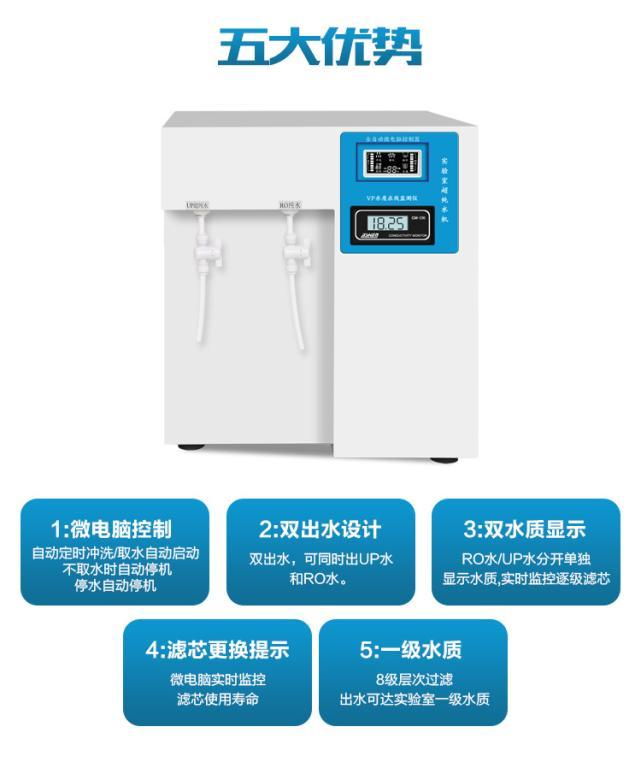
The raw water first enters the pretreatment unit, where a multi-media filter performs initial purification. It is filled with filter media such as quartz sand and anthracite of varying particle sizes. These media act like layered filters, effectively removing large suspended particles from the raw water, such as sediment and rust, significantly reducing the turbidity of the raw water. This prevents clogging or damage to subsequent treatment units by large particles, laying a solid foundation for the stable operation of the entire system.
Next, the activated carbon filter begins its work. Activated carbon has an extremely porous structure and a large specific surface area, enabling it to adsorb residual chlorine, organic matter, and certain odorous substances in the water. In water used for dental hospital testing, residual chlorine may react chemically with certain components in samples, affecting the accuracy of test results, while the presence of organic matter may interfere with chemical reactions during testing or the detection accuracy of analytical instruments. The role of the activated carbon filter is to remove these potential interfering factors, further purifying the water quality.
The pretreated water then enters the precision filter. The precision filter uses a microporous filter element with a pore size typically around 5 microns, capable of capturing finer particulate impurities in the water, such as residual colloidal particles. This ensures that the water entering the ion exchange unit achieves a high level of purity, avoiding damage to the ion exchange resin by fine particles, which could affect its exchange performance and service life.
The ion exchange unit is the core process part of this equipment. It typically employs cation and anion exchange resins. When water passes through the ion exchange resin bed, various cations in the water (such as calcium, magnesium, sodium, etc.) exchange with hydrogen ions on the cation exchange resin, while anions (such as chloride, sulfate, etc.) exchange with hydroxide ions on the anion exchange resin. Through this ion exchange process, the majority of ions in the water are removed, resulting in high-purity deionized water. To ensure the effectiveness of ion exchange and the regeneration and reuse of the resin, the equipment is also equipped with a resin regeneration system. When the resin becomes saturated with adsorbed ions, it can be regenerated using a specific regeneration solution to restore its ion exchange capacity.
After ion exchange, some advanced equipment may include an ultrafiltration unit. Ultrafiltration membranes have relatively larger pore sizes and are primarily used to remove potential residual macromolecular organic matter, colloids, and microorganisms in the water. These macromolecular substances may interfere with the normal operation of testing instruments or affect the accuracy of test results in dental testing. The ultrafiltration unit further enhances the purity and stability of the water, ensuring the quality of water used for testing.
Finally, the treated deionized water passes through a ultraviolet (UV) sterilizer or ozone sterilization device. UV sterilization uses specific wavelengths of ultraviolet light to destroy the DNA structure of microorganisms, rendering them unable to reproduce, thereby killing residual bacteria, viruses, and other microorganisms in the water. Ozone sterilization utilizes the strong oxidizing properties of ozone to oxidize and decompose organic matter and microorganisms in the water, providing a sterilizing and disinfecting effect. Additionally, ozone can remove odors from the water, further optimizing water quality and ensuring that the deionized water does not introduce any contaminants during dental testing processes, providing a solid guarantee for accurate and reliable test results.
Through the close coordination and synergistic effects of this series of process steps, the deionized water equipment for laboratory use in dental hospitals can stably and efficiently produce deionized water that meets the stringent requirements of dental medical testing, strongly supporting the clinical diagnosis and research experiment needs of dental hospitals.
| Industry Category | Environment/Raw Water Treatment Equipment/Reverse Osmosis Equipment |
|---|---|
| Product Category | |
| Brand: | 滨润 |
| Spec: | BR-15L |
| Stock: | 100 |
| Manufacturer: | 湖北滨润环保科技有限公司 |
| Origin: | 114201 |


