


High-Quality Softened and Purified Water Equipment
Other Products


# Water Softening Equipment Process
## 1. Introduction Water softening equipment is widely used in industrial production, domestic water supply, and many other fields. Its primary purpose is to remove calcium, magnesium, and other ions from water, reducing water hardness to minimize scale formation and improve the efficiency and quality of water in production and usage. The following sections provide a detailed introduction to the water softening equipment process.
## 2. Basic Principles of Water Softening Equipment Water softening equipment primarily operates on the ion exchange principle. Calcium and magnesium ions in the water exchange with exchangeable ions (such as sodium ions) on the ion exchange resin. This process adsorbs calcium and magnesium ions onto the resin while releasing sodium ions into the water, thereby achieving water softening. When the ion exchange resin becomes saturated, it requires regeneration to restore its exchange capacity.
## 3. Water Softening Equipment Process Flow 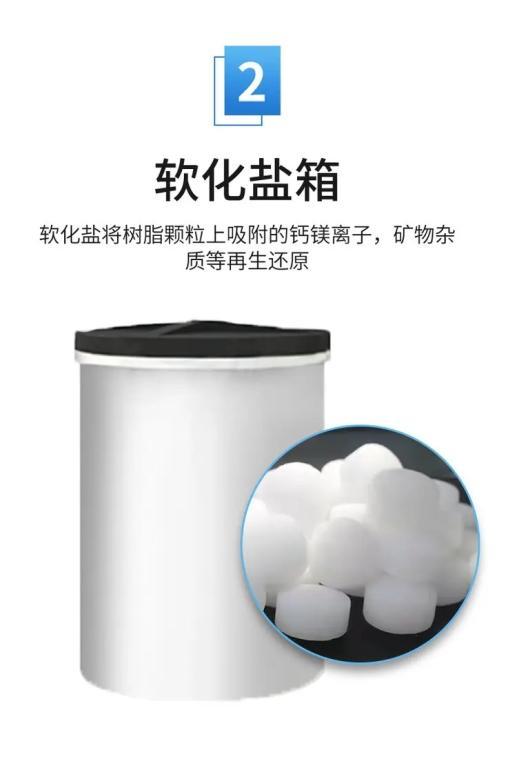
### (1) Water Inlet Raw water first enters the water softening equipment. The raw water can be surface water, groundwater, or other water sources. During the inlet process, an inlet valve typically controls the water flow, and instruments such as pressure gauges may be installed to monitor the inlet pressure.
### (2) Filtration Before softening, the raw water usually undergoes filtration to remove suspended solids, sediment, colloids, and other impurities. This step can employ multi-media filters, activated carbon filters, etc. Multi-media filters are filled with filter materials like quartz sand and anthracite of varying particle sizes, which physically remove larger particulate impurities. Activated carbon filters utilize the adsorption properties of activated carbon to remove organic matter, residual chlorine, etc., improving the effectiveness of subsequent softening treatment.
### (3) Softening Treatment 1. **Ion Exchange Resin Bed** The filtered water enters the ion exchange resin bed, which is the core component of the water softening equipment. The ion exchange resin is typically housed in cylindrical exchange columns. Water enters the resin bed from the top or bottom and fully contacts the resin within the bed. Exchangeable ions on the resin undergo an exchange reaction with calcium and magnesium ions in the water.
. 2. **Softening Process Control** During the softening process, parameters such as water flow rate, resin bed height, and diameter need to be controlled. An appropriate flow rate ensures sufficient contact time between the water and the resin, enhancing softening effectiveness. The size of the resin bed is designed based on the treatment capacity and water quality requirements. Additionally, monitoring the hardness of the softened water provides insight into the softening effect. If the hardness exceeds standards, it may indicate that the resin requires regeneration. #
## (4) Regeneration Process 1. **Selection and Dosing of Regenerant** When the ion exchange resin becomes saturated, it needs to be regenerated using a regenerant. A common regenerant is a sodium chloride (NaCl) solution. The regenerant is delivered to the resin bed via equipment such as a regenerant tank and regeneration pump. The concentration and dosage of the regenerant are determined based on factors like the type of resin and the degree of saturation. 2. **Regeneration Steps** The regeneration process generally includes steps such as backwashing, brine drawing (regeneration), and rinsing. Backwashing involves introducing clean water from the bottom of the resin bed to loosen the bed, remove dirt and broken resin from the surface, and discharge them from the top. During the brine drawing step, the regenerant solution is drawn into the resin bed to fully contact the resin, displacing the adsorbed calcium and magnesium ions and restoring the resin's exchange capacity. Rinsing involves using clean water to flush out residual regenerant and displaced ions from the resin bed until the effluent meets the required standards. #
## (5) Water Outlet The softened water, after softening and regeneration treatment, flows out of the equipment and can be directly delivered to the point of use or enter subsequent treatment processes. Water quality monitoring instruments, such as hardness meters, are typically installed on the outlet pipeline to monitor the effluent quality in real time.
## 4. Process Characteristics and Advantages
### (1) Efficient Softening Water softening equipment effectively removes most calcium and magnesium ions from water through the efficient exchange action of ion exchange resin, significantly reducing water hardness and meeting the softened water needs of various users. ### (2) Automated Control Most modern water softening equipment can achieve automated control. Through control systems, a series of operations such as softening and regeneration can be automatically completed, reducing the complexity and errors of manual operation and improving the stability and reliability of equipment operation.
### (3) Wide Application
This process can be applied in various fields, including boiler feed water, textile printing and dyeing, chemical production, and domestic water supply. It plays a crucial role in improving equipment operational efficiency, extending equipment service life, and enhancing product quality.
## 5. Conclusion
The water softening equipment process is a mature and important water treatment technology. Through reasonable process design and operation, it can stably produce softened water that meets requirements, providing strong support for water needs across various industries. In practical applications, further optimization and adjustment of the equipment and process are necessary based on specific water source quality and usage requirements.
| Industry Category | Others |
|---|---|
| Product Category | |
| Brand: | 滨润 |
| Spec: | BR-1000L |
| Stock: | 100 |
| Manufacturer: | 湖北滨润环保科技有限公司 |
| Origin: | 114201 |


