


Low Temperature Brittleness Impact Tester
Contact Info
- Add:Room 1707, 17th Floor, Building 4, Yard No. 1, Shangdi 10th Street, Zip:
- Contact: 吴
- Tel:010-66024083
- Email:3440125819@qq.com
Other Products


This instrument is designed in accordance with the GB1682GJ standard, and its technical specifications comply with the requirements of GJ standards such as HG 2-162-1965 Plastic Low-Temperature Impact Compression Test Method and GB5470-2008 Plastic Impact Brittleness Temperature Test Method.
Technical Parameters:
Temperature Control Range: Room Temperature to -70°C (Room Temperature ≤ 25°C)
Constant Temperature Accuracy: ±0.3°C
Cooling Rate: 0°C to -30°C: Approximately 2.5°C/min
-30°C to -40°C: Approximately 2.5°C/min
-40°C to -70°C: Approximately 2.0°C/min
Maximum Overall Dimensions: 900 × 500 × 800 mm (Length × Width × Height)
Effective Workspace of the Chamber: 280 × 170 × 120 mm (Length × Width × Height)
Number of Samples That Can Be Loaded: 1
Digital Timer: 0 seconds - 99 minutes, Resolution 1 second
Cooling Medium: Ethanol or other non-freezing liquid
Stirring Motor: 8W
Power Supply: 220V--240V, 50Hz, 1.5kW
Operating Temperature: ≤25°C
Structural Principle
This equipment consists of a refrigeration compressor main unit, heating device, electronic control box, cooling bath, cooling medium circulation system, automatic alarm device, and other components. After starting the refrigeration switch, the compressor begins to operate, and the refrigeration system enters the formal working state. The refrigeration compressor works continuously. When approaching the set temperature, the heating device in the cooling bath begins to provide heat proportionally to balance the excess cooling capacity generated by the refrigeration system, achieving the purpose of constant temperature. Stirring ensures the continuous circulation of the cooling medium in the bath, maintaining uniform temperature.
Sample Holder
One side of the sample holder clamps 4 samples (rubber type), and the other side clamps 15 samples (plastic type).
Impact Device
The impact device consists of an impact hammer and a self-locking mechanism.
Impactor
Impact head radius: 1.6 ± 0.1 mm;
During impact, the gap between the impact head and the sample holder is 6.4 ± 0.3 mm;
The distance between the centerline of the impact head and the sample holder is 8 ± 0.3 mm.
Features and Applications:
The low-temperature brittleness tester is used to determine the highest temperature at which a material sample fails under impact under specified conditions, i.e., the brittleness temperature. It allows for comparative evaluation of the performance of plastics and other elastic materials under low-temperature conditions. It can determine the brittleness temperature and low-temperature performance of different rubber materials or vulcanized rubber with different formulations. Therefore, it is indispensable in scientific research, quality inspection of materials and products, production process control, and other aspects.
Applicable Industries:
It can be used to assess and determine the adaptability of products such as electrical, electronic, automotive electrical, and materials for storage and use under low-temperature environmental conditions. It is suitable for schools, factories, military industry, research institutions, and other units.
Usage Method
Connect the power supply, and the temperature controller and timer indicator lights will illuminate.
Pour the cooling medium (generally industrial ethanol) into the cooling well. The amount injected should ensure that the distance from the lower end of the holder to the liquid surface is 75 ± 10 mm.
Clamp the sample vertically in the holder. It should not be too tight or too loose to prevent deformation or falling off of the sample.
Lower the holder to start freezing the sample, and simultaneously start the sequence control switch (or press the stopwatch) to time. The sample freezing time is specified as 3.0 ± 0.5 min. During sample freezing, the temperature fluctuation of the cooling medium must not exceed ±1°C.
Raise the lifting holder to allow the impactor to strike the sample within half a second.
Remove the sample and bend it 180° in the impact direction. Carefully observe for any damage.
After impact (each sample is only allowed to be impacted once), if damage occurs, increase the temperature of the cooling medium; otherwise, decrease its temperature and continue the test. The test ends when the difference between these two results is not greater than 1°C.
Precautions
During the test, the cooling circulation must not be cut off, otherwise it will result in ineffective refrigeration.
The cylinder pressure has been adjusted before leaving the factory and should not be arbitrarily changed.
Determination of Low-Temperature Brittleness of Vulcanized Rubber - Single Sample Method
Raise the lifting holder and clamp the sample vertically in the holder (as shown in Figure 1). It should not be too tight or too loose to prevent deformation or falling off of the sample.
Lower the lifting holder to start freezing the sample and simultaneously start timing. The sample freezing time is specified as 3.0 ± 0.5 min. During sample freezing, the temperature fluctuation of the cooling medium should not exceed ±1°C.
Raise the lifting holder to allow the impactor to strike the sample within 0.5 s.
Remove the sample, let it stand for at least 30 s, wipe off any residual liquid on the sample surface, and bend the sample 180° in the impact direction. Carefully observe under bright light for any damage and record. When the sample is damaged, record the specific damage phenomenon.
After impact (each sample is only allowed to be impacted once), if damage occurs, increase the temperature of the cooling medium; otherwise, decrease its temperature and continue the test.
Through repeated tests, determine the lowest temperature at which at least two samples are not damaged and the highest temperature at which at least one sample is damaged. The test ends when the difference between these two results is not greater than 1°C.
Procedure B: Conduct the test step by step. A set of tests requires at least 3 samples.
Test Results and Processing Procedure A
The highest temperature at which the sample shows damage is the brittleness temperature of that sample.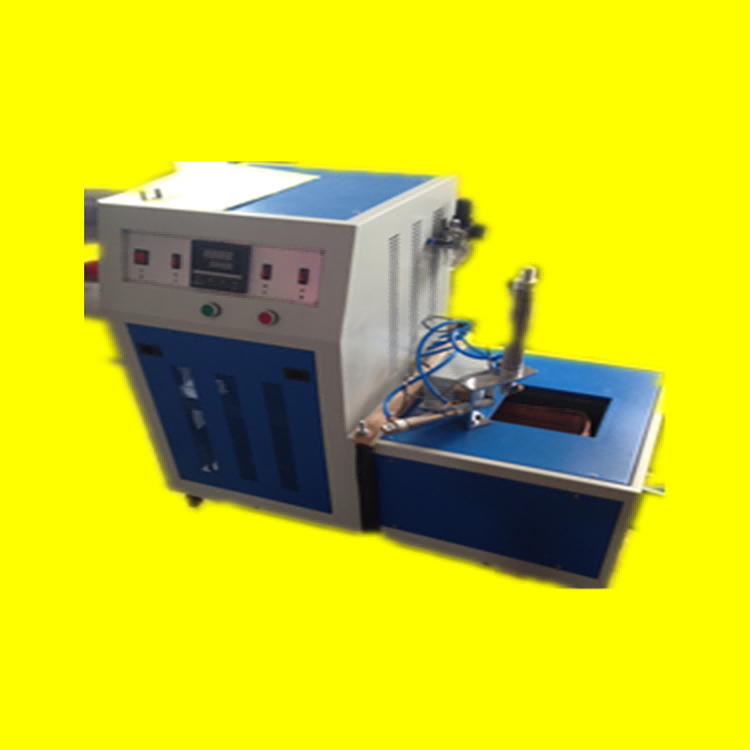
| Industry Category | Instruments & Meters/Testing Machines/Impact Testing Machines |
|---|---|
| Product Category | |
| Brand: | 北广精仪 |
| Spec: | BWD |
| Manufacturer: | 北京北广精仪仪器设备有限公司 |
| Origin: | 111108 |


