


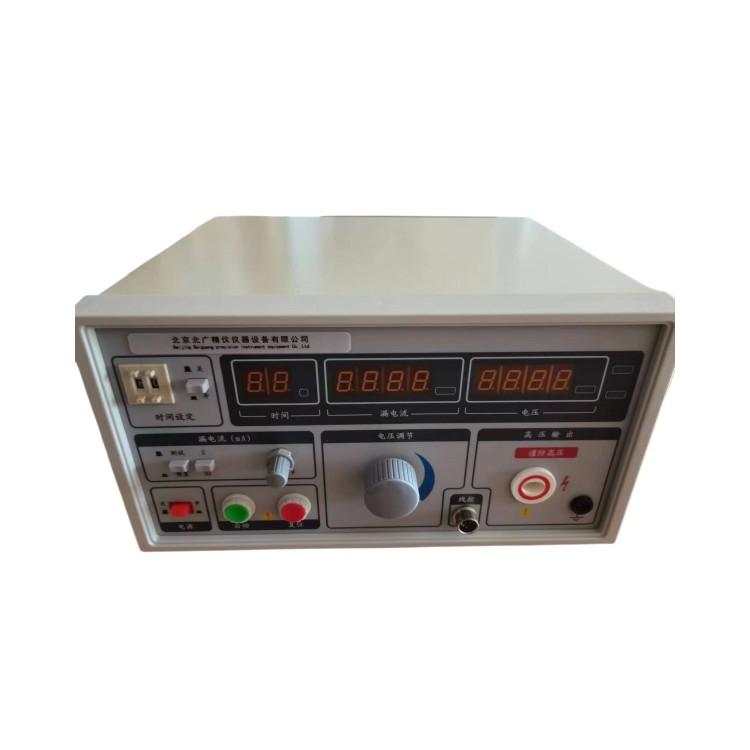
Withstand Voltage Tester
Contact Info
- Add:Room 1707, 17th Floor, Building 4, Yard No. 1, Shangdi 10th Street, Zip:
- Contact: 吴
- Tel:010-66024083
- Email:3440125819@qq.com
Other Products


Withstand Voltage Measurement
Analysis of Key Technical Points in Withstand Voltage Measurement
I. Core Testing Principles
Basic Method
By applying an AC/DC high voltage higher than the operating voltage (typically 2 times the operating voltage + 1000V) for a specified duration, monitor whether the leakage current exceeds the preset threshold to determine insulation performance.
The test voltage range covers 0-100kV, with leakage current detection accuracy up to 0-200mA.
Instrument Composition
The withstand voltage tester consists of a programmable power supply module, signal acquisition and conditioning module, and computer control system, supporting manual/timing/remote three test modes.
Key components include a high-voltage generator, TVS transient suppression protection circuit, and a multi-stage cyclic voltage acquisition system.
II. Test Process Specifications
Parameter Settings
Test Type Voltage Waveform Typical Ramp Rate Judgment Standard
AC Withstand Power Frequency 50Hz 0.1-5kV/s Leakage Current ≤5mA
DC Withstand Smooth DC 2000V/s Current Fluctuation ≤1μA
Operation Steps
Pre-treatment: Clean and dry the test sample, measure initial insulation resistance
No-load Test: Raise voltage to target value without load to calibrate the instrument
Formal Test: Ramp voltage uniformly to the specified value, hold for 1 minute, then step down
III. Safety Protection Measures
Equipment Requirements: Must be equipped with door interlock power-off function, discharge time ≤50ms, test interval ≥3 minutes
Personnel Protection: Operators must wear insulation equipment, set up dual leakage current alarms (audible and visual + automatic power-off)
IV. Application Scenario Differences
Power Equipment
Transformer winding tests use AC withstand voltage (AC 30kV/1min), requiring oil-immersed environment to simulate actual working conditions.
Electronic Components
Capacitor dielectric layer verification uses DC withstand voltage (DC 10kV), employing hemispherical electrodes (R=1mm) to reduce edge effects.
I. Withstand Voltage Test
Electrical strength test, commonly known as withstand voltage test, involves applying a high voltage several times the rated voltage between the live parts and the enclosure of the device under test to verify whether the live parts are grounded or broken down. During the test, the insulation parts of the device under test are subjected to abnormal stress. If insulation failure occurs in any part due to processing, components, or materials, breakdown will occur. Additionally, if there is an implied insufficient electrical gap in the device under test for some reason, such as a gap smaller than (3~4)mm, such a small electrical gap may not fail under normal operating voltage. However, after a period of use, dust accumulation and increased humidity may cause the insufficient electrical gap to break down, leading to electric shock hazards. The withstand voltage test can detect this in advance.
II. Methods of Withstand Voltage Test
(1) Impulse Withstand Voltage Measurement
During the test, a non-periodic transient voltage is applied, which typically rises rapidly to a peak and then decreases slowly to zero. Impulse withstand voltage testing is commonly used for inter-turn insulation testing of windings.
(2) DC Withstand Voltage Measurement
DC withstand voltage testing is similar to insulation resistance testing, except that the applied voltage value may be higher, and the test result is expressed in the form of leakage current. Most devices under test have large insulation resistance, so their insulation parts contain stray distributed capacitance. During DC testing, after the stray distributed capacitance on the device under test is charged, only the actual leakage current flowing through the device remains, so DC withstand voltage testing can accurately measure the actual leakage current.
DC testing is only a single-polarity test. If the device under test operates in an AC power environment, DC testing cannot realistically simulate actual usage conditions. Moreover, since the peak value of AC testing is 1.414 times the meter reading, which cannot be achieved by DC testing, the DC withstand voltage test value is generally higher.
(3) AC Withstand Voltage Measurement
Since most electrical products use AC power supply, AC withstand voltage testing is widely used for electrical products to more realistically simulate the actual usage conditions of the device under test.
Depending on the operating state of the device under test, AC withstand voltage testing is further divided into cold withstand voltage testing and hot withstand voltage (electrical strength at operating temperature) testing.
1. Cold Withstand Voltage Test
The wiring method for cold withstand voltage testing is the same as for insulation resistance testing—the device under test is in a non-operating state, its power switch is in the on position, and the test voltage is applied between the power input and the accessible metal enclosure. The value of the applied voltage is determined based on the type of insulation and product standards.
For example, GB4706.1-2005 stipulates that for basic insulation, the applied test voltage is (1250~1500) V AC; for double insulation (basic insulation + supplementary insulation), the applied test voltage is 2500V AC; and for reinforced insulation, the applied test voltage is 3750V AC.
2. Hot Withstand Voltage (Electrical Strength at Operating Temperature) Test
The so-called hot withstand voltage test is to perform a withstand voltage test on the device under test while it is operating. The standard requires an isolation transformer secondary winding (with center tap). For electric heating appliances, it should provide 1.15 times the rated input power; for motor-operated appliances, it should provide 1.06 times the rated voltage. Since the internal circuit has functions such as zero-crossing startup and power conversion, the impact of power interference and load changes can be minimized. Traditional withstand voltage testers using autotransformer voltage regulation methods, due to the lack of power conversion function in their internal circuits, should pay attention to eliminating measurement errors caused by power or load changes.
3. Issues to Note in Hot Withstand Voltage Testing
The voltage regulation rate of the isolation transformer should be as small as possible to eliminate measurement errors caused by changes in the power supply voltage to the device under test. The best isolation transformer has its primary connected to an adjustable power supply to ensure accurate input voltage is provided to the device under test.
Section II Insulation Resistance Measurement
I. Insulation Resistance Test
Insulation resistance is an important electrical parameter reflecting the performance of insulating materials. The basic theory of insulation resistance testing is very similar to withstand voltage testing. The judgment of withstand voltage testing is based on the amount of leakage current, while insulation resistance testing uses the resistance value as the basis for judgment. Typically, the test value must be in MΩ or higher. Generally, the higher the insulation resistance value, the better the insulation of the product. Insulation resistance testing is sometimes specified as an additional test to ensure that the insulation is not damaged during the withstand voltage test. A simplified diagram of the working principle of an insulation resistance tester is shown in Figure 4-2-1.
The wiring method for insulation resistance testing is largely the same as for withstand voltage testing. It mainly measures the equivalent resistance formed between two endpoints and the various associated networks connected peripherally. Insulation resistance refers to the resistance between two parts of conductors separated by insulating material. To ensure the safe operation of electrical equipment, a minimum requirement is set for the insulation resistance between conductive parts of different polarities (different phases) or between conductive parts and the enclosure.
II. Purpose of Conducting Insulation Resistance Testing
Factors affecting the measurement value of insulation resistance include: temperature, humidity, measurement voltage and duration, residual charge in windings, and surface condition of insulation. By measuring the insulation resistance of electrical equipment, the following purposes can be achieved:
(1) Understand the insulation performance of the insulation structure; a reasonable insulation structure or system composed of high-quality insulating materials should have good insulation performance and high insulation resistance value.
(2) Understand the insulation performance status of electrical products; poor insulation treatment in electrical products will significantly reduce their insulation performance.
(3) Understand the moisture and contamination of insulation; when the insulation of electrical equipment is damp or contaminated, its insulation resistance usually decreases significantly.
(4) Verify whether the insulation can withstand the withstand voltage test; if the withstand voltage test is performed when the insulation resistance of the electrical equipment is below a certain limit, a large test current will be generated, causing thermal breakdown and damaging the insulation of the electrical equipment. Therefore, various test standards generally stipulate that insulation resistance should be measured before the withstand voltage test.
New generations of safety analyzers mainly emphasize integrated testing. Integrated testing means that after completing the initial setup, pressing the test key (Test Key) can complete basic safety tests; and most tests include insulation resistance testing functions. AC/DC withstand voltage/insulation testers have insulation resistance testing as an independent function within the safety test equipment, which does not overlap with the withstand voltage testing function, making it more convenient to use. These integrated withstand voltage and insulation testing functions on a single machine can meet product requirements. Safety enforcement units such as TUV and VDE require insulation resistance testing to be performed first before conducting withstand voltage tests for certain specific products. This requirement is now widely referenced in safety tests performed during product design.
III. Importance of Insulation Resistance Testing
(1) Importance of Insulation Resistance Testing for Electrical Equipment
Manufacturers, installers, users, and repairers of electrical machines find insulation resistance testing very useful in determining the insulation quality of electrical machines. For an experienced person who knows how to interpret the readings, a single insulation resistance measurement can indicate whether a machine is suitable for use.
Conducting measurements on new machines or at least once a year after commissioning provides information with true value. To test a machine with no past records, a calculation method called polarization index is sometimes used. This index is obtained by dividing the insulation resistance reading at 10 minutes by the reading at 1 minute. Generally, for large machines, the polarization index should be at least 2.
(2) Importance of Insulation Resistance Testing for Product Components
Another application example of insulation resistance testing is testing components before they are installed into products. Wires and cables, connectors, switches, transformers, resistors, capacitors, printed circuit boards, and other components have corresponding minimum specified insulation resistance, and it is often necessary to verify whether these components meet the specifications.
Any component has a voltage usage limit, or a specified insulation resistance for a particular voltage. These limitations are mainly to avoid damaging the component or making incorrect tests, so the test voltage should be carefully selected and not exceed the maximum allowable test voltage across the measurement points on the component.
IV. Safety Standard Requirements for Insulation Resistance
Generally, safety standards require insulation resistance testing as a type test. In testing, a DC voltage of about 500V is applied for 1 minute before measuring the insulation resistance value. For example, safety standard specifications such as IEC60065 "Safety Requirements for Audio, Video, and Similar Electronic Equipment," IEC60598-1 "General Safety Requirements and Tests for Luminaires," and IEC60950-1 "General Safety Requirements for Information Technology Equipment." Generally, insulation resistance is required to be at least 2MΩ for basic insulation or supplementary insulation; double insulation or reinforced insulation requires at least 4MΩ.
V. Definition of Insulation Resistance
Insulation resistance refers to the total resistance between the conductive parts of the device under test and the enclosure or exposed non-conductive parts. It is the simplest and most commonly used method to evaluate the insulation performance of electrical products. The basic measurement principle of insulation resistance is Ohm's law—apply a specified DC voltage between the conductive and non-conductive parts of the electrical product under test, forming a certain value of leakage current in the insulating medium under the applied voltage, and then measure and calculate to convert this current value into a resistance value.
Commonly used DC voltages for insulation resistance testing are 250V, 500V, 1000V, 2500V, etc. For electrical products using AC 220V power supply, 500V/1000V DC test voltage is generally selected.
In power equipment and power transmission lines, conductors at different potentials must be separated by insulators. The basic function of an insulator is to prevent current flow, ensuring that electrical energy is transmitted along the designed path and that the equipment operates normally. However, insulators are not absolutely non-conductive; they just have very small leakage currents. Insulation resistance is a parameter that characterizes the ability of an insulator to阻止 current flow and is one of the basic parameters of insulation characteristics. If insulation resistance is too low and leakage current is large, it not only wastes electrical energy but also causes other issues such as heating. It is also one of the main causes of electric shock to personnel, which may lead to serious consequences, so it must be verified.
| Industry Category | Chemicals/Chemical Intermediates/Intermediate Compounds |
|---|---|
| Product Category | |
| Brand: | 北广精仪 |
| Spec: | BDCZ-10KV |
| Origin: | 111108 |


