


PSL Irradiation Food and Drug Detector
Contact Info
- Add:No. B12, Xinzhong Street, Dongcheng District, Beijing, Zip: 100027
- Contact: 李伟
- Tel:13683081768
- Email:yzpsm1986@163.com
Other Products


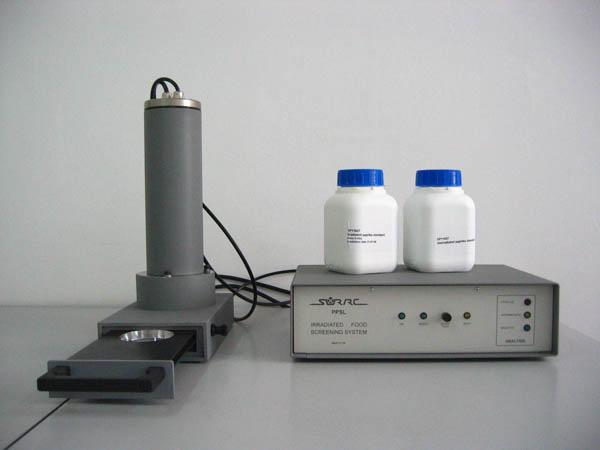
PSL Irradiated Food and Drug Detector
The PSL Irradiated Food and Drug Detector System SURRC (also known as the Irradiated Food Screening System) is a conveniently portable laboratory instrument used for rapid detection or screening of whether food or its ingredients have been irradiated. The detectable range includes herbs, spices and seasonings, fruits and vegetables (including dehydrated vegetables), as well as products with shells or bone fragments such as crustaceans and meat. It is currently the recommended detection instrument in the EU standard method for detecting irradiated food (EN13751-2002) (Note: The EU standard EN13751 has now been accepted by the Codex Alimentarius Commission as a global standard for detecting irradiated food). It is also the primary instrument used by many European and American countries, Japan, and others when testing the irradiation levels of imported food (i.e., by measuring the PSL signal intensity of the food to determine whether it has been irradiated).
The PSL Irradiated Food and Drug Detector System SURRC consists of a pulsed excitation light source, sample chamber, detection probe, patented photon counting system (UK Patent No. 2291707), and control unit. It is very simple to operate and can be used both in the laboratory and carried for on-site measurements. With supporting software, it can also be connected to a computer for data acquisition and processing. The patented photon counting technology greatly enhances detection sensitivity, making direct testing of samples possible without tedious and time-consuming pre-treatment. The SURRC PPSL system is particularly suitable for detecting herbs, spices, and seasonings, and can also be used for testing fruits and vegetables, as well as products with shells or bone fragments such as crustaceans and meat. In fact, the system is applicable to a broader range of food products.
For measurement, simply place the sample in a covered petri dish and insert it into the sample chamber. The sample can be measured directly without any preparation. The non-contact measurement process makes it very convenient to test different types of food without worrying about cross-contamination. Screening detection takes only 15 seconds; test results are indicated by corresponding indicator lights. For irradiated samples such as herbs and spices, the one-time correct detection rate is over 95%. The PSL Irradiated Food and Drug Detector System SURRC offers two operating modes:
Screening Mode—Based on pre-set threshold and time parameters, simply press the test button after placing the sample in the chamber, and results are provided in 15 seconds. Screening mode does not require a computer connection. It is ideal for routine rapid testing of conventional samples.
Computer-Connected Use—When connected to a computer, measurement parameters (such as measurement time, threshold criteria, and data recording conditions, etc.) can be customized via software. Specific photon counts of the sample can be obtained, and dark counts (photon count rate in the sample chamber without light stimulation), empty chamber counts (count rate without a sample to check for chamber contamination), as well as photomultiplier tube sensitivity tests, etc., can be performed. Additionally, corrective PSL measurements can be conducted for samples with uncertain screening results.
Compared to other PSL irradiated food detection methods, the PSL Irradiated Food and Drug Detector System SURRC has many outstanding advantages:
1. No sample pre-treatment required—The vast majority of samples can be measured directly after being placed in a petri dish. In contrast, thermoluminescence (TL) methods require complex pre-treatment of samples, often taking several days for general sample preparation, so the testing cycle for a single sample typically exceeds a week.
2. Simple operation—Results are obtained in just 15-60 seconds after pressing the button.
3. High accuracy—For irradiated herbs and spices, the one-time correct detection rate is over 95%.
4. Wide applicability—It can detect the vast majority of food products, making it the most widely applicable method among all irradiated food detection techniques.
5. Clean and environmentally friendly—No chemical reagents are required. Methods like thermoluminescence (TL) involve the use of many toxic and harmful chemical reagents.
6. Cost-effective—Due to the absence of sample pre-treatment, daily testing costs are very low.
7. Portable—Easy to carry for on-site measurements or shared use between different laboratories.
[About the PSL Method]
PhotoStimulated Luminescence (PSL) is a standard method for detecting irradiated food. It is based on the principle that mineral residues, especially silicates or inorganic calcium, are very common in food. When exposed to ionizing radiation (irradiation), these minerals accumulate energy from charge carriers. When stimulated by excitation light, this stored energy is released in the form of photons, creating an excitation spectrum. The PSL method does not damage the sample, allowing repeated measurements of both organic and inorganic mixtures. However, repeated measurements of the same sample will weaken the PSL signal. For screening detection, the generated signal level is compared against two defined thresholds. Samples with signal intensity above the higher threshold indicate irradiation; those below the lower threshold indicate no irradiation; intermediate signal intensity between the two thresholds suggests that further testing or investigation of the sample is needed. The dual-threshold concept provides an extremely effective screening tool, with a one-time correct detection rate of over 95%.
| Industry Category | Instruments & Meters/Specialized Instruments/Other Specialized Instruments |
|---|---|
| Product Category | |
| Brand: | 金工鸿泰 |
| Spec: | PSL |
| Stock: | 100 |
| Manufacturer: | 北京金工鸿泰科技有限公司 |
| Origin: | 111101 |


