


Stray Current Explosion-Proof Solid-State Decoupler
Other Products



Installation and Protection Requirements for Solid-State Decouplers
1. When installing the decoupler using a steel pile method, the overall length should be 2m, suitable for environments requiring deeper burial, such as areas with significant frost depth.
2. The protective enclosure for decouplers installed vertically with steel piles should be made of sturdy, impact-resistant materials and possess anti-atmospheric corrosion functionality. The enclosure protection rating should reach IP65. All electrical connections are housed within the protective enclosure without the need for additional bridging components, ensuring safe, stable, and reliable connections. For non-explosion-proof solid-state decouplers, the front of the protective enclosure should feature an outward-opening door with a lock, with a door thickness ≥4mm. The steel protective enclosure and pile should preferably be welded together.
3. The outer layer of the protective enclosure pile column must be coated with anti-corrosion paint. Before applying the paint, the surface of the steel pile and base plate should be treated for rust removal to achieve Sa2.5 grade. The paint structure consists of epoxy zinc-rich primer (≥80μm) + epoxy mica iron intermediate coat (90μm) + polyurethane topcoat (≥80μm), with a total dry film thickness ≥250μm. The topcoat should be yellow (color code R255, G230, B0). The performance indicators of the paint must comply with the requirements of SY/T0320 "Technical Standard for External Anti-Corrosion Coatings of Steel Storage Tanks."
Function of Solid-State Decouplers
The primary function of solid-state decouplers is to provide protection, specifically for cathodic protection of pipelines, reducing electrical faults to extend their service life. This is because cathodic protection systems for pipelines have certain drawbacks, such as electromagnetic interference or increased coupled stray currents. These stray currents cause significant interference during daily use, greatly affecting the pipeline's lifespan. Thus, solid-state decouplers were developed to effectively eliminate currents that do not comply with cathodic protection, reduce fault probabilities, and minimize interference with communications. They also protect pipelines from damage caused by severe weather conditions like thunderstorms and lightning. Additionally, solid-state decouplers can reduce some factors harmful to human health.
Working Principle of Solid-State Decouplers
The main working principle of solid-state decouplers involves using rectification devices to release excess unwanted currents and suppress voltages, specifically targeting currents and voltages caused by AC/DC interference. Furthermore, solid-state decouplers employ fast-response varistor-type surge protectors and spark gap-type surge protectors to eliminate electromagnetic interference and the effects of severe weather like thunderstorms, intelligently switching between these two functions. Additionally, solid-state decouplers utilize advanced solid-state technology, making them highly popular in the industry.
Installation of Solid-State Decouplers
Solid-state decouplers can be installed in two ways: surface installation and bracket installation. Surface installation involves connecting one end of the decoupler to the pipeline and the other end to the grounding grid, with attention to the resistance value of the grounding grid. Bracket installation involves mounting the solid-state decoupler within an explosion-proof enclosure structure. This installation method typically results in a longer service life for the decoupler compared to surface installation.
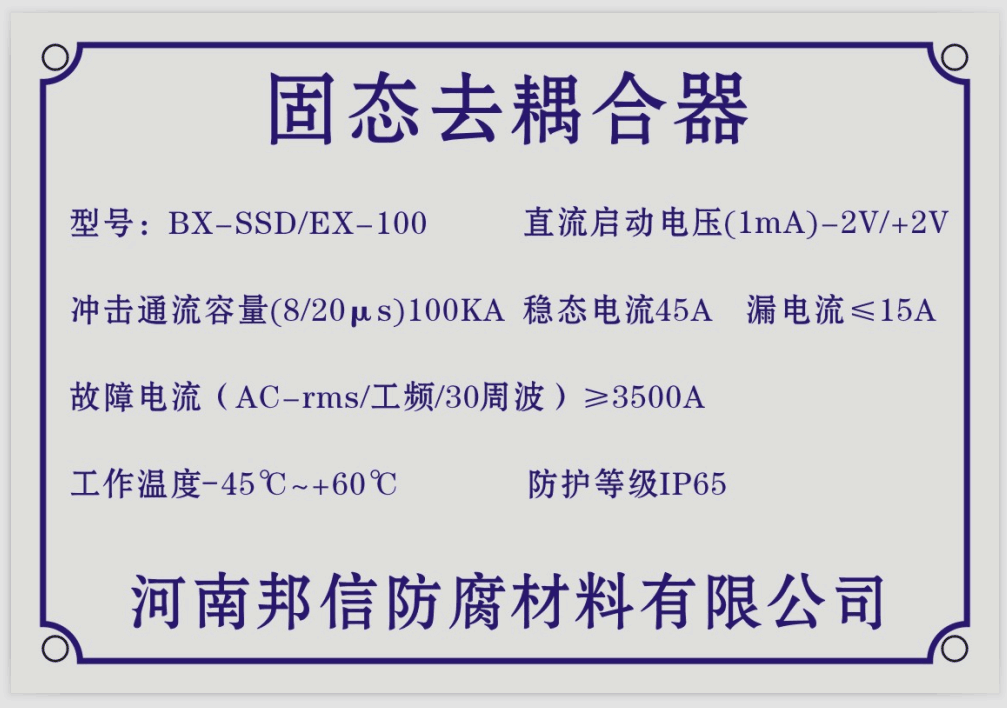
| Industry Category | Chemicals/Chemical Intermediates/Intermediate Compounds |
|---|---|
| Product Category | |
| Brand: | 邦信防腐 |
| Spec: | BX-SSD/EX-L100 |
| Stock: | 1700 |
| Manufacturer: | 河南邦信防腐材料有限公司 |
| Origin: | 114101 |


