


Reverse Osmosis Equipment
Contact Info
- Add:Xinhe Industrial Park, Qingyang County, Chizhou City, Anhui Province, Zip:
- Contact: 周志俊
- Tel:17306773426
- Email:875595691@qq.com
Other Products


The product water from a primary reverse osmosis unit typically has a conductivity of around 10 μS/cm. If higher purity water is required, a mixed bed of cation and anion exchange resins can be used for purification. Its working principle involves the ion exchange method, which removes cationic and anionic ions present in water. Taking sodium chloride (NaCl) as an example of inorganic salts in water, the basic reaction for water desalination can be expressed by the following equations: 1. Cation exchange resin: R—H + Na⁺ → R—Na + H⁺ 2. Anion exchange resin: R—OH + Cl⁻ → R—Cl + OH⁻ The overall reaction equation for cation and anion exchange resins can be written as: RH + ROH + NaCl → RNa + RCl + H₂O From this, it can be seen that NaCl in the water is replaced by H⁺ and OH⁻ from the resin, and the only reaction product is H₂O, thus achieving the removal of salts from the water. The water quality can reach 10-18 MΩ·cm. After the resin in the mixed bed becomes saturated, the water quality declines and no longer meets the usage standards. At this point, acid and alkali regeneration is required. First, the cation and anion resins must be separated, then the cation resin is regenerated with acid and the anion resin with alkali. After rinsing with clean water, they are thoroughly mixed with air agitation before reuse. The regeneration process is cumbersome and produces acidic and alkaline wastewater, which is why this method is less commonly used today.
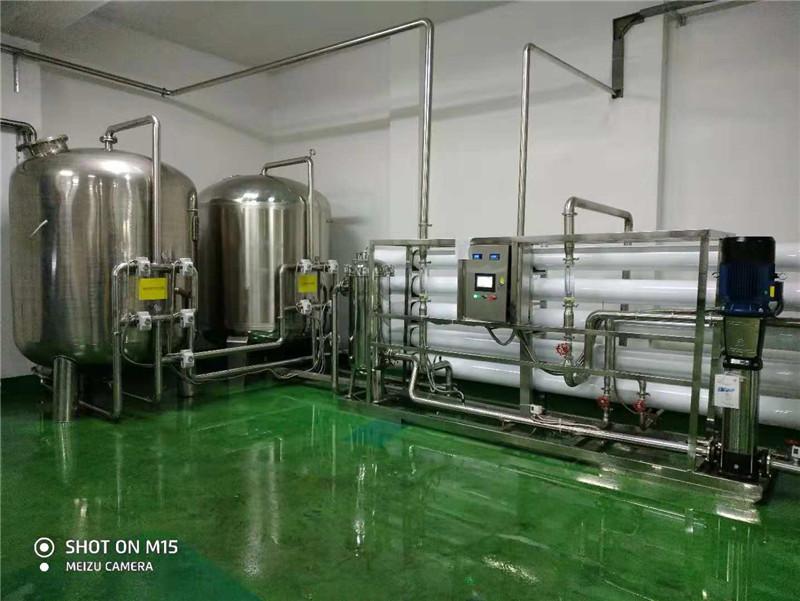
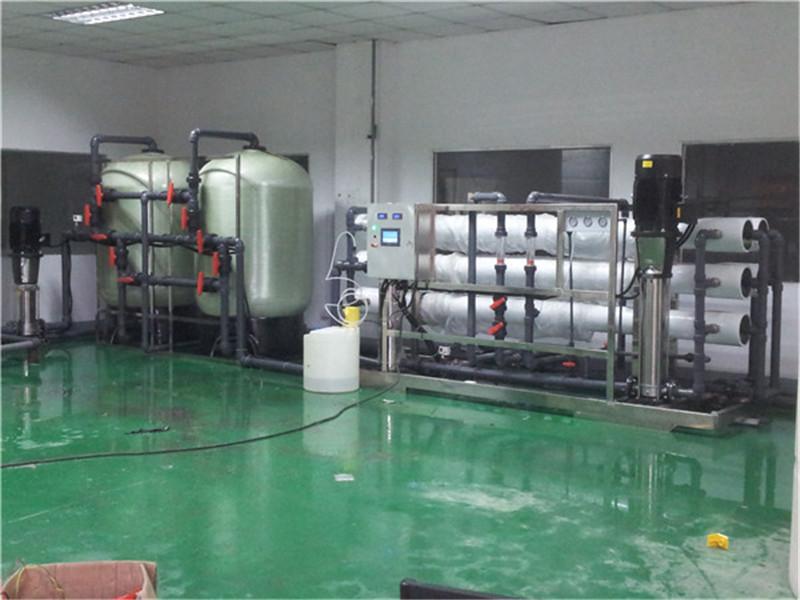
The reverse osmosis system mainly consists of multi-stage high-pressure pumps, reverse osmosis membrane elements, membrane housings (pressure vessels), control systems, and support structures. Its primary function is to remove impurities from water, ensuring the product water meets usage requirements. Multi-stage centrifugal high-pressure pumps elevate the feed water pressure to the operating pressure of the RO system, then evenly distribute it to the pressure vessels. The water flows through the reverse osmosis membranes, separating into two streams within the pressure vessels. One stream becomes purified water, while the remaining inorganic salts and solid impurities are retained and concentrated, forming the concentrate (brine), thus achieving the separation of inorganic salts from water. Purified water flows out from each pressure vessel containing the reverse osmosis membrane elements, converges, passes through a flow meter, and then exits the equipment outlet into the pure water tank. The concentrate is discharged from the brine outlet of the pressure vessel, either discarded or collected for other uses. The desalination mechanism of reverse osmosis membranes: The surface of the semi-permeable membrane is covered with extremely fine pores, and the membrane selectively adsorbs a layer of water molecules, while salt solutes are repelled. The higher the valence of the ion, the farther it is repelled. Under the driving force of reverse osmosis pressure, water molecules around the pores flow out as pure water through the capillary action of the membrane, achieving desalination. When the pore size exceeds the range of reverse osmosis membrane pores, salt solutions leak through the membrane, with monovalent salts leaking more, divalent salts less, and trivalent salts even less. The pore size of RO membranes is at the nanoscale, capable of filtering out bacteria, various viruses such as influenza and meningitis viruses, and even pyrogens. Nanofiltration is a membrane-based liquid separation technology situated between reverse osmosis and ultrafiltration. Nanofiltration can remove solutes with a molecular weight of around 0.001 micrometers. 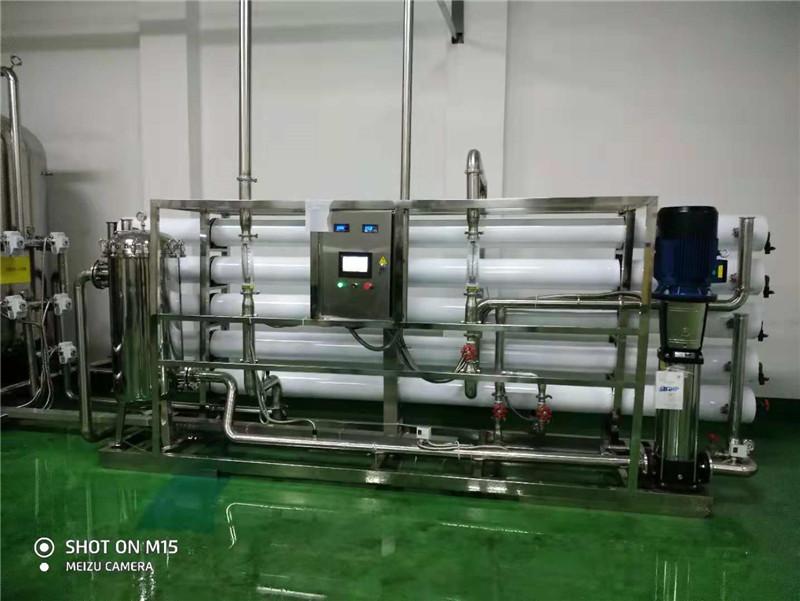
| Industry Category | Environment/Raw Water Treatment Equipment/Reverse Osmosis Equipment |
|---|---|
| Product Category | |
| Brand: | 达方 |
| Spec: | DFRO-1000L |
| Stock: | 10 |
| Manufacturer: | 安徽达方环保设备有限公司 |
| Origin: | 113417 |


