


Submersible Jet Aerator
Contact Info
- Add:No. 8, Xiongzhou Industrial Park, Zip: 211500
- Contact: 王经理
- Tel:025-57523831
- Email:770822429@qq.com
Other Products


Name: QSB Submersible Jet Aerator
Brand: Jiangsu Du'an Environmental Protection
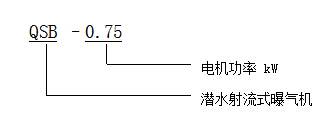
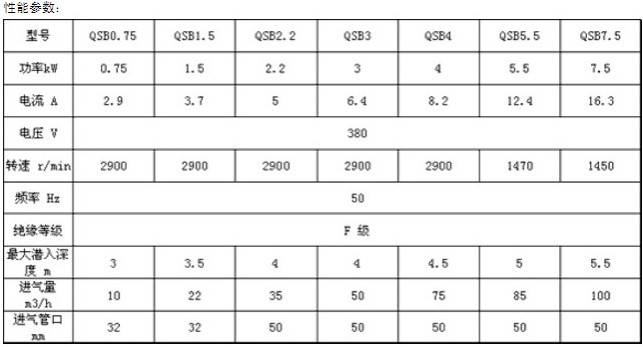
Model: QSB-7.5
Material: Cast iron casing, carbon steel aeration disc
Voltage: 380V
Motor Power: 7.5KW
Equipped with air intake pipe, silencer, bell mouth, fixing bolts, and sealing gasket
Application Scope of Jet Aerator
The QSB deep-water self-priming submersible jet aerator can operate normally and continuously under the following conditions:
1. Medium temperature not exceeding 40°C;
2. Medium pH value between 5~9;
3. Medium density not exceeding 1150kg/m³
Du'an Environmental Protection QSB Jet Aerator Technical Description:
The QSB submersible jet aerator consists of five parts: submersible pump, jet device, diffuser, air suction pipe, and hose. It combines advanced diffuser technology based on traditional jet mechanisms and adopts jet aeration methods.
Working Principle: During operation, the pump impeller, driven by the submersible motor, rotates at high speed, pushing the mud-water mixture into the jet device to form a jet stream. This creates a negative pressure zone around the jet, drawing air through the suction pipe into the jet nozzle's negative pressure area. In the throat of the jet device, air, water, and mud are fully mixed. The kinetic energy of the jet is gradually converted into pressure energy through the diffuser tube of the jet device before entering the diffuser. Inside the diffuser, the air, water, and mud mixture is further mixed, forcing the gas to undergo shearing, crushing, and emulsification, ensuring that most of the oxygen is fully dissolved in the water. Simultaneously, under the pressure of the jet fluid, the jet carries oxygen molecules and micro-bubbles, spraying obliquely downward from the diffuser nozzle and dispersing. This impacts and stirs the water body and the sludge at the bottom of the biochemical tank, gradually rising from the bottom to the surface. The micro-bubbles typically remain in the water for over 30 seconds, allowing full dissolution and absorption of oxygen from the air, improving oxygen transfer efficiency and oxygenation capacity. This equipment generates high negative pressure and intense turbulence, mixing, and shearing within the jet device, promoting high-frequency oscillation of the liquid and gas films, significantly reducing bubble diameter, increasing the number of bubbles, enlarging the specific surface area of the bubbles, and thinning the gas-liquid film. This greatly reduces mass transfer resistance, enabling better transfer of oxygen molecules from the gas phase to the liquid phase. As the jet advances at high speed, the high-speed rotation within the disperser gives it high angular velocity, resulting in strong penetration. This allows micro-bubbles to travel far in the water, enhancing mixing, flow propulsion, and oxygenation capabilities. Applicable for deep-water aeration, aeration and mixing in biochemical tanks, sludge aeration and mixing, and high-concentration organic wastewater treatment processes.

Jet Aerator Performance Description:
High Efficiency and Energy Saving
As water depth increases, the oxygenation efficiency of jet aeration also increases. The new jet aerator achieves an oxygenation efficiency of up to 35% at 8 meters depth, with an air-to-water ratio of only 4:1. Using relatively less water for the same amount of air reduces energy consumption, significantly lowering wastewater treatment costs.
Oxygen Transfer Rate
Gas is impacted and cut into extremely fine bubbles by high-speed fluid, which is one reason for the high oxygen utilization rate. The turbulence generated by the jet aerator continuously renews the gas/liquid contact surface, facilitating oxygen transfer.
The oxygen utilization rate measured for various aeration methods in oxygen-free clean water at 20°C and one atmosphere is SOTR (Standard Oxygen Transfer Rate). In actual wastewater oxygenation, the presence of large amounts of salts, COD, and SS in the wastewater causes the actual oxygen utilization rate to decrease to varying degrees. The alpha coefficient characterizes this degree of reduction. For a given wastewater, the alpha coefficient depends on the aeration device and is defined as the ratio of the oxygen utilization rate of an aeration device in the given wastewater to that in clean water. The alpha coefficient for fine bubble aeration is generally 0.4, while for jet aeration it is as high as 0.95. This is mainly due to the powerful jet fluid, which provides the energy for the gas to overcome the surface tension of the wastewater, making it easier to overcome the resistance during gas/liquid phase transfer.
Strong Applicability
The oxygenation and mixing of the jet aerator can be controlled separately. Operators can adjust the air volume based on dissolved oxygen requirements, while mixing is achieved through circulating water. Combined with manual control and DO meter automatic control, air supply can be reduced at low loads to effectively lower energy consumption while maintaining system load requirements. Maintaining mixing状态 when air supply is stopped is highly suitable for biochemical treatment systems with alternating anaerobic/aerobic cycles (such as SBR, CASS).
Equipment Installation
Jet aeration systems do not need to cover the entire pool bottom to achieve sufficient mixing, significantly saving installation time and costs.
Exhaust Gas and Water Mist
Due to high oxygen utilization and underwater installation, jet aerators do not produce water mist and foam like surface aeration equipment (surface aerators, brush aerators).
Equipment Maintenance
Jet aeration systems, with their completely different working principles and structural features compared to traditional aeration methods like fine bubble aeration, feature high-strength jet main pipes and highly wear-resistant nozzles, making them maintenance-free for life. The excellent corrosion resistance of the PP material used effectively prevents breakage,脱落, corrosion, and wear. Additionally, there are no moving parts in the pool, allowing for lifelong maintenance-free operation. For environments with high hardness, high salt, and high COD that often cause clogging and damage in fine bubble aeration and other methods, the narrowest part of the jet aeration system is the nozzle, but its inner diameter still exceeds 20mm, and this is where high-speed jetting occurs. The strong scouring action prevents scaling and crystallization from forming.
Convenient Maintenance
The ancillary equipment of the jet aeration system includes circulating water pumps and blowers. All moving parts are located outside the pool, making maintenance very convenient without the need to empty the pool.
Service Life
Thanks to its materials and structure, the jet aeration system is sturdy, wear-resistant, and corrosion-resistant, with a service life of up to 30 years or more.
WQ Submersible Sewage Pump | AS Cutter Pump | AV Scraper Suction Pump | QJB Submersible Mixer | WL Vertical Sewage Pump | WQB Explosion-Proof Sewage Pump | LS Vertical Inline Pump | Coupling Device | LB-05 Leakage Protector | NS-4 Comprehensive Protector | INT Thermal Protector | FK2 Float Switch | ZQB Submersible Axial Flow Pump | SQB Hyperboloid Mixer | QJB-W Sludge Return Pump | QJB Submersible Flow Propeller | QXB Submersible Aerator | QSB Submersible Jet Aerator | Bar Screen | Scraper Suction Machine | Prefabricated Pump Station | Frame Mixer | Paddle Mixer | Shaftless Screw Conveyor | Grit Classifier | Belt Conveyor |
| Industry Category | Others |
|---|---|
| Product Category | |
| Brand: | 杜安环保 |
| Spec: | QSB-7.5 |
| Stock: | 999 |
| Manufacturer: | 杜安环保设备(江苏)有限公司 |
| Origin: | 113201 |


