


Submersible Hyperboloid Mixer
Contact Info
- Add:No. 8, Xiongzhou Industrial Park, Zip: 211500
- Contact: 王经理
- Tel:025-57523831
- Email:770822429@qq.com
Other Products


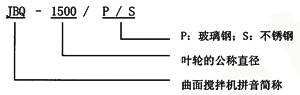
The selection of Jiangsu Du'an Environmental Protection's SGSJ/QSJ series curved surface mixers is exactly the same; the only difference between the two is the installation method. Similar to other types of mixers, the selection of curved surface mixers depends on parameters such as the pool type, volume, liquid depth, medium concentration, temperature, and pH level where the equipment is located.
The selection of curved surface mixers is primarily based on the effective service area of each unit. According to the principle that the ratio of pool length to width should not exceed two, a rectangular pool can be divided into several equal working units to determine the number of mixers required.
For water depths exceeding 5 meters or concentrations beyond the specified limits, it is advisable to increase the power or enhance the operating speed of the mixer during selection to ensure effective mixing in large-capacity and high-concentration media.
Under conventional working conditions, dry installation is recommended. For applications with noise or visual requirements, submerged installation is suggested. Our company can assist users in selecting the appropriate type for special environments.
I. Application Scope
The GSJ/QSJ series double-curved surface mixers are our company's latest developed products. They are widely used in environmental protection, chemical, energy, light industry, and other sectors where solid, liquid, and gas exchange in liquids is required. They are particularly suitable for mixing and blending in coagulation tanks, regulation tanks, anaerobic tanks, aeration tanks, nitrification and denitrification tanks in wastewater treatment processes, as well as in applications involving abrasive and high-temperature media.
II. Structural Overview
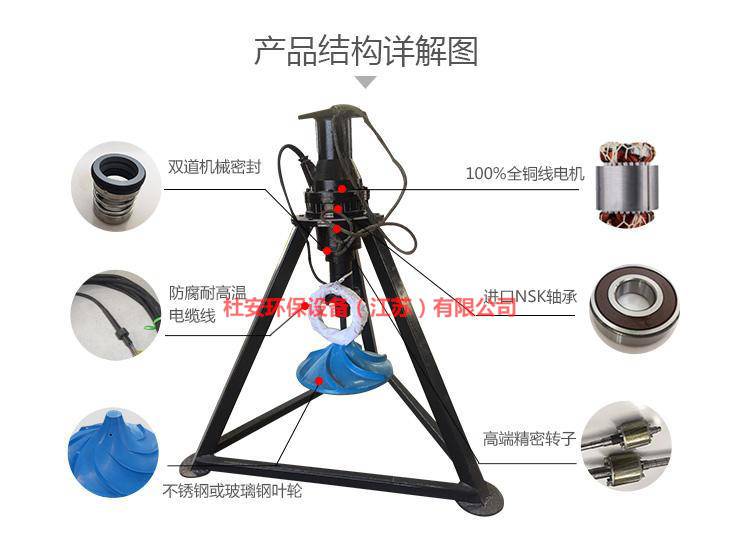
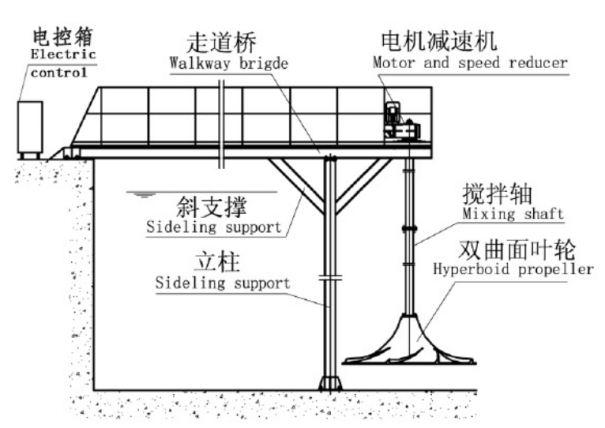
Double-curved surface mixers can be divided into two types based on installation methods: GDJ type (dry) and QDJ type (submerged).
The GSJ type double-curved surface mixer consists of a geared motor, vibration damping seat, mixing shaft, double-curved surface impeller, electrical control box, and bridge frame (which can be provided by the user). The QDJ type double-curved surface mixer consists of a frame, lifting steel cable, main unit, double-curved surface impeller, and electrical control box.
III. Transportation and Storage
1. During transportation, the mixing shaft and impeller must not be subjected to pressure or collision. Lifting equipment should be used for loading and unloading, and the impeller surface should be protected from scratches.
2. For long-term storage, avoid high-temperature and high-humidity environments. The mixing shaft should be hung vertically, and the impeller should be placed on a flat surface to prevent deformation.
IV. Installation
GDJ Series Installation Steps
1. The bridge frame should be leveled, and the bridge frame columns should be vertically aligned. Anchor bolts and connection points must be secure and reliable.
2. Place the vibration damping seat on the designated position of the bridge frame, level it, and fix it to the bridge frame.
3. Install the geared motor on the vibration damping seat and secure it.
4. Connect and fasten the impeller and mixing shaft flange with bolts.
5. Lower the impeller and mixing shaft into the pool, then connect and fasten the mixing shaft to the output shaft of the geared motor. If there is water in the pool, first connect the shaft and impeller and lower them into the water, then connect the shaft to the geared motor.
6. After installation, the mixing shaft must be perpendicular to the horizontal plane. The vertical deviation should be less than 1/1000.
7. After installation, remove the motor tail cover and manually rotate the fan blades to check if the mixer operates smoothly and normally. The swing deviation of the mixing shaft should be less than 3/1000.
8. After connecting the power supply, briefly run the mixer to observe the rotation direction of the mixing shaft. The correct rotation direction, when viewed from above, is counterclockwise. If it rotates in the opposite direction, swap any two power supply wires.
9. Electrical equipment installation must comply with national regulations and safety procedures.
QDJ Series Installation Steps
1. Briefly run the mixer on land to observe the rotation direction of the impeller. The correct rotation direction, when viewed from above, is counterclockwise. If it rotates in the opposite direction, swap any two power supply wires.
2. Separate and secure the motor cable and lifting cable. Do not bundle the cable and steel rope together. Prevent the steel rope and cable from being entangled in the impeller.
3. Use a crane to lift the double-curved surface mixer and slowly lower it into the pool at the designated position, taking care not to hit the pool walls.
4. Secure one end of the fixing rope to the bank, and connect the cable to the electrical control cabinet.
V. Operation
After installation, the equipment must undergo a trial run. Before the trial run, fill the pool with approximately 70% of its volume with water. Never operate the equipment without water, as this may cause uneven stress on the mixing shaft and lead to bending. After the trial run, check the following:
1. Whether there are abnormal noises or temperature rises in the geared motor.
2. Whether the motor current is within the rated range (a brief overcurrent during startup is normal).
3. The swing condition of the mixing shaft.
4. Whether there are any debris in the pool.
If any abnormal conditions are observed in the above aspects, identify the cause and rectify it before use.
VI. Maintenance
1. For new machines, replace the gear oil in the geared motor after 200–300 hours of operation and clean internal sludge. Subsequently, replace the oil every six months to a year. For details on geared motor usage, refer to the manufacturer's operation and maintenance manual.
2. Regularly check the tightness of the mixing shaft lock nut and all connecting bolts for looseness.
3. Regularly inspect the swing condition of the mixing shaft and promptly remove any entanglements on the impeller and shaft.
4. Regularly check for abnormal noises or temperature rises in rotating parts.
5. Regularly monitor the current for any abnormal changes.
6. Before restarting the equipment after a prolonged shutdown, check the motor's insulation. Also, prevent sediment buildup from causing difficulty in startup, which could damage the motor and impeller.
7. Keep records of all inspections. If any abnormalities occur, contact our company.
WQ Submersible Sewage Pump | AS Cutter Pump | AV Scraper Suction Pump | QJB Submersible Mixer | WL Vertical Sewage Pump | WQB Explosion-Proof Sewage Pump | LS Vertical Pipeline Pump | Coupling Device | LB-05 Leakage Protector | NS-4 Comprehensive Protector | INT Thermal Protector | FK2 Float Switch | ZQB Submersible Axial Flow Pump | SQB Double-Curved Surface Mixer | QJB-W Sludge Return Pump | QJB Submersible Propeller | QXB Submersible Aerator | QSB Submersible Jet Aerator | Bar Screen | Scraper Suction Machine | Prefabricated Pump Station | Frame Mixer | Paddle Mixer | Shaftless Screw Conveyor | Grit Classifier | Belt Conveyor |
| Industry Category | Machinery & Equipment/Other Industry-Specific Equipment/Coating Machines |
|---|---|
| Product Category | |
| Brand: | 杜安环保 |
| Spec: | G/QSJ-3000 |
| Stock: | 999 |
| Manufacturer: | 杜安环保设备(江苏)有限公司 |
| Origin: | 113201 |


