


Oxygen-enriched combustion industrial oxygen generator
Contact Info
- Add:Innovation Industrial Park, No. 198 Gaoke Road, Fuyang District, Hangzhou City, Zip:
- Contact: 李经理
- Tel:15268538866
- Email:fylcqt@163.com
Other Products


Role of Oxygen-Enriched Combustion Industrial Oxygen Generators
1. Increase Flame Temperature: Using oxygen-enriched combustion technology reduces the amount of nitrogen, significantly decreasing both air and flue gas volumes. As a result, the flame temperature rises notably with the increase in oxygen proportion in the combustion air. However, oxygen concentration should not be excessively high. Domestic and international studies indicate that when the oxygen volume fraction is around 26% to 30%, each percentage point increase in oxygen concentration raises the flame temperature by 35°C. When the oxygen volume fraction in the gas produced by the oxygen-enriched combustion device is approximately 28%, the overall furnace temperature can be effectively increased by about 50°C. Further increasing oxygen content beyond 30% results in minimal flame temperature gains, while oxygen production costs surge, making it economically unviable.
2. Accelerate Combustion Speed and Promote Complete Combustion: The combustion speed of fuels differs significantly in air versus pure oxygen. For instance, hydrogen burns 2 to 4 times faster in pure oxygen than in air, while natural gas burns about 10.2 times faster. Oxygen-enriched combustion technology not only enhances combustion speed and improves heat conduction but also raises temperatures, facilitating combustion reactions and ensuring complete combustion, thereby eliminating soot pollution at its source.
3. Lower Ignition Temperature of Fuels: The ignition temperature of fuels is not constant. For example, carbon monoxide ignites at 609°C in air but only at 388°C in pure oxygen. Thus, oxygen-enriched combustion enhances flame intensity and increases heat release.
4. Reduce Post-Combustion Flue Gas Emissions: When using air for combustion, nitrogen, which constitutes about 4/5 of the volume, does not participate in combustion and carries away substantial heat energy. Oxygen-enriched gas combustion reduces exhaust gas volume, thereby improving combustion efficiency.
5. Increase Heat Utilization Efficiency: Oxygen-enriched combustion technology improves heat utilization. For instance, with ordinary air combustion at a heating temperature of 1300°C, utilizable heat is 42%, whereas with 26% oxygen-enriched air, it rises to 56%. Heat utilization increases rapidly with oxygen concentration in the range of 21% to 30%, leading to better energy-saving effects within this oxygen concentration range.
6. Decrease Excess Air Coefficient: As oxygen content in the air increases with oxygen-enriched combustion, nitrogen volume decreases, allowing for a reduction in the excess air coefficient. This correspondingly lowers fuel consumption, conserving energy. Additionally, oxygen-enriched combustion technology reduces the ignition point of carbon, ensuring complete and intense combustion with improved flame fullness and higher overall furnace temperature. The heat radiated by an object is proportional to the fourth power of its temperature.
Applications of Oxygen-Enriched Combustion Industrial Oxygen Generators
1) Industrial Furnaces and Kilns: Glass furnaces, ceramic kilns, cement kilns, hot blast stoves, heating furnaces, incinerators, smelting furnaces, etc.
2) Various Boilers: Chain grate boilers, spreader stoker boilers, pulverized coal boilers, oil and gas boilers, etc.
Principle of Oxygen-Enriched Combustion Industrial Oxygen Generators
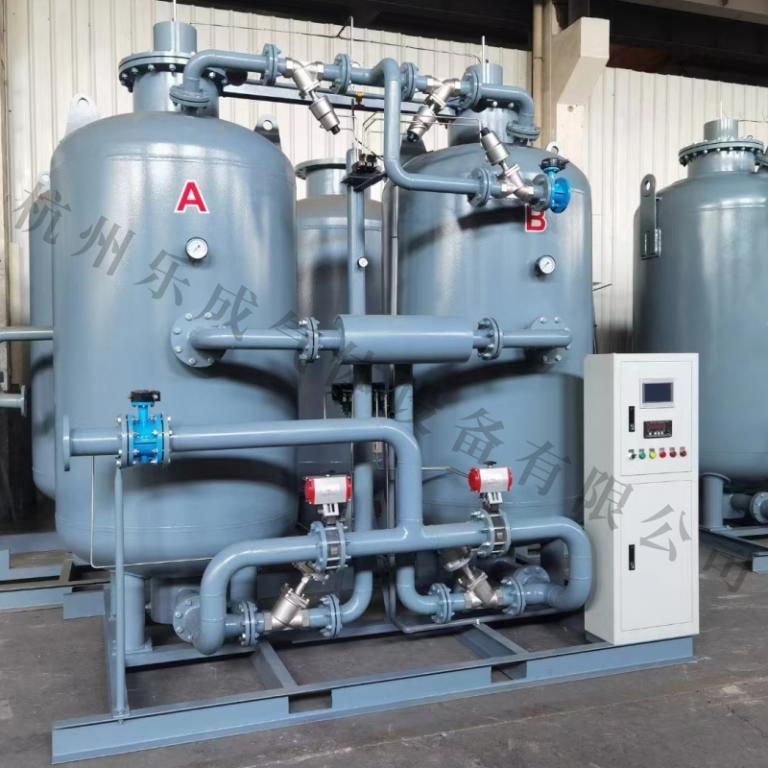
Industrial oxygen generators use zeolite molecular sieve as the adsorbent, employing the principle of pressure swing adsorption (PSA) to adsorb and release oxygen from air, thereby separating oxygen automatically. Zeolite molecular sieve is a spherical, white granular adsorbent with numerous micropores on its surface and interior, processed through special pore-forming techniques. Its pore characteristics enable kinetic separation of O2 and N2. The separation is based on the slight difference in kinetic diameters of O2 and N2 molecules. N2 molecules diffuse faster in the micropores of zeolite molecular sieve, while O2 molecules diffuse more slowly. Water and CO2 in compressed air diffuse at rates similar to nitrogen. Ultimately, oxygen molecules are enriched and released from the adsorption tower. PSA oxygen generation leverages the selective adsorption properties of zeolite molecular sieve, using cycles of pressurization for adsorption and depressurization for desorption, allowing compressed air to alternately enter adsorption towers for air separation and continuous production of high-purity oxygen. PSA oxygen generators produce oxygen from air under certain pressures using high-quality zeolite molecular sieve as the adsorbent, based on the pressure swing adsorption principle.
| Industry Category | Machinery & Equipment/Engineering & Construction Machinery/Other Engineering & Construction Machinery |
|---|---|
| Product Category | |
| Brand: | 乐成气体 |
| Spec: | LCO |
| Stock: | 100 |
| Manufacturer: | 杭州乐成气体设备有限公司 |
| Origin: | 113301 |


