


Nitrogen Generator for Fire Extinguisher Refilling
Contact Info
- Add:Innovation Industrial Park, No. 198 Gaoke Road, Fuyang District, Hangzhou City, Zip:
- Contact: 李经理
- Tel:15268538866
- Email:fylcqt@163.com
Other Products


Nitrogen generators are widely used in the industrial field and are also applicable to fire protection systems. Because the nitrogen produced by nitrogen generators possesses special chemical properties—nitrogen is an inert gas with low chemical reactivity and is unlikely to react with open flames—it can effectively extinguish fires, making it suitable for firefighting purposes. In fire protection systems, nitrogen produced by nitrogen generators can be applied in nitrogen fire extinguishers, nitrogen generator fire suppression systems, and fire sprinkler pipeline systems, all with significant effectiveness.
Nitrogen Generator for Filling Nitrogen Fire Extinguishers
The nitrogen produced by nitrogen generators can be used to fill nitrogen fire extinguishers. Nitrogen fire extinguishers are also known as IG100 fire extinguishers, which can be used in various settings such as computer rooms, data centers, libraries, museums, and other locations. Since nitrogen does not combust, it will not burn in the presence of an open flame at any concentration. 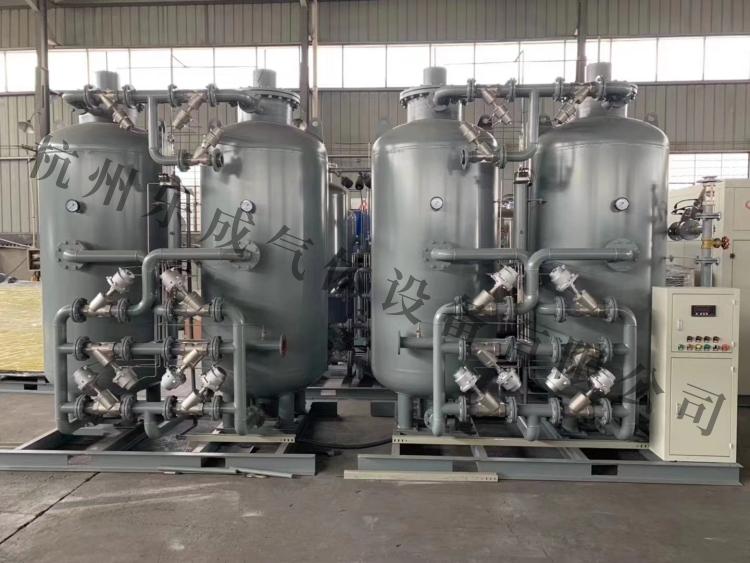
Working Process of Nitrogen Generator for Fire Extinguisher Filling
1. Air Intake: The air compressor pushes air at a certain pressure into the delivery pipeline, which then passes through a compressed air purification system to remove moisture, oil, dust, and other impurities. The purified air reaches the air buffer tank and is then delivered to two adsorption towers.
2. Adsorption: When air enters the adsorption towers, under pressure, oxygen and carbon dioxide are rapidly adsorbed. Nitrogen becomes enriched near the gas outlet inside the tower.
3. Gas Output: When the adsorption process reaches a specific point (where the adsorption ratio of nitrogen to oxygen is minimal), the gas output valve opens, and the finished nitrogen is delivered to the nitrogen buffer tank.
4. Pressure Equalization: After the exhaust process is completed, there is still a certain pressure and purity of nitrogen mixture inside the tower. It would be wasteful to discharge it, so it is directly released into the other adsorption tower to undergo re-adsorption along with the incoming air. This process ends when the pressures in both towers equalize, hence it is called pressure equalization.
5. Exhaust: After pressure equalization is completed, the gases adsorbed by the molecular sieve in the tower need to be released to prepare for the next adsorption cycle. The program automatically opens the exhaust valve, returning the tower pressure to its initial state and discharging all gases (oxygen and carbon dioxide) adsorbed by the molecular sieve, allowing the molecular sieve to regain its ability to adsorb new air.
6. The two adsorption towers work alternately to continuously produce nitrogen with a purity of 99.99% to meet demand.
| Industry Category | Safety & Security/Fire Protection Equipment/Other Fire Protection Equipment |
|---|---|
| Product Category | |
| Brand: | 杭州乐成气体设备有限公司 |
| Spec: | LCN-A |
| Stock: | 100 |
| Manufacturer: | 杭州乐成气体设备有限公司 |
| Origin: | 113301 |


