


HSW Photoelectric Float Level Gauge Liquid Level Meter
Contact Info
- Add:Building 15, 1st Floor, Unit 15#02, Phase I of Liandong U Valley-Xuzhou Economic and Technological Development Zone Intelligent Manufacturing Park, Xuzhou Economic and Technological Development Zone, Zip:
- Contact: 高经理
- Tel:0516-87939789
- Email:2811207280@qq.com
Other Products


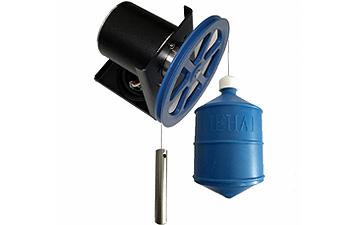
The HSW float-type level gauge is a digital sensor integrating optical, mechanical, and electronic technologies. Through photoelectric conversion, it transforms the angular displacement of the output shaft into corresponding digital quantities, enabling high-precision measurement of liquid level height and absolute position confirmation. It features a power-off memory function.
Its working principle is as follows: the water level sensor measuring wheel is mounted on the encoder input shaft, with one end of the steel wire rope connected to the float and the other end to the counterweight, wound around the measuring wheel. When the liquid level changes, the float rises or falls accordingly, driving the measuring wheel to rotate via the steel wire rope, and the encoder outputs the corresponding real-time water level value.
This sensor has a rational structure, strong anti-interference capability, high resolution, large measuring range, long service life, and a signal tracking memory function after power loss. It can be used for long-term liquid level measurement while ensuring stable and reliable performance.
It is widely applicable for water level measurement of surface water or groundwater in rivers, lakes, reservoirs, ship locks, hydropower stations, hydrological stations, water plants, and petrochemical industries.
II. Main Technical Specifications:
1. Basic Parameters
a. Measuring range: 20 meters with a measuring wheel circumference of 320; 40 meters with a measuring wheel circumference of 640
b. Water level change rate: < 100 cm/min
c. Resolution: 1 mm
d. Starting torque of water level wheel: < 100 g·cm (0.0098 N·m)
e. Measurement accuracy: ≤ ±2 cm or 0.2% F·S
2. Mechanical Parameters
a. Working circumference of water level wheel: 32 cm / 64 cm
b. Measuring cable: Φ0.8 mm plastic-coated stainless steel cable
c. Float diameter: 10 cm or 15 cm (other sizes customizable)
3. Electrical Parameters
a. Gray code output: 16-bit
b. Output form: Open-collector (OC) gate
4. Communication Interface (Optional)
a. Gray code output (B)
b. RS485 interface: MODBUS-RTU protocol (M)
c. 4–20 mA analog signal output (A)
5. Operating Environment
a. Ambient temperature: -25°C to 85°C
b. Relative humidity: <95% (at 40°C)
d. Power supply voltage: 12–24 VDC
III. Working Principle of Float Water Level Gauge
Instrument Structure and Working Principle:
This instrument consists of a float, steel wire rope, counterweight, measuring wheel, sensor, bracket, output socket, and other components.
The working principle is as follows: the instrument uses the float to sense water level changes. During operation, the float and counterweight are securely connected by the steel wire rope, which is suspended in the "V"-shaped groove of the water level wheel. The counterweight tightens the steel wire rope and balances the system. Adjusting the float's counterweight allows it to operate at the normal waterline. When the water level is constant, the forces on both sides of the float and counterweight are balanced. When the water level rises, the float generates upward buoyancy, causing the counterweight to pull the steel wire rope and rotate the water level wheel clockwise, increasing the sensor's reading. When the water level falls, the float sinks, pulling the steel wire rope and rotating the water level wheel counterclockwise, decreasing the sensor's reading.
The water level wheel of this series of sensors has a measuring circumference of 32 cm and is coaxially connected to the sensor. Each rotation of the water level wheel corresponds to one full rotation of the sensor, outputting 1024 sets of digital codes. As the water level rises or falls, the sensor's shaft rotates a certain angle, synchronously outputting a corresponding set of digital codes (binary cyclic code, also known as Gray code). Instruments of different measuring ranges can output 65,535 sets of distinct codes, suitable for measuring water level variations of 10 to 20 meters.
The encoded signals can be transmitted via a multi-core cable connected to the instrument socket to an electronic display or computer in the observation room for monitoring, recording, or data processing. Water level gauges equipped with an RS485 digital communication interface can directly connect to communication devices or computers, forming hydrological automatic monitoring systems or hydrological satellite telemetry systems.
The built-in RS485 digital communication interface (optional) features addressing and gating functions, enabling long-distance information transmission via a two-wire system. A single pair of twisted signal wires can drive or receive multiple water level (or gate position) sensors, facilitating remote monitoring networking.
Installation and Calibration of Float Water Level Gauge
(1) Secure the instrument to the working platform using four M5×20 screws. Ensure the float and counterweight maintain a certain distance from the inner wall of the measuring well.
(2) Thread one end of the Φ0.8 mm stainless steel wire rope through the counterweight wire hole from above the working platform.
(3) Fix and lock the counterweight to the steel wire rope, then slowly lower the counterweight to the bottom of the well.
(4) Wind the other end of the steel wire rope around the "V"-shaped groove of the water level wheel, leaving a reserve of 1.2 meters before cutting.
(5) Thread the steel wire rope through the float wire hole, secure it to the float suspension cap, insert a rubber pad into the suspension cap, and then tighten the float cap onto the float.
(6) Slowly lower the float into the measuring well until it contacts the water surface.
(7) Check steps (1) to (7). If everything is normal, tighten the two fastening screws of the water level wheel.
(8) Calibration: Gently lift the steel wire rope with your fingers to slightly disengage it from the water level wheel, then rotate the water level wheel until the output water level value matches the actual water level value. Slowly release the steel wire rope to ensure the actual water level and the data received by the upper device are consistent. Observe water level changes on-site or in the observation room. If everything functions normally, the installation and calibration are complete.
| Industry Category | Instruments & Meters/Level Instruments/Level Measurement Instruments |
|---|---|
| Product Category | |
| Brand: | 徐州海河 |
| Spec: | HSW |
| Stock: | 38 |
| Manufacturer: | 徐州海河水文设备有限公司 |
| Origin: | 113203 |


