


Low-voltage withdrawable switchgear
Contact Info
- Add:Chuangxin Avenue, Lingkong Economic Zone, Xiaogan City, Hubei Province, Zip:
- Contact: 秦阳
- Tel:13871361728
- Email:sales@hbgydq.com
Other Products


>>Product Introduction
The GCS type low-voltage withdrawable switchgear is suitable for power distribution systems in industries such as power plants, petroleum, chemical, metallurgy, textiles, and high-rise buildings. In large power plants, petrochemical systems, and other places with high automation requirements and the need for computer interfaces, it serves as a low-voltage complete power distribution device for three-phase AC frequencies of 50(60)Hz, rated operating voltages of 400V and 660V, and rated currents up to 5000A in power generation and supply systems for distribution, centralized motor control, and reactive power compensation.
The design of the device complies with the following standards: IEC439-1 "Low-voltage switchgear and controlgear assemblies" and GB7251 "Low-voltage switchgear and controlgear assemblies".
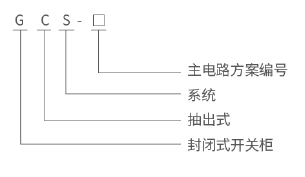
>>Model Meaning
>>Operating Conditions
◇The ambient air temperature should not exceed +40°C and should not be lower than -5°C. The average temperature within 24 hours should not exceed +35°C. If exceeded, derated operation should be implemented based on actual conditions;
◇For indoor use, the altitude of the installation site should not exceed 2000m;
◇The relative humidity of the surrounding air should not exceed 50% at the highest temperature of +40°C. Higher relative humidity is allowed at lower temperatures, such as 90% at +20°C. Consideration should be given to the occasional formation of condensation due to temperature changes;
◇When installing the device, the inclination relative to the vertical plane should not exceed 5°, and the entire cabinet row should be relatively flat (in compliance with the GBJ232-82 standard);
◇The device should be installed in a location free from severe vibration and impact, and where electrical components are not subject to undue corrosion;
◇If the user has special requirements, they can be resolved through consultation with the manufacturer.
>>Main Technical Parameters
Basic technical parameters are shown in Table 1
|
No. |
Name |
Parameter |
|
|
1 |
Rated voltage of main circuit (V) |
AC 400/660 |
|
|
2 |
Rated voltage of auxiliary circuit |
AC 220, 380(400); DC 110, 220 |
|
|
3 |
Rated frequency (Hz) |
50(60) |
|
|
4 |
Rated insulation voltage (V) |
660 |
|
|
5 |
Rated current (A) |
Horizontal busbar |
≤5000 |
|
|
Rated current (A) |
Vertical busbar (MCC) |
1000 |
|
6 |
Rated short-time withstand current of busbar (kA/1s) |
50, 80 |
|
|
7 |
Rated peak withstand current of busbar (kA/0.1s) |
105, 176 |
|
|
8 |
Power frequency test voltage (V/1min) |
Main circuit |
2500 |
|
|
|
Auxiliary circuit |
2000 |
|
9 |
Busbar |
Three-phase four-wire system |
A.B.C.PEN |
|
|
|
Three-phase five-wire system |
A.B.C.PE.N |
|
10 |
Protection level |
IP30, IP40 |
|
◆Main Circuit Schemes
The GCS cabinet has 32 groups and 118 specifications of main circuit schemes, excluding derived schemes and specifications due to changes in auxiliary circuit control and protection. It meets the needs of power generation, power supply, and other power users, with a rated operating current of 5000A, suitable for distribution transformers up to 2500kVA. Additionally, capacitor compensation cabinets are designed to improve power factor, and reactor cabinets are designed for comprehensive investment needs.
◆Auxiliary Circuit Schemes
The GCS auxiliary circuit diagram set includes 120 auxiliary circuit schemes, divided into two volumes. The first volume, "AC Operation Section," contains 63 schemes, and the second volume, "DC Operation Section," contains 57 schemes. The DC operation schemes are mainly used in low-voltage plant (substation) systems of power plants and substations. They are suitable for low-voltage plant systems of units with capacities up to 200MW and above 300MW, general control methods for working (standby) power incoming lines, power feeders, and motor feeders.
The AC operation schemes are mainly used in low-voltage systems of substations in industrial and mining enterprises and high-rise buildings. There are six combined schemes suitable for dual-power operation control. They include control circuits for electrical interlocking, automatic standby switching, and automatic recovery, which can be directly adopted in engineering design.
The control power supply for DC is 220V or 110V, and for AC is 380V or 220V. For cabinets composed of drawer units, the 220V control power is derived from a dedicated control transformer within the cabinet. The common control power supply uses an ungrounded control transformer, with a 24V power supply reserved for use with weak signal lights when needed.
The installation location of energy meters, the method of introducing voltage signals, and other installation and usage requirements are detailed in the "Compilation Instructions" of the auxiliary circuit diagrams.
◆Main Busbar
To improve the dynamic and thermal stability of the busbar and reduce the temperature rise of contact surfaces, the equipment uses TMY-T2 series hard copper bars with full-length tin plating. Full-length silver-plated copper busbars are also available as an option.
◇Horizontal and vertical busbars are installed in separate busbar isolation chambers within the cabinet.
◇Neutral grounding busbars use hard copper bars. They贯通 horizontal neutral grounding lines (PEN) or grounding + neutral lines (PE+N).
◆Selection of Electrical Components
The GCS cabinet primarily uses electrical components with stable technical performance and high indicator values, which are domestically produced using introduced technology.
◇Main Switch
For power incoming and feeder switches of 630A and above, the DW45 series is primarily selected. The DW48 series, AE series, 3WE or ME series can also be chosen. If necessary, imported M series or F series switches may be used.
◇For feeder and motor control switches below 630A, the TG series, CM1 series, NM series, CDM series, TG30 series, and other molded case switches are mainly selected.
◇To enhance the dynamic stability of the main circuit, dedicated combined busbar clamps and insulating supports for the GCS series are designed. They are made of high-strength, flame-retardant synthetic materials through thermoplastic molding, offering high insulation strength, good self-extinguishing properties, and a unique structure.
◇To reduce the temperature rise of partition plates, connectors, and cable heads in functional units, dedicated transfer pieces for the GCS cabinet are designed. These transfer pieces have large capacity and lower temperature rise.
◇If design departments choose new electrical components with better performance and more advanced technology based on user needs, the GCS series cabinet's good versatility ensures no difficulties in manufacturing and installation due to component updates.
Table 2
|
Dimensions (mm) |
||||
|
Cabinet height (H) |
2200 |
|
|
|
|
Cabinet width (D) |
400 |
600 |
800 |
1000 |
|
Cabinet depth (W) |
8001000 |
8001000 |
6008001000 |
6008001000 |
Table 3
|
No. |
Name |
Tolerance (mm) |
|
|
1 |
Verticality |
|
3.3 |
|
2 |
Horizontality |
Adjacent two cabinets top |
2 |
|
|
|
Entire row of cabinets top |
5 |
|
3 |
Flatness |
Adjacent two cabinet edges |
1 |
|
|
|
Entire row of cabinet edges |
5 |
|
4 |
Cabinet joint gap |
|
2 |
>>Installation and Use
After the product arrives at the delivery location, first check if the packaging is intact and undamaged. If any issues are found, promptly notify the relevant contract departments to make a commercial record, jointly analyze the cause, and handle the evidence and aftermath. For products not installed immediately, they should be stored in an appropriate place according to normal usage conditions and the temporary storage regulations for electrical equipment.
◆Product installation should be carried out according to the installation diagram. Base channel steel and bolts for bolt fixation should be provided by the user. When connecting the main busbar, if the surface is uneven due to transportation or storage, it should be leveled before tightening.
◆When installing the equipment individually or in a row, the verticality, cabinet surface flatness, and cabinet gap deviations should comply with Table 3.
◆Inspection and testing before putting the product into operation after installation:
◇Check if the cabinet surface paint or other coating materials (such as spray plastic) are damaged, and if the cabinet interior is dry and clean.
◇Check if the operating mechanisms of electrical components are flexible, without jamming or excessive operating force.
◇Check if the switching of main electrical components is reliable and accurate.
◇Drawers or withdrawable mechanisms should pull out flexibly, easily, without jamming or collision.
◇The centerlines of moving and stationary contacts in drawers or withdrawable structures should be aligned, and contact should be tight. The insertion depth of main and auxiliary contacts should meet requirements. Mechanical or electrical interlock devices should operate correctly, and locking or releasing should be reliable.
◇Drawers with identical primary schemes, secondary principles, and drawer dimensions should be easily interchangeable without jamming or collision.
◇When replacing fuse links, they should comply with engineering design requirements.
◇Protection setting values should be correctly set based on actual load.
◇Measure insulation resistance with a 1000V megohmmeter; it should not be lower than 10MΩ.
◇All busbar connections should be good; insulating supports, installation parts, and other accessories should be firmly and reliably installed.
◆Usage Precautions
◇The equipment is a low-voltage distribution cabinet for front operation and double-sided maintenance, not to be installed against a wall. The maintenance passage and cabinet door should only be accessed or opened by qualified professionals for operation, inspection, and maintenance.
◇After multiple operations, especially after short-circuit breaking and closing, air circuit breakers and molded case circuit breakers may have locally burned contacts and carbon deposits, increasing contact resistance. Maintenance and repair should be performed according to the circuit breaker's instruction manual.
◇After installation and maintenance, strictly check the isolation between compartments and functional units to ensure good functional separation of the device and prevent fault expansion.
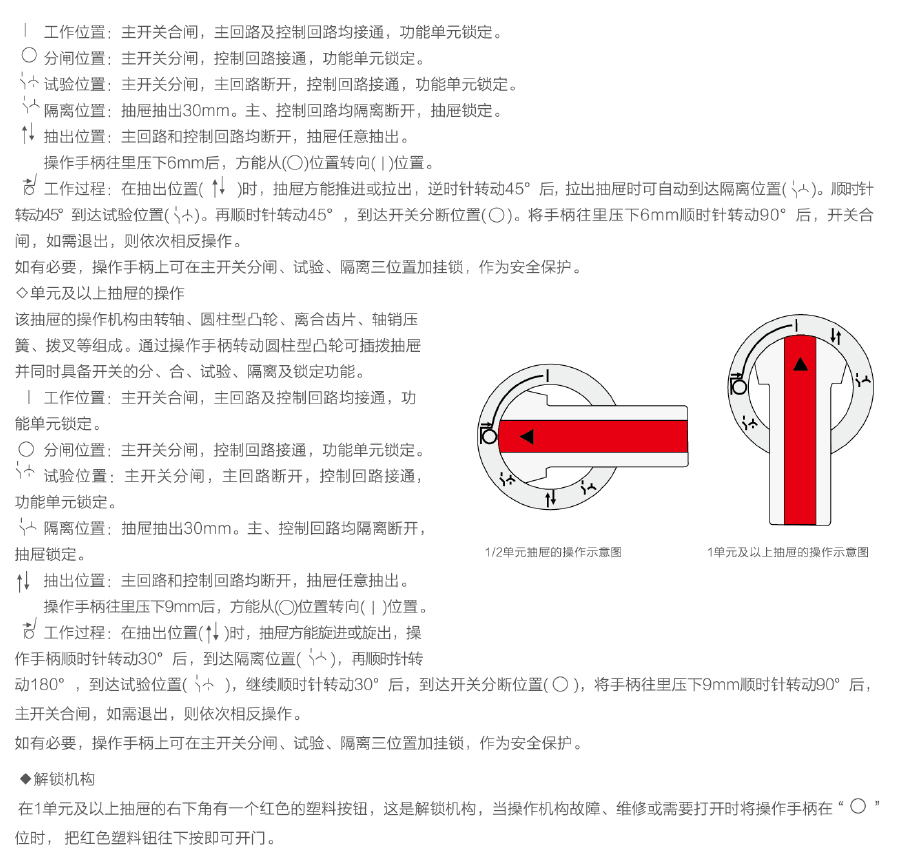
◆Drawer Operation
◇Operation of 1/2 Drawer
The operating mechanism of this drawer consists of rotating parts, shafts, locks, etc., with functions for switch on/off, test, isolation, and locking. The operating mechanism is also equipped with microswitches for electrical interlocking.
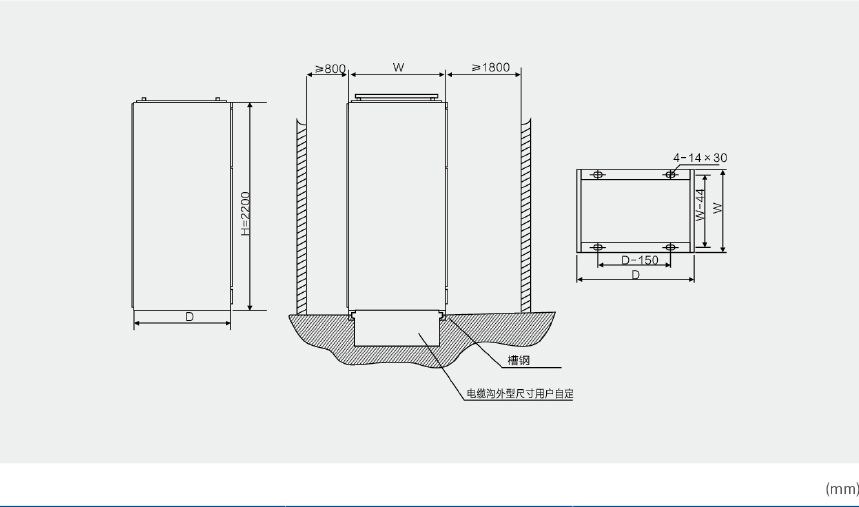
>>Outline and Installation Dimensions
|
Cabinet width (D) 6008001000 |
Cabinet depth (W) 8001000 |
Cabinet height (H) 2200 |
>>Delivery Documents and Accessories
◆The manufacturer should provide the following documents and accessories upon delivery:
◇Packing list
◇Product certificate and factory test report
◇Instruction manual
◇Relevant electrical drawings
◇Main component manuals
◇Cabinet door keys, operating handles, and spare parts as specified in the contract
>>Ordering Instructions
◆When ordering, the user should provide:
◇Main circuit distribution system diagram and layout plan, rated operating voltage, rated operating current, protection device setting current, and necessary technical parameters.
◇Specify the specifications of incoming and outgoing cables.
◇The model, specifications, and quantity of main electrical components in the switchgear.
◇If busbar bridges or bus ducts are required between switchgear or for incoming cabinets, specify specific data such as span and height from the ground.
◇If the switchgear is used in special environmental conditions, provide detailed descriptions when ordering.
◇The surface color of the switchgear and other specific requirements.
| Industry Category | Electrical Equipment & Supplies/Power Distribution & Transmission/Power Distribution Cabinets |
|---|---|
| Product Category | |
| Brand: | |
| Spec: |


