


Drying cylinder machine Babbitt metal tin-based alloy bearing bush bearing sleeve casting processing
Contact Info
- Add:Li Zhai Xiao Zhuang Village, Zhangzhuang Township, Shangshui County, Zhoukou City, Henan Province, Zip: 466100
- Contact: 张粉
- Tel:15938614066
- Email:hnhcjsclmyyxgs@sohu.com
Other Products


Casting and renovation of dryer machine sliding bearing bush and bushing. The difference between sliding bearings and rolling bearings: rolling bearings use balls as a medium to reduce resistance and support rotation; sliding bearings rely on the clearance of the bush to reduce resistance and support rotation. In sliding bearings, the bush and liner directly cooperate with the journal.
Details
Casting and renovation of Babbitt alloy bush and bushing for dryer machine sliding bearings. The difference between sliding bearings and rolling bearings: rolling bearings use balls as a medium to reduce resistance and support rotation; sliding bearings rely on the clearance of the bush to reduce resistance and support rotation. In sliding bearings, the bush and liner are directly used in conjunction with the journal, resulting in friction between them, and they also need to withstand alternating loads and impact loads. Since the shaft is an important component of the machine, with complex manufacturing processes, high cost, and difficulty in replacement, to ensure minimal wear on the journal, the hardness of the bush should be much lower than that of the journal. If necessary, the worn bush can be replaced while the shaft continues to be used. [Performance]: Sufficient compressive strength and fatigue resistance; good anti-friction properties (low friction coefficient); good ability to reserve lubricating oil; excellent running-in properties; good thermal conductivity and corrosion resistance; good processability for easy manufacturing. No single material can meet all the above performance requirements simultaneously. Sliding bearing alloys can be cast onto low-carbon steel or copper bush backings using casting methods to create bimetallic bearings. Bearing alloys should combine both soft and hard properties: (1) a soft matrix with uniformly distributed hard particles, or (2) a hard matrix with distributed soft particles. During operation, the soft parts wear down first, creating depressions that can store lubricating oil and form a continuous oil film, while the hard parts support the journal. This significantly reduces the actual contact area between the bearing and the journal, thereby reducing friction. [Materials]: (1) Tin-based bearing alloys: Tin-based bearing alloys are alloys based on tin, with added elements such as antimony, copper, nickel, and cadmium. Their advantages include excellent plasticity, thermal conductivity, and corrosion resistance, as well as low friction and expansion coefficients, making them suitable for important bearings such as high-speed bushes in large machines like turbines, engines, and compressors. The disadvantages are low fatigue strength and a lower operating temperature (not exceeding 150°C). Common grades include: ZChSnSb11-6, ZChSnSb8-8, ZChSnSb8-4, etc. Tin-based Babbitt alloys offer good compliance, anti-seizure properties, wear resistance, corrosion resistance, vibration damping, pressure resistance, and good embeddability. They are composed of tin, antimony, copper, and lead. The fusion of tin and copper forms acicular structures, while the fusion of antimony and tin forms crystalline structures. With proper proportions and appropriate temperatures, the structure is uniform and fine. The common tin-based alloy ZChSnSb11-6 has a chemical composition of antimony 10-12%, copper 5.5-6.5%, and the remainder tin. (2) Lead-based bearing alloys: These are alloys primarily based on lead, with added elements such as antimony, tin, copper, cadmium, calcium, silver, and tellurium. Lead-based bearing alloys have lower strength, hardness, thermal conductivity, and corrosion resistance compared to tin-based bearing alloys, and they also have a higher friction coefficient. They are suitable for manufacturing bushes under medium and low loads, such as in crushers, dryer machines, pulpers, cold rolling mills, and railway vehicle bearings. Henan Huachuang specializes in the production and processing of Babbitt alloys.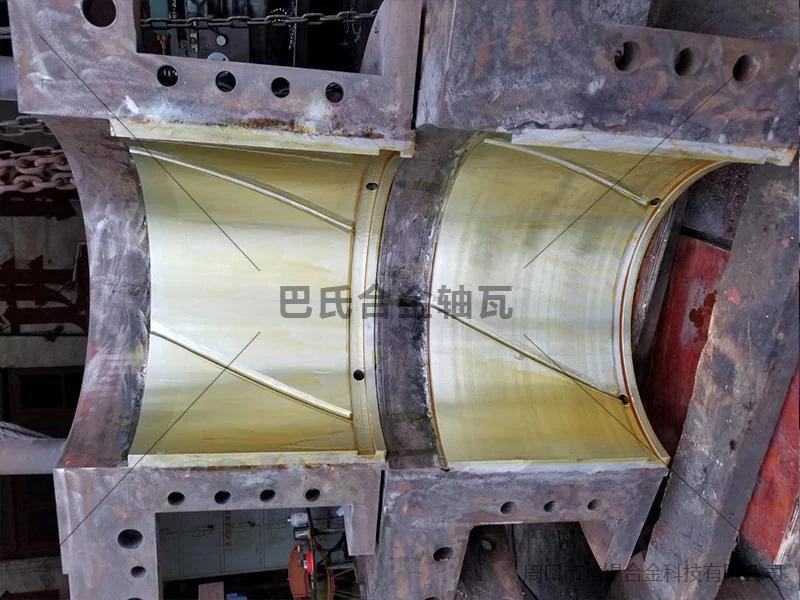
| Industry Category | Chemicals/Chemical Intermediates/Intermediate Compounds |
|---|---|
| Product Category | |
| Brand: | 桦创 |
| Spec: | 桦创 |
| Stock: | 80000 |
| Manufacturer: | 河南桦创 |
| Origin: | 114116 |


