


Microwave High Temperature Roller Hearth Kiln
Other Products


Microwave High-Temperature Roller Hearth Kiln
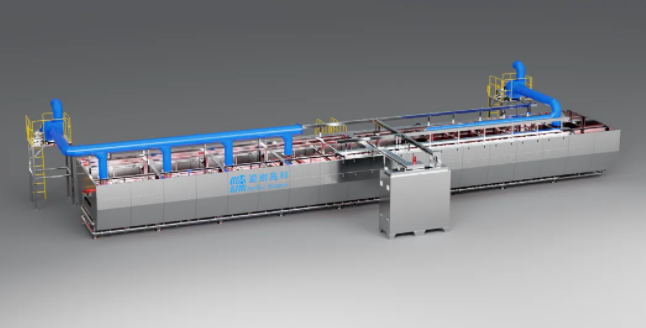
As a high-tech enterprise dedicated to the research and development of processes and equipment in the materials field, Innov Source Technology has always adhered to the philosophy of "Originating from Technology, Equipping China." It has successfully introduced multiple innovative material preparation processes and equipment across various industrial sectors.
The microwave high-temperature roller hearth kiln features high efficiency, energy savings, and environmental friendliness. Compared to traditional heating methods, it significantly enhances overall product quality, improves production efficiency, and offers high automation levels with simple operation, greatly reducing labor costs.
I. Product Features:
1. Rapid and Uniform Heating: Due to the unique heating mechanism of microwaves, which act directly on the interior of materials, it ensures uniform heating throughout the material.
2. Precise Temperature Control: The sintering of battery materials requires high temperature control accuracy. The microwave high-temperature roller hearth kiln can precisely control the temperature during heating, ensuring materials undergo phase transitions and chemical reactions at specific temperatures and times to achieve desired physical and chemical properties.
3. High Efficiency and Energy Savings: It saves over 20% more energy compared to traditional heating kilns. Compared to conventional gas kilns, the energy saving rate (converted to standard coal) exceeds 40%, and compared to conventional resistance heating kilns, the electricity saving rate exceeds 20%.
4. Improved Product Yield: Since microwaves are not limited by the shape and size of objects and provide uniform heating, the product yield can be significantly increased.
5. Environmentally Friendly and Pollution-Free: Microwave equipment does not produce pollutants such as smoke, exhaust gases, or wastewater, contributing to reduced environmental pollution and enabling green production.
6. Enhanced Material Performance: Microwave heating allows materials to reach high temperatures in a short time, facilitating rapid sintering and crystallization, thereby improving material properties.
7. High Automation Level: Easy to operate, user-friendly, safe, reliable, and simple to maintain and repair.
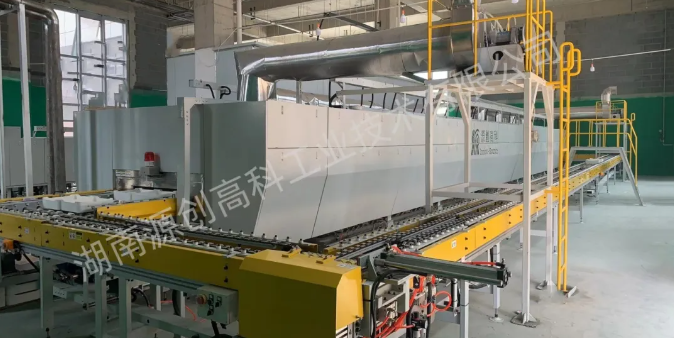
II. Product Parameters (Customized according to customer requirements):
Maximum Operating Temperature: 1300°C
Process Temperature: 1250°C
Temperature Measurement Method: Thermocouple
Temperature Control Method: Digital Display, Automatic Control
Microwave Leakage Intensity: ≤2mW/cm²
Number of Sagger Columns: 4 columns
Applicable Atmospheres: Air, nitrogen, and other protective atmospheres
III. ProductApplication Scope(Customized according to customer requirements):
1. Sintering of Lithium Battery Cathode Materials: Lithium cobalt oxide, lithium manganese oxide, ternary materials, lithium iron phosphate, and other cathode materials;
Treatment of Lithium Battery Anode Materials: Graphite coating heat treatment;
Synthesis of Solid Electrolytes: Oxide solid electrolyte synthesis;
2. Sintering of Magnetic Materials: Nickel-zinc ferrite;
3. Sintering of Electronic Ceramic Powders: BaTiO₃, SrTiO₃ powders, etc.;
4. Other Materials: Impurity removal from synthetic diamonds, heating decomposition and oxidation of minerals, oxidative roasting of petrochemical molecular sieves, sintering of daily-use ceramics, impurity removal from metal oxides, etc.;
5. Customizable according to customer requirements.
IV. Overview and Background
As the core of new energy technology, the manufacturing process of lithium batteries is crucial to their performance. The sintering process (such as cathode material, anode material, and separator coating sintering) is a key step in production that affects material density, crystal phase structure, and electrochemical performance. As a continuous sintering equipment, roller hearth kilns are mainly divided into microwave roller hearth kilns and electric heating roller hearth kilns for comparison. This article systematically compares the two from multiple dimensions, including heating principles, energy efficiency, process applicability, and cost, to provide reference for lithium battery manufacturers in equipment selection.
V. Comparison of Working Principles
Dimension | Microwave Roller Hearth Kiln | Electric Heating Roller Hearth Kiln (Resistance Heating) |
Heating Mechanism | Directly acts on the polar molecules of the material (e.g., H₂O, Li compounds) through the microwave electromagnetic field, causing high-frequency vibration to generate heat. | Relies on resistance wires or silicon carbide rods for heating, indirectly heating the material through thermal radiation and conduction. |
Energy Transfer Path | Volumetric heating with strong penetration, enabling simultaneous heating inside and outside the material. | Gradient heating from surface to core, with thermal conduction efficiency limited by the material's thermal conductivity. |
Temperature Uniformity | Temperature Control: Reasonable configuration of microwave power distribution and precise adjustment of microwave power. When the microwave field is evenly distributed, the temperature difference inside the material can be controlled within ±5°C. | Relies on precise zonal temperature control, but temperature differences may exceed ±5°C due to heating element layout and insulation design. Uniformity: Highly dependent on heat source distribution; surface temperature field is uniform, but internal temperature gradients may exist. Temperature Control: Mature process with simple zonal temperature control technology, suitable for stable process requirements. |
Process Cycle | Volumetric heating combined with non-thermal effects can reduce the heating and holding cycle by 1/2 to 2/3. The cooling cycle remains similar. | Heating and cooling speeds are limited by the thermal inertia of resistance elements, requiring longer process times. |
VI. Energy Consumption and Operational Efficiency
Dimension | Microwave Roller Hearth Kiln | Electric Heating Roller Hearth Kiln |
Energy Consumption | Significant overall energy savings. Microwave energy acts directly on the material, reducing ineffective heat loss and shortening the process cycle. Comprehensive energy savings of approximately 20%~30%. | Energy loss occurs during radiation, conduction, and prolonged constant temperature processes. |
VII. Process Applicability
Dimension | Microwave Roller Hearth Kiln | Electric Heating Roller Hearth Kiln |
Material Adaptability | Requires materials with high dielectric constants (e.g., LiCoO₂, NCM cathode materials). Materials that reflect microwaves should be avoided. Suitable for high dielectric loss materials, nano-scale powders, solid electrolytes, and high-nickel/high-compaction density requirements. | High versatility, suitable for all lithium battery materials requiring high-temperature treatment, such as graphite anodes and ceramic separators. |
Sintering Quality | The non-thermal effects of microwaves play a unique role in material synthesis, significantly influencing reaction kinetics, crystal structure, and product performance through direct interaction with the material's electromagnetic field (without relying on thermal conduction or radiation). The microstructure is more uniform, contributing to improved battery energy density and cycle life. Microwave synthesis can reduce impurity phases and improve crystallinity. For example, microwave-synthesized lithium iron phosphate (LiFePO₄) particles are uniform and fine, with a 30% improvement in rate performance. Rapid sintering of Li₇La₃Zr₂O₁₂ (LLZO) ceramic sheets reduces lithium volatilization. | Under conventional processes, material homogeneity depends on temperature curve optimization, with risks of surface overheating or incomplete core reactions. |
VIII. Equipment Structure, Maintenance, and Cost
Dimension | Microwave Roller Hearth Kiln | Electric Heating Roller Hearth Kiln |
Core Components | Magnetron, waveguide, resonant cavity, high-precision reflection suppression device. | Resistance heating elements (silicon carbide rods or alloy wires), insulation layer, temperature control sensors, transmission system. |
Maintenance Difficulty | Microwave generator lifespan is about 5,000~8,000 hours, requiring periodic magnetron replacement. | Silicon carbide rods need replacement every 6-12 months, with an average lifespan of 8 months. |
Initial Investment | Cost is about 1.5 times that of an electric heating roller hearth kiln. | / |
Operational Cost | 20-30% lower than that of an electric heating roller hearth kiln. | / |
With its high energy efficiency, short process time, and excellent material performance, the microwave roller hearth kiln shows great potential in high-end lithium battery material manufacturing. The electric heating roller hearth kiln, with its mature technology, strong adaptability, and low investment threshold, dominates the mid-to-low-end market. As microwave technology costs decrease in the future, the two may coexist complementarily, jointly advancing lithium battery manufacturing toward high efficiency and low carbon emissions.
| Industry Category | Machinery & Equipment/Electric Heating Equipment/Medium Frequency Power Supplies |
|---|---|
| Product Category | |
| Brand: | |
| Spec: | |
| Origin: | 114301 |


