


Electric Dynamometer
Contact Info
- Add:Room 101, Building C, Jinxing Village West Science and Technology Park, Yuhang Street, Yuhang District, Zip: 311121
- Contact: 刘晓梅
- Tel:13758209206
- Email:sales@hzchangniu.com
Other Products


Product Introduction:
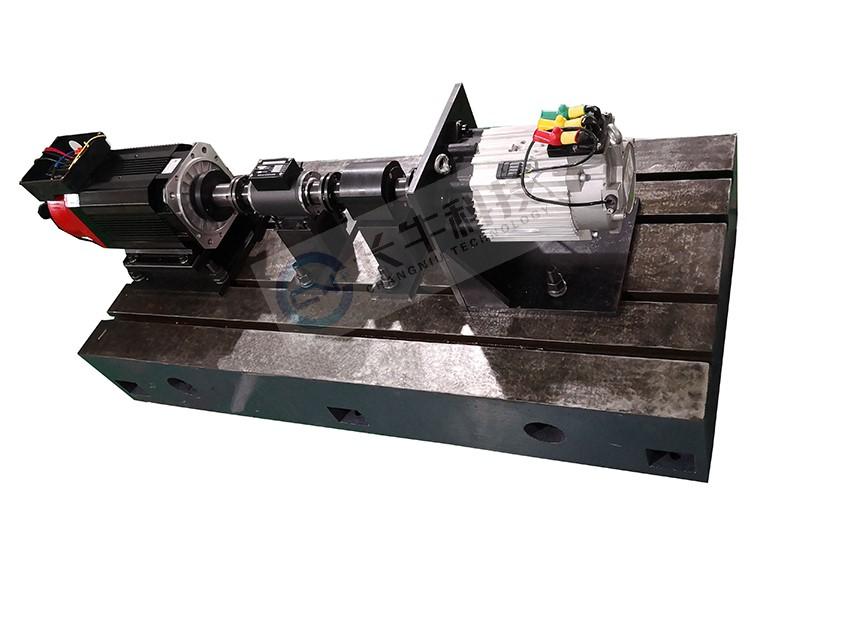
The electric dynamometer test system adopts AC variable frequency regenerative loading, where the loading energy is fed back to the grid through the AC load generator; torque and speed are directly measured via a torque sensor; electrical parameters such as current, voltage, frequency, and power factor are detected by a comprehensive electrical measurement instrument; the computer automatically detects, displays, and completes data processing, reports, and various curves. It is a device used to measure the torque output from the shaft of various power machinery using an electric motor, combined with speed to determine power. Since the measured power machinery may operate at different speeds, the motor used as an electric dynamometer must be capable of smooth speed regulation. Electric dynamometers are divided into DC electric dynamometers and AC electric dynamometers, with AC electric dynamometers being more commonly used today.
1. Test Items: Based on customer testing requirements, this test system can perform the following tests on motors
1) No-load Test: According to GB/T1032, tests are conducted under rated sine wave conditions, adjusting voltage for testing. The computer collects data, fits curves, and determines windage and friction losses as well as iron losses.
2) Locked-rotor Test: According to GB/T1032, tests are conducted under rated sine wave conditions, adjusting voltage for testing. The computer collects data, fits curves, and determines locked-rotor current and locked-rotor torque.
3) Load Test: According to GB/T1032, tests are conducted under rated sine wave conditions, adjusting load for testing. The computer collects data, fits curves, and determines current, voltage, power, efficiency, frequency, slip, etc.
4) Temperature Rise Test: According to GB/T1032, tests are conducted under rated sine wave conditions, adjusting load for testing. The user's original bridge is used to manually measure armature resistance, while the computer collects data and fits the temperature rise curve.
5) M-S Curve: (Determination of maximum torque and minimum torque): The torque measurement method is used. If conditions such as power supply and load capacity permit, the M-S curve can be plotted to complete the test.
Note: For large motors, the M-S curve can be plotted using high-speed data acquisition during the startup process. However, due to the high rate of speed change during startup, the impact torque and impact current are correspondingly large. Therefore, special attention must be paid to preventing destructive damage to the torque sensor and power grid. Generally, this is not recommended.
For large motors, reduced-voltage testing can be used to collect data, and the computer can fit the curve to complete the testing of minimum and maximum torque.
For medium and large motors, according to the GB1032 standard, maximum torque can also be determined using the circle diagram method.
To complete locked-rotor and M-S curve tests, the following test conditions must be met:
a) Sufficient power supply capacity: at least 4–7 times the motor's rated current.
b) The test load must be capable of stable loading across high and low speed ranges.
c) Considering the testing of maximum torque conditions, it is generally recommended that the load motor's maximum torque be about three times the rated power of the motor under test. Therefore, the load motor's rated power should also be three times that of the motor under test. Similarly, the torque sensor range should be selected to be at least three times the rated torque of the motor under test.
d) The load motor's rated speed should not be lower than the rated speed of the motor under test. At the same speed, its rated power should not be less than that of the motor under test but preferably not exceed 10 times that of the motor under test.
e) Pay attention to the pole number of the motor under test: For example, if the load motor has 4 poles and an 8-pole motor is being tested, the power of the motor under test will be halved. This pattern applies similarly.
f) The test bench must have sufficient mechanical strength.
2. System Functions
1) The system is designed according to GB/T1032, GB9651, and GB 12350 (current effective versions).
2) Capable of performing Method A and Method E tests to calculate iron loss, windage and friction loss, copper loss, stray loss, etc.
3) The system can perform no-load tests, locked-rotor tests, temperature rise tests, load tests, and maximum/minimum torque tests on single- and three-phase asynchronous motors.
4) The system can display the motor's three-phase voltage, three-phase current, input power, frequency, power factor, torque, speed, output power, and efficiency in real time.
5) The system can automatically identify and display positive and negative torque.
6) The system can automatically store test data.
7) The system can analyze and process no-load test results to obtain no-load current, no-load power, iron loss, and mechanical loss, and generate curves.
8) The system can analyze and process load test results to obtain full-load current, full-load power, full-load efficiency, full-load slip, and full-load power factor, and generate curves.
9) The system can analyze and process locked-rotor test results to obtain locked-rotor current and locked-rotor torque, and generate curves.
10) The system can generate real-time T-n curves for asynchronous motors and automatically identify maximum and minimum torque.
11) During testing, if bad data points are collected, deletion and reinsertion for retesting are allowed.
12) The system has a memory function for various parameter settings, requiring input only once.
13) The system can print test results, including data and curves, via a printer.
14) The system allows one-time clamping and one-click operation for any test item.
15) The system can automatically collect the three-phase resistance at the motor terminals according to the set program.
16) The system can automatically collect temperatures such as ambient temperature and motor surface temperature.
17) The system can automatically adjust the voltage of the variable frequency power supply (or voltage regulator) via computer.
18) The system can automatically adjust the load of the motor under test via computer.
19) During load testing, based on the rated parameters of the motor under test, the variable frequency power supply automatically powers the motor under test to operate at no-load rated conditions before entering the loading process. The load system can automatically control the loading process and load magnitude. According to relevant motor testing standards, the load system automatically completes the loading process for the motor under test while measuring parameters such as voltage, current, power, power factor, torque, speed, and output power. Based on the measured parameters and relevant standards, it automatically calculates the motor's load parameters and generates relevant curves.
20) During temperature rise testing, when the motor under test reaches its rated load (which can be based on current or torque), the load is held constant. As the motor heats up and its characteristics change, the load system automatically performs closed-loop control based on the measured parameters, tracking changes to maintain a constant load. When the motor under test reaches thermal equilibrium (criteria must be provided), the system automatically or manually unloads according to set conditions, automatically or manually shuts off the power, quickly measures hot resistance, and automatically calculates the motor's temperature rise value based on the previously entered motor rated parameters and relevant standards, completing the test.
21) During locked-rotor testing, the variable frequency power supply automatically starts supplying power from zero voltage, slowly increasing the voltage while monitoring the current. When the current multiple specified by the standard is reached, the voltage is automatically reduced. Parameters such as voltage and current are measured simultaneously, and the locked-rotor curve and calculated data are automatically generated.
3. Technical Specifications
1) Voltage measurement range: AC 0–500V
2) Current measurement range: Depends on the current transformer
3) Electrical parameter measurement accuracy (voltage, current, power, etc.): ±0.5%
4) Torque measurement range: Depends on the torque sensor
5) Torque measurement accuracy: ±0.5%
6) Speed measurement range: Depends on the speed sensor
7) Speed measurement accuracy: ±1 rpm
8) Resistance measurement range: 0–20 kΩ
9) Resistance measurement accuracy: ±0.2%
10) Temperature measurement range: 0–100°C
11) Temperature measurement accuracy: ±0.1°C
12) Torque control accuracy: ±2%
II. Equipment Composition and Technical Parameters
1. Test Power Supply
The test power supply is configured according to customer needs with different types and sizes of power supplies.
1. It is recommended to equip a variable frequency power supply, which can automatically set different output voltages via computer and automatically compensate for voltage drops at the motor terminals. Alternatively, a high-power voltage regulator can be equipped.
2. Sufficient power supply capacity is required: Locked-rotor tests and M-S curve tests require at least 4–7 times the motor's rated current. Therefore, the test power supply is selected as 3 kVA; the provided current is 3 kVA/660 = 4.5 A. If the starting current of the motor under test exceeds this, reduced-voltage starting is required.
2. High-Power Section
1) High-power cabinet: PLC, current transformers, and contactors form the range conversion system.
2) Motor starting generally requires soft starting, especially for large motors.
3) Test stations generally have low power factors, so it is recommended to equip power factor compensation devices.
4) The laboratory site must be equipped with reliable grounding and five-wire power supply according to electrical standards. All electrical devices, instruments, computers, and sensors must be reliably grounded.
5) Power cables and motor cables are to be prepared by the user based on site requirements or can be configured by us.
3. Load System
Uses an AC electric dynamometer to complete loading tasks for 200–1000 W, 0–3000 rpm.
1) Loading controller: ABB ACS-800
2) Loading motor:
Different load motors are configured based on the specifications of the motor under test. The basic configuration is as follows:
3 kW, 3000 rpm, 57.3 N·m, capable of meeting the needs of various tests for 200–1000 W motors.
4. Torque, Speed, and Output Power Measurement:
Torque measurement uses strain-gauge torque sensors, which exhibit consistent torque characteristics at high and low speeds and in both forward and reverse directions. They do not require additional small motors, are easy to use, especially for zero adjustment, and offer good stability. Different-sized motors require sensors of different ranges to ensure accuracy.
1) Torque measurement:
a) Torque measurement range: Select several torque sensors of different ranges based on the motor under test.
b) Torque measurement accuracy: ±0.2% (F.S.)
c) Output signal: Frequency output (conventional ordering method)
Pulse signal amplitude: 0–10 V
Zero torque: Approximately 10 kHz
Forward full scale: Approximately 15 kHz
Reverse full scale: Approximately 5 kHz
Specific sensor details are provided in the factory calibration report.
d) Overload capacity: Accurate measurement within 120% of rated torque. Instantaneous impact should not exceed 300% of rated torque to avoid damaging the sensor.
2) Speed measurement: The strain-gauge torque sensor has a built-in photoelectric speed sensor suitable for speed measurement at high and low speeds.
a) Speed range: 0–5000 rpm
b) Speed signal pulses: 60 pulses per revolution.
c) Pulse signal amplitude: 0–10 V.
d) Speed measurement accuracy: 0.1% ±1 digit
5. Electrical Parameter Measurement
1) AC transformers: To ensure measurement accuracy for various motor tests and test items, it is recommended to use multiple-range AC electrical transformers to improve accuracy for different-sized motors. Current transformers have a standard output of 5 A. Different-sized motors and different tests can be configured with transformers of different ranges to ensure measurement accuracy.
2) AC electrical instrument: Measures AC current, voltage, active power, reactive power, power factor, power frequency, etc.; 232 interface; measurement accuracy: ±0.5% FS
3) AC single-phase current and voltage transformers + transmitters + A/D fast acquisition; voltage + transmitter + A/D fast acquisition for rapid acquisition as required by tests.
6. Armature Resistance Measurement: Manually clamped and measured, with data automatically collected by the computer for temperature rise curve fitting.
7. Temperature Measurement: Uses temperature sensors + temperature acquisition modules to measure ambient temperature, core temperature, and shell temperature, automatically input into the computer.
8. Computer, Software System, and Operation Control Cabinet:
1) Torque, speed, current, voltage, power, power factor, power frequency, temperature, resistance, etc., are automatically collected via 485/232 interfaces. The computer performs data processing, display, reporting, curve fitting, printing, etc.
2) The asynchronous motor computer test system software is developed according to GB-1032 and completes no-load tests, locked-rotor tests, load tests, temperature rise tests, etc., automatically generating data reports and curves. The operation interface is in Chinese, and test reports are in Chinese and English. The report format is determined by the requester; parameters not automatically collected by the computer (e.g., vibration, noise) can be manually input.
3) The M-S curve test system software completes the testing and curve plotting of asynchronous motor M-S curves when the test bench and power supply capacity permit. This software can also be used to complete other transient and steady-state tests and their curve tests.
| Industry Category | Others |
|---|---|
| Product Category | |
| Brand: | 长牛科技 |
| Spec: | |
| Stock: | 99 |
| Manufacturer: | 杭州长牛科技有限公司 |
| Origin: | 113301 |


