


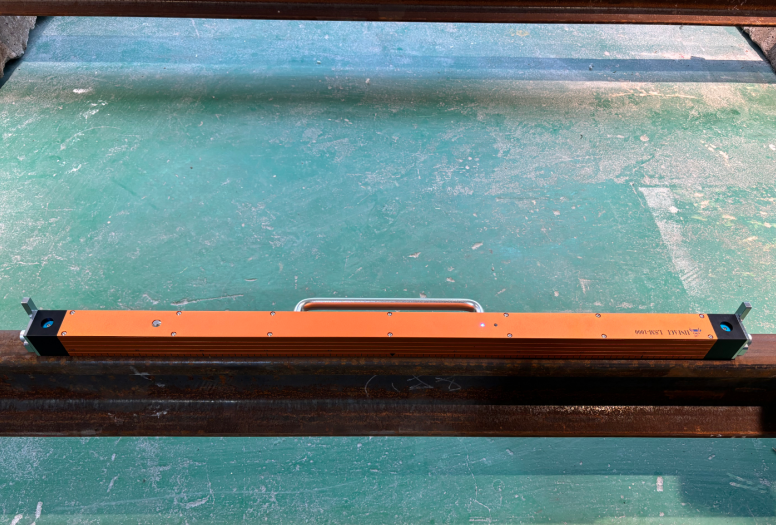
Rail Straightness Measuring Instrument LJ-ZDY-1000
Other Products


I. Overview
A flatness measuring instrument is a specialized device used for accurately measuring the flatness of an object's surface. In various industrial fields, such as mechanical manufacturing, metal processing, and building material production, ensuring the flatness of products is a critical factor for guaranteeing product quality, performance, and the smooth progress of subsequent assembly tasks. As a result, flatness measuring instruments have emerged to meet this need.
II. Measurement Principles
1. Optical Principles
• Laser Interferometry
• Utilizes the coherence of laser light. The laser beam emitted from the source is split into a reference beam and a measurement beam. The measurement beam is directed onto the surface of the object being measured, and after reflection, it interferes with the reference beam. If the surface is ideally flat, the interference fringes are regular; if there are surface irregularities, the interference fringes will bend or deform. By analyzing the shape, spacing, and phase changes of the interference fringes, the surface irregularities can be precisely calculated.
• Light Reflection Principle
• The instrument emits a beam of parallel light (which can be from a conventional light source or a laser source) onto the surface being measured. When the surface is perfectly flat, the reflected light returns along a specific direction and is captured by a receiver. If the surface has undulations, the direction of the reflected light changes. The receiver detects variations in the angle, intensity, etc., of the reflected light to determine the surface irregularities. For example, in some light reflection-based flatness measuring instruments using the triangulation principle, the height difference is calculated by measuring the angular change between the reflected and incident light, thereby determining the surface flatness.
2. Mechanical Contact Principle
• Employs a high-precision probe that makes contact with the surface of the object being measured. As the probe moves along the surface, it undergoes vertical displacement when encountering surface irregularities. Sensors (such as inductive, capacitive, or strain gauge sensors) convert the probe's displacement into electrical signals, which are then amplified and processed to ultimately obtain flatness data. This method is suitable for measuring relatively rough surfaces or situations where higher measuring force is required to ensure good contact between the probe and the surface.
III. Product Features
1. High Precision
• Capable of measuring irregularities with micron or even nanometer-level accuracy, which is crucial for high-precision products such as aerospace components and precision optical lenses. The use of high-precision optical components, advanced sensor technology, and precise mechanical structures ensures the accuracy of measurement results.
2. High Resolution
• Offers high resolution when measuring small-scale variations in flatness. For instance, when measuring minor undulations on the surface of electronic circuit boards, it can clearly distinguish height differences of a few microns, helping to detect subtle surface defects and improve product quality.
3. Multiple Measurement Modes
• Supports single-point measurement, multi-point measurement, or continuous scanning measurement. Single-point measurement is suitable for checking flatness at specific locations; multi-point measurement collects flatness data from multiple discrete points on the surface to analyze the overall flatness distribution; continuous scanning measurement comprehensively maps the flatness profile of the surface, making it ideal for inspecting large-area surfaces.
4. Non-Contact Measurement (Some Models)
• Non-contact measuring instruments based on optical principles do not cause scratches, wear, or contamination to the measured surface during the process. This is particularly advantageous for measuring soft, fragile, or high-precision surfaces, such as optical films and semiconductor chip surfaces.
5. Real-Time Measurement and Data Processing
• Capable of displaying measurement data in real time during the process and supports data storage and analysis. Some advanced instruments can also compare measurement results with preset standard values and automatically issue alerts when tolerances are exceeded, enabling operators to promptly adjust production processes.
• In railway construction and maintenance, it ensures the precise measurement of track flatness, guaranteeing smooth and safe train operation. In automotive manufacturing, it measures the flatness of components such as frames and body shells, enhancing the overall quality of vehicles.
| Industry Category | Instruments & Meters/Specialized Instruments/Geological & Seismic Instruments |
|---|---|
| Product Category | |
| Brand: | 襄阳聚高测控 |
| Spec: | |
| Stock: | 1000 |
| Origin: | 114206 |


