


Wuxi Liangke Valve Integrated High-Temperature Ball Valve
Contact Info
- Add:No. 32 Chengnan Road, Zip:
- Contact: 殷德坤
- Tel:15261666917
- Email:1819666917@qq.com
Other Products


Working Principle of Ball Valves: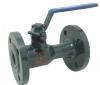
The ball valve features a 90-degree rotation action, with the plug body being a sphere that has a circular through-hole or passage along its axis. In pipelines, ball valves are primarily used for cutting off, distributing, and changing the flow direction of the medium. They only require a 90-degree rotation and a small torque to achieve a tight seal. Ball valves are most suitable for on/off and shut-off applications, but recent developments have designed them for throttling and flow control, such as V-type ball valves.
The main characteristics of ball valves include a compact structure, reliable sealing, simple design, easy maintenance, and sealing surfaces that are often in a closed state, making them less susceptible to erosion by the medium. They are easy to operate and maintain, suitable for general working media such as water, solvents, acids, and natural gas, as well as harsh conditions like oxygen and hydrogen peroxide. They are widely used across various industries. The valve body can be either integral or modular.
Classification and Features of Ball Valves:
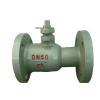
Ball valves include manual ball valves, electric ball valves, pneumatic ball valves, high-pressure ball valves, high-temperature ball valves, three-way ball valves, insulated ball valves, low-temperature ball valves, threaded ball valves, flanged ball valves, welded ball valves, wafer ball valves, butt-weld ball valves, ferrule ball valves, clamp ball valves, floating ball valves, fixed ball valves, hard-seal ball valves, soft-seal ball valves, socket-weld ball valves, stainless steel ball valves, etc.
1. Floating Ball Valve
The ball in a floating ball valve is free to move. Under the pressure of the medium, the ball can shift slightly and press tightly against the sealing surface at the outlet end, ensuring a seal, such as in the hard-seal floating manual flanged ball valve Q41H. Floating ball valves have a simple structure and good sealing performance, but the entire load from the working medium is transferred to the outlet sealing ring. Therefore, the material of the sealing ring must withstand the working load of the ball medium. Under high-pressure impact, the ball may shift. This design is generally used for medium and low-pressure ball valves.
2. Fixed Ball Valve
The ball in a fixed ball valve is stationary and does not move under pressure. Fixed ball valves come with floating valve seats that shift under medium pressure, pressing the sealing ring against the ball to ensure a seal. Bearings are typically installed on the upper and lower shafts of the ball, resulting in low operating torque, making them suitable for high-pressure and large-diameter valves.
To reduce operating torque and enhance sealing reliability, oil-sealed ball valves have emerged in recent years. Special lubricating oil is injected between the sealing surfaces to form an oil film, improving sealing and reducing operating torque, making them more suitable for high-pressure and large-diameter ball valves.
3. Elastic Ball Valve (Orbital Ball Valve)
The ball in an elastic ball valve is flexible. Both the ball and the valve seat sealing ring are made of metal materials, requiring a high sealing pressure. The medium's own pressure is insufficient to achieve sealing, so external force must be applied. This type of valve is suitable for high-temperature and high-pressure media.
The elastic ball is achieved by cutting an elastic groove on the inner wall of the ball. When closing the passage, the wedge-shaped head of the valve stem expands the ball to press against the valve seat for sealing. Before rotating the ball, the wedge-shaped head is released, allowing the ball to return to its original shape, creating a small gap between the ball and the valve seat to reduce friction and operating torque.
4. V-Type Ball Valve
This type of ball valve is a fixed ball valve and also a single-seat sealing ball valve. It has excellent regulating performance among ball valves, with a flow characteristic that is equal percentage and an adjustable ratio of up to 100:1, such as in the hard-seal floating manual flanged ball valve Q41H. The V-shaped notch and metal valve seat have a shearing effect, making it particularly suitable for media containing fibers, fine solid particles, slurries, etc.
5. Three-Way Ball Valve
Three-way ball valves come in T-type and L-type. The T-type can interconnect three orthogonal pipelines and cut off the third channel, serving分流 and合流 functions. The L-type can only connect two orthogonal pipelines and cannot simultaneously maintain the interconnection of the third pipeline, serving only a distribution function.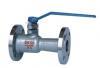
| Industry Category | Machinery & Equipment/Valves/Ball Valves |
|---|---|
| Product Category | |
| Brand: | 良科 |
| Spec: | QJ41M-16 |
| Manufacturer: | 无锡良科阀门科技有限公司 |
| Origin: | 113202 |


