


Wireless Water Leak Sensor
Other Products


In substation cable chambers, equipment rooms, and other locations, water immersion due to equipment leaks or rainfall frequently occurs, posing risks to the safe operation of equipment. The wireless water immersion sensor is another installation application capable of real-time online monitoring of whether the sensor's installation location (site) is flooded (or has accumulated water), and it uploads water immersion information to the control host via a data transmission base station in real time to achieve monitoring and alarm purposes. Under normal conditions, the water immersion sensor transmits wireless signals at 60-second intervals. When its status changes, it transmits wireless signals three times consecutively at 6-second intervals. The signal indicating the status change is then uploaded to the control host via the data transmission base station. Based on the sensor ID, the control host can determine where the status change and alarm occurred, as well as the time of the status change. Below is a complete solution design for the wireless water immersion sensor, covering technical selection, networking solutions, installation specifications, and typical application scenarios:
I. Core Requirements Analysis
Parameter Requirements
Detection Method Contact/Non-contact
Alarm Threshold Water level ≥1mm (adjustable)
Wireless Transmission Range Indoor 50m, Outdoor 200m (line-of-sight)
Protection Rating IP67 (water immersion protection)
Battery Life ≥3 years (low-power mode)
II. Sensor Technical Selection
1. Detection Principle Comparison
Type Principle Pros and Cons
Electrode Type Detects conductivity between electrodes Low cost, susceptible to electrolytic corrosion
Optical Type Infrared reflection detects water surface reflection Non-contact, resistant to contamination, high cost
Capacitive Type Detects changes in dielectric constant Can be installed hidden, requires calibration
Recommended Solution:

Conventional Scenarios: Electrode type (304 stainless steel electrodes with gold plating for corrosion resistance)
High-Reliability Scenarios: Optical type (e.g., Sensirion SHT40 + infrared module)
2. Wireless Communication Protocol
Protocol Transmission Range Power Consumption Applicable Scenarios
LoRaWAN 2-5km Very low Large warehouses/underground pipelines
NB-IoT Cellular coverage Medium Urban drainage monitoring
Zigbee 50-100m Low Smart homes/small equipment rooms
Bluetooth Mesh 30m Relatively low Local area networking
Recommended Solution:
Industrial scenarios: LoRaWAN (e.g., Semtech SX1276)
Civilian scenarios: Zigbee 3.0 (e.g., TI CC2652R)
III. System Architecture Design
Functional Features
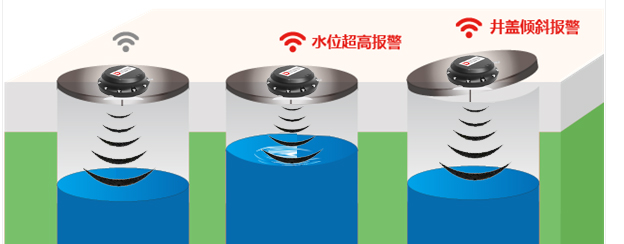
01 Users can manually set angle alarm thresholds to detect illegal movements, instantly push alarm information to users, and clear the alarm once the manhole cover status is restored.
02 Supports water level monitoring function; when the water level exceeds the alarm threshold, an alarm is triggered, and alarm information is pushed to the cloud. The alarm threshold length can be customized as needed.
03 Enables free switching between disarmed and armed states. Users can set the disarming start time and duration, after which the system automatically switches to the armed state (working and non-working states).
04 Supports periodic reporting, allowing the cloud to monitor device online status. Users can set the device reporting cycle based on actual needs and check device status regularly.
05 Supports cloud configuration/on-site configuration. WeChat Mini Program connects to the device via mobile Bluetooth for on-site configuration and debugging.
Key Component Description
Sensor Node:
Built-in STM32L071 MCU (ultra-low power consumption)
Supports multi-probe expansion (e.g., simultaneous monitoring of water leaks and humidity)
Gateway:
Edge computing capability (local judgment of water level change trends)
4G/Ethernet dual-mode backhaul
IV. Installation and Deployment Specifications
1. Deployment Strategy
Scenario Installation Location Spacing Requirements
Data Center Under raised floors, next to air conditioning drain pipes 1 per 20㎡
Underground Parking Lot Above drainage ditches and sump pits 1 per 50m linear distance
Pipeline Shaft Below flange connections 1 per critical node
2. Waterproofing Treatment
Cable entry: Use waterproof connectors (e.g., PG7 specification)
Housing seal: Silicone ring + ultrasonic welding process
V. Typical Application Cases
Smart City Waterlogging Monitoring
Can be applied to various underground smart pipeline management systems, such as water supply, drainage, power, and heating. Enables remote real-time monitoring of井下 equipment data and manhole cover status, transmitting the data to monitoring center software. Automatic alarms are triggered when data exceeds limits or manhole covers are lost/open/loose. Assists regulatory personnel in promptly detecting pipeline and manhole cover abnormalities to take quick measures and prevent accidents or disasters.
| Industry Category | Instruments & Meters/Specialized Instruments/Other Specialized Instruments |
|---|---|
| Product Category | |
| Brand: | 德明电子 |
| Spec: | NB-IOT |
| Manufacturer: | 内蒙古德明电子科技有限公司 |
| Origin: | 111502 |


