


Coal Gangue Wireless Temperature Measurement Pole
Other Products


Spontaneous combustion of coal is an extremely complex process, primarily caused by the interaction between coal and oxygen, which triggers a series of endothermic and exothermic reactions. This leads to a continuous rise in the internal temperature of the coal pile, eventually resulting in spontaneous combustion.
I. Project Background
Coal gangue piles are prone to spontaneous combustion (critical temperature range: 80°C–120°C), and traditional manual inspections are inefficient. This solution utilizes a wireless sensor network to achieve real-time temperature monitoring, covering typical accumulation layers at depths of 0–5 meters. The "Guidance on Disaster Prevention and Control of Coal Gangue Hills" emphasizes the need for regular temperature measurement, prediction, and early warning mechanisms to prevent spontaneous combustion in coal gangue hills. Currently, conventional temperature measurement technologies often rely on infrared thermal imaging, which presents several challenges during implementation:
1. Infrared thermal imaging is sensitive and accurate for surface temperature detection but struggles to effectively capture internal deep-layer temperatures.
2. Coal gangue hills are generally large, making temperature detection using infrared technology labor-intensive, time-consuming, and inefficient.
3. It is difficult to accurately pinpoint abnormal temperature areas.
4. Harmful gases released from coal gangue hills pose health risks to operators.
5. Real-time monitoring and comprehensive temperature distribution analysis are not feasible.
Causes of Spontaneous Combustion in Coal Gangue
The main theories explaining spontaneous combustion in coal gangue are the pyrite oxidation theory and the coal-oxygen composite spontaneous combustion theory. The pyrite oxidation theory is currently the dominant explanation. It posits that pyrite in coal gangue oxidizes at low temperatures, generating heat that accumulates and raises the internal temperature, igniting the coal and combustible organic matter in the gangue, leading to spontaneous combustion. The coal-oxygen composite spontaneous combustion theory suggests that coal gangue typically contains 10%–25% carbonaceous combustible material. At room temperature, the coal in gangue undergoes slow oxidation reactions, releasing heat. When this heat accumulates to a certain temperature, it can ignite the combustible material, causing the gangue hill to spontaneously combust.
Inner Mongolia Company has developed a real-time, user-friendly, and highly applicable spontaneous combustion prevention and monitoring system for coal gangue hills, effectively addressing the shortcomings of existing temperature monitoring methods. The system offers: a coal gangue hill anti-spontaneous combustion temperature monitoring and alarm system, long-distance temperature field detection for coal gangue hills, temperature monitoring of spontaneously combusting coal gangue hills, methods for measuring surface temperature fields of coal gangue hills, and a coal gangue hill spontaneous combustion temperature monitoring system—specifically, a remote wireless LoRa temperature acquisition system for coal gangue hills. Advantages of LoRa Wireless Temperature Measurement
1. Long Transmission Distance
One of the main reasons LoRa wireless temperature measurement is popular in the market is its ability to transmit over longer distances compared to other wireless temperature measurement systems at the same power level. For example, both the LoRa1276-C1 and RF4432PRO wireless temperature measurement modules have a power output of 100mW, but the LoRa1276-C1 module can transmit up to 5 kilometers, while the RF4432PRO module only reaches 1.4 kilometers—a clear difference.
II. System Architecture
Sensing Layer
High-temperature PT100 sensors (-40°C to 600°C) with armored stainless steel probes for corrosion resistance
Deployment density: One node per meter in depth, with a horizontal grid spacing of 20m × 20m
Transmission Layer
LoRaWAN gateways (CN470 frequency band) with penetration capabilities up to 500 meters
Dual-mode 4G/BeiDou backhaul (for backup in no-signal areas)
Platform Layer
3D heat map visualization (temperature gradient analysis)
Multi-level alarms: >60°C for yellow warning, >100°C for red emergency response
Features of the Wireless Coal Pile Temperature Measurement Rod:
(1) Uses imported temperature sensors for rapid response and high accuracy, with temperature measurement precision ≤0.3°C or higher;
(2) To meet the temperature detection needs of different coal yards, specifications such as probe length, number of built-in temperature measurement points, and node spacing can be customized based on actual requirements;
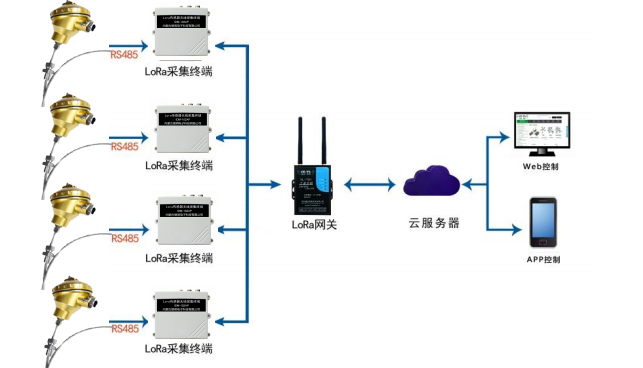
(3) Employs wireless communication methods like LoRa and NB-IoT, offering advantages such as flexible networking, low power consumption, long transmission distance, and strong anti-interference performance, hence it is also known as the "wireless coal pile temperature measurement rod";
(4) The device is powered by a built-in high-capacity lithium battery with a lifespan of ≥5 years, providing ultra-long standby time and enabling long-term online monitoring within coal piles.
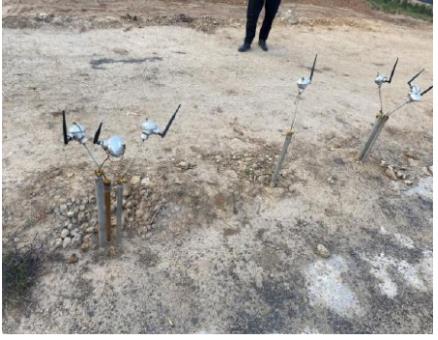
The wireless coal pile temperature measurement rod, which integrates sensor technology, location positioning, and wireless transmission, can form self-organizing networks to build an internal temperature monitoring and alarm system for preventing spontaneous combustion in coal piles. It enables real-time detection and early identification of spontaneous combustion risks in coal storage yards, making it a powerful tool for safety supervision.
2. Low Power Consumption
In the field of wireless communication, a long-standing challenge has been how to maintain low power consumption while achieving ultra-long transmission distances in wireless temperature measurement. This issue was only resolved with the introduction of LoRa modules, which is a key reason for their widespread popularity.
3. Strong Anti-Interference Capability
LoRa wireless temperature measurement uses LoRa modulation, which offers strong anti-interference performance. Compared to traditional modulation methods like GFSK and FSK, LoRa modulation features excellent spread spectrum modulation and forward error correction technology, enabling it to extract data from noise. The stronger the anti-interference capability, the more stable and reliable the data transmission.
4. High Sensitivity
LoRa modulation technology uniquely applies spread spectrum functionality to signals. At the same data rate, its spread spectrum modulation achieves 8–10 dB higher sensitivity than traditional modulation methods like GFSK and FSK. When transmitting over longer distances, signals weaken; higher sensitivity allows modules to receive weaker signals, which is why increased sensitivity correlates with longer transmission ranges.
Monitoring Solution
III. Key Technologies
Anti-Interference Design:
Sensors use a three-wire connection to eliminate the influence of wire resistance
Frequency-adaptive frequency hopping technology (to avoid electromagnetic interference in mining areas)
Low Power Consumption Strategy:
Sleep-wake mechanism (data collection once per hour, continuous monitoring for abnormal temperatures)
Temperature difference self-triggering (activates neighboring nodes when the temperature difference between adjacent nodes is ≥15°C)
Drill-free installation: On-site drilling with ordinary probes is not allowed, and the hot blast stove surface is rough. The probe must maintain secure fixation at high temperatures up to 200°C.
High protection rating: Harsh working environments require a high level of protection.
Wide temperature range: Hot blast stoves operate at high temperatures, so the device must measure temperatures from 0°C to 500°C with high precision.
Easy maintenance: Frequent on-site maintenance is impractical, so devices must have long battery life and be easy to maintain.
● Supports communication protocols such as TCP Server, UDP, and MQTT

| Industry Category | Instruments & Meters/Analytical Instruments/Other Analytical Instruments |
|---|---|
| Product Category | |
| Brand: | 德明电子 |
| Spec: | NB-IOT |
| Manufacturer: | 内蒙古德明电子科技有限公司 |
| Origin: | 111502 |


