


Sodium Linoleate for Construction Additives
Contact Info
- Add:No. 96 Jinjing Avenue, Zhangdian District, Zibo City, Zip: 255000
- Contact: 孙婷
- Tel:15153307677
- Email:2303378232@qq.com
Other Products


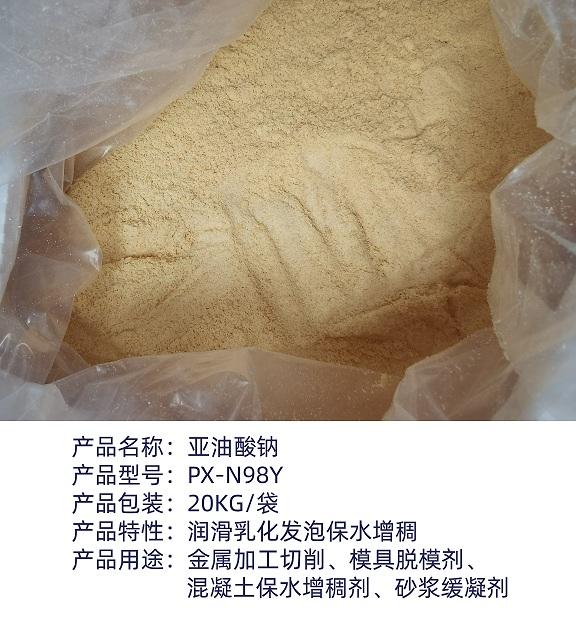
Sodium LinoleatePX-N98Y
Chinese Name: Sodium Linoleate
English Name:Sodium soyate
Category: Anionic Surfactant - Sodium Carboxylate
CAS: 822-17-3
Solid Content: 98%±1
Color: Light yellow to yellow
Physical Form: Powder
Solubility: Soluble in water
Packaging: 20Kg/bag (Kraft paper woven bag lined with high-strength polyethylene bag)
Introduction to Sodium Linoleate PX-N98Y:
Sodium Linoleate is developed by Zibo Pengxin Chemical Technology Co., Ltd. through the reaction of sodium hydroxide with linoleic acid purified from soybean oil, using continuous saponification. It is a compound composed of hydrophobic and hydrophilic groups, belonging to an anionic surfactant. Its specific physical properties vary with changes in alkyl chain length. The powder is soluble in water. It has excellent lubrication, thickening, dispersion, emulsification, demolding, concrete water retention, foaming, and cleaning capabilities. It is used as a water-retaining agent, retarder, foaming agent in concrete cement mortar to improve pumpability, as a saponification agent and lubricant in metal drawing processes, rubber release agent, thickener in industrial water-based latex paints, and mineral flotation agent.
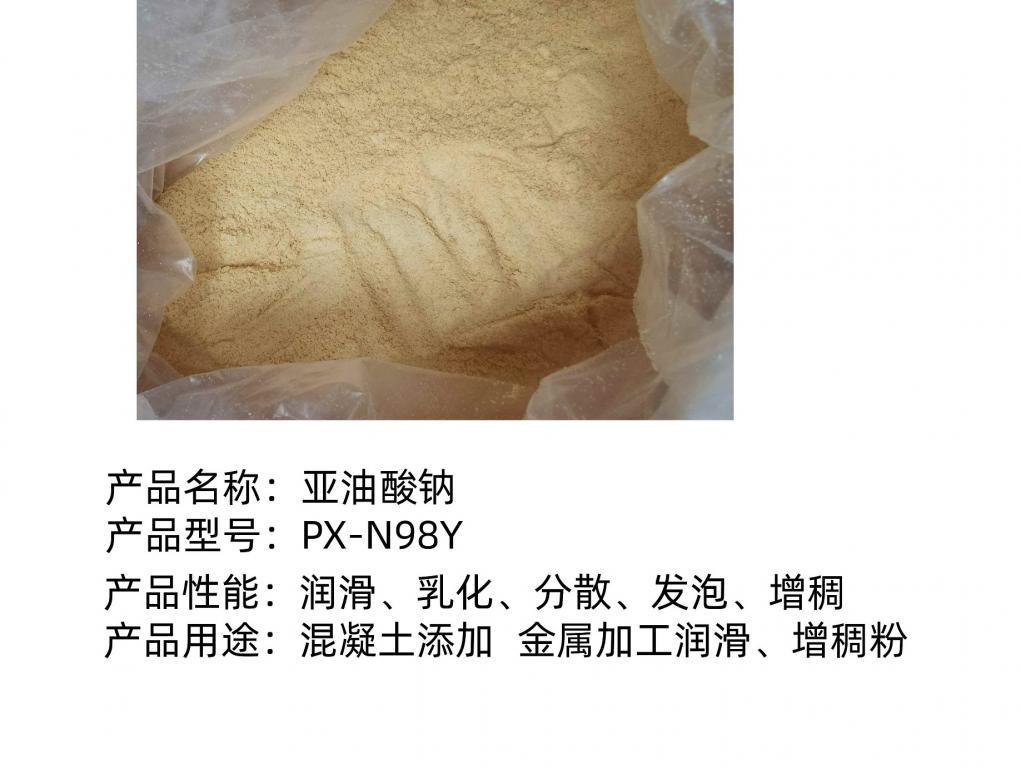
1. Water-retaining agent, retarder, foaming agent for concrete cement mortar, improving mortar pumpability
Sodium Linoleate is used as a water-retaining agent, retarder, and foaming agent in concrete cement mortar to improve pumpability. It enhances the dispersion of cement and sand, significantly improves the plasticity and water retention of mortar, effectively prevents cracking, and increases cement strength. Its water retention property ensures the slurry does not crack due to rapid drying after application, while its retarding effect improves workability and extends operational time, enhancing post-hardening strength. Its excellent foaming ability reduces the weight per volume of mortar, decreasing cement usage. Closed-cell foam provides excellent waterproofing to concrete, making it an additive for waterproof mortar. It acts as a binder in plaster, gypsum, putty powder, or other building materials for tiling, marble, plastic decoration, and adhesion enhancer. Used in ceramic glazes and enamel to improve adhesion and processability. In refractory mortar for firebrick or castable furnace materials, it improves plasticity and water retention. Sodium Linoleate's superior performance and cost advantage make it an ideal replacement for hydroxypropyl methylcellulose and other cellulose derivatives.
Usage: Add 0.8-1.5kg per ton of concrete cement mortar.
2. Used as a saponification agent in metal processing----saponification powder
Phosphated workpieces are immersed in a Sodium Linoleate drawing lubricant soap solution, where Sodium Linoleate reacts with the zinc phosphate film on the workpiece surface to form a zinc linoleate film and soap film layer. This film increases the plastic thickness of the workpiece deformation zone, forming a lubricating film between the die and the material, significantly reducing heat and preventing metal sintering and adhesion. It acts as a friction-reducing medium and plasticizer between the die and the drawn part, improving surface finish and processing accuracy, reducing wear on drawing tools and dies, and preventing damage. It is easily soluble in water and can be easily removed from the workpiece surface, with no adverse effects on heat treatment, annealing, or tempering quality. Stearic acid can be added to the saponification solution (temperature above 60°C) to enhance friction reduction and extreme pressure resistance.
Usage: Prepare a 1%-7% Sodium Linoleate soap solution.
Stearic acid addition should be within 30% of the Sodium Linoleate mass.
3. Industrial thickener
Sodium Linoleate is a water-based thickener made from natural plant oils, a high molecular bio-material. Its thickening mechanism involves hydrophobic main chains forming hydrogen bonds with surrounding water molecules, increasing the polymer's fluid volume and reducing the free movement space of particles, thereby increasing system viscosity. It can also achieve viscosity increase through molecular chain entanglement, exhibiting high viscosity under static and low shear conditions and low viscosity under high shear. This is because, at static or low shear rates, soybean protein adhesive molecules are disordered, resulting in high viscosity, while at high shear rates, molecules align parallel to the flow direction, facilitating sliding and reducing viscosity. It is resistant to acids, alkalis, and high temperatures, dissolves well in cold water, viscosity increases over time, and is less affected by temperature. It adjusts rheology to thicken adhesives and sealants, prevents filler sedimentation, provides good physical and mechanical stability, controls rheology during application, prevents sagging, dripping, or splashing, and reduces costs.
Main Applications:
Can be used as a powerful emulsifier for water/oil and oil/water systems.
Used in detergents as a dispersant/foam stabilizer/emulsifier. Impurity re-absorber.
In the textile industry as a sizing agent. Emulsifier stabilizer, anti-settling agent. Thickener.
Structural component in paper and paperboard production.
Flotation agent for selected copper, nickel, and potassium ores.
Adhesive component in wallpaper.
Component in dry construction-cement mixtures.
Thickening/dispersing/stabilizing component in water-based latex paints.
Thickening and stabilizing agent for viscous suspensions in oil and gas well drilling.
| Industry Category | Chemicals/Inorganic Salts/Other Inorganic Salts |
|---|---|
| Product Category | |
| Brand: | 鹏鑫 |
| Spec: | PX-N98Y |
| Stock: | 100000000 |
| Manufacturer: | 淄博鹏鑫化工科技有限公司 |
| Origin: | 113703 |


