


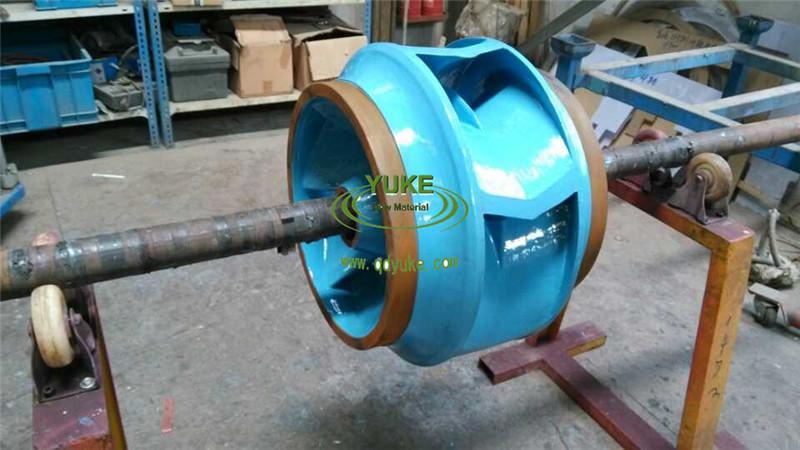
Energy-saving renovation of circulating water pumps
Contact Info
- Add:No. 1 Xiuyuan Road, High-tech Zone, Zip:
- Contact: 岳明
- Tel:0532-81981420
- Email:3283251232@qq.com
Other Products


Keywords: Water pump energy-saving manufacturers, water pump energy-saving retrofit technology, energy-saving water pump prices, energy-saving pump manufacturers, water plant energy-saving technology, water plant energy-saving retrofitting, principles of water pump energy efficiency. Pump efficiency is a technical and economic indicator that measures the operational effectiveness of a water pump. It refers to the ratio of the pump's effective power (i.e., the output power of the pump) to the pump's shaft power (i.e., the input power of the pump). Pump efficiency generally ranges from 65% to 90%, with large pumps capable of exceeding 90%. The level of pump efficiency largely depends on the usage conditions of the pump. If maintenance and operation are improper, even a highly efficient pump will not achieve the goal of economical operation with high efficiency and low consumption. Therefore, during the actual operation of a pump, efforts should be made to improve pump efficiency and minimize various energy losses, particularly the cost associated with electrical energy losses, during the process of transferring energy from the pump to the water. Taking a water plant as an example, electrical energy is the primary energy source in daily production. Analysis shows that electricity costs can account for 80% or more of the total production costs of a water plant. Among the total electricity consumption of the entire plant, water pumps account for over 90% of the electricity usage, indicating that water pumps are the main energy-consuming equipment in water plants. To reduce energy consumption, the first step is to decrease the energy consumption of water pumps. Energy conservation and emission reduction have now become primary components of China's economic development planning outline. Particularly for high-energy-consuming enterprises in industrial sectors such as power, steel, non-ferrous metals, papermaking, petrochemicals, and water treatment, more stringent emission reduction targets have been proposed. As general mechanical equipment, water pumps are widely used in various sectors of the national economy. Water pumps are characterized by simple and compact structure, a wide range of flow and head, broad adaptability, ease of use, easy maintenance, and low cost. Due to the destructive effects of rust, corrosion, erosion, and cavitation, the surfaces of the pump casing and impeller become uneven, the friction coefficient gradually increases, pump efficiency declines, and the service life of the pump shortens. Water pumps are also major consumers of power. According to statistics from the General Machinery Industry Association, water pump electricity consumption accounts for about 20% of China's total power generation. Improving pump efficiency is of great significance for energy conservation and emission reduction. Losses due to pump resistance factors During the operation of a water pump, the flowing water inside the pump is affected by friction with the flow passage and the surface of the pump impeller, as well as the water's own viscosity. The energy consumed by the pump is primarily used to overcome the frictional resistance of the water surface and eddy current resistance. The energy consumed (head loss) during the flow process is used to overcome internal friction and the friction between the water and the equipment interface. If the pump and impeller surfaces are smooth (such surfaces are referred to as hydraulically smooth surfaces), surface resistance is lower, and energy consumption is reduced. By spraying polymer materials onto the pump's flow surface and impeller, a hydraulically smooth surface is formed. The surface smoothness of an ultra-smooth surface coating is 20 times that of polished stainless steel. This extremely smooth surface reduces fluid stratification inside the pump, thereby decreasing internal turbulence, reducing volumetric and hydraulic losses within the pump, lowering electricity consumption, and achieving the goal of reducing water flow resistance losses. This improves the hydraulic efficiency of the pump and, to some extent, also enhances mechanical and volumetric efficiency. The dense molecular structure of the coating can isolate the contact between media such as air and water and the base material of the pump impeller, significantly reducing electrochemical corrosion and rust. Additionally, polymer composite materials are inherently polymer-based and possess chemical corrosion resistance, which can enhance the pump's corrosion resistance and greatly improve its ability to resist erosion and corrosion. Due to their excellent wear and impact resistance, they provide effective anti-wear and buffering effects when fine solid particles come into contact with and impact the pump. Ultra-smooth fluid coating technology The polymer ultra-smooth energy-saving technology developed by Qingdao Yuke New Material Co., Ltd. features low investment, requires no modifications to the water pump, has a short engineering period that does not affect production, and offers a short investment return period, with the fastest payback in just one month. Moreover, due to its excellent protective properties, the service life of the water pump is significantly extended, improving equipment operational efficiency and increasing benefits. Polymer ultra-smooth technology can improve the efficiency of new pumps by 2-5%. For old pumps that have already suffered corrosion and wear, this article also provides a rapid repair coating process that can restore pump efficiency by approximately 15%. For the water supply industry, due to the high flow efficiency of water pumps, the unit water output and head can be significantly increased, while output power is reduced, thereby improving equipment operational efficiency and achieving energy conservation and emission reduction effects.
| Industry Category | Machinery & Equipment/Pumps/Other Pumps |
|---|---|
| Product Category | |
| Brand: | |
| Spec: | |
| Origin: | 11 |


