


Cast iron platform
Other Products


Form Structure and Uses of Cast Iron Platforms
Cast iron platforms, also known as cast iron plates, are widely used equipment in the industrial sector. They play a crucial role not only in industries such as machining, sheet metal processing, and mold manufacturing but also serve as indispensable reference plane measuring tools for tasks like workpiece inspection, marking, equipment debugging, assembly, welding, and riveting. This article will delve into the form structure of cast iron platforms and their diverse applications.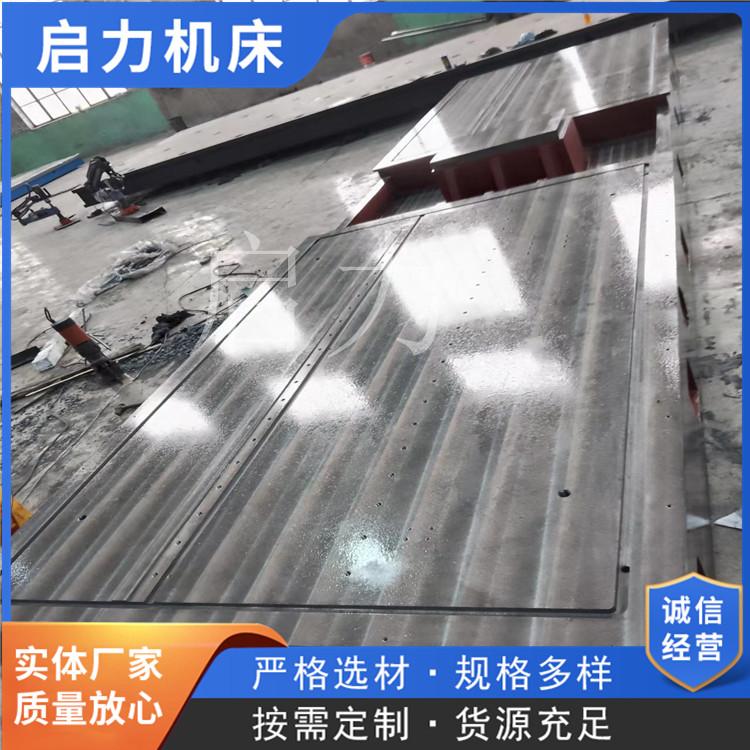
I. Form Structure of Cast Iron Platforms
Cast iron platforms come in various form structures to meet the needs of different industrial applications. Their overall structure is primarily divided into two categories: box-type and ribbed plate-type. Both structural forms offer high strength, excellent stability, and good load-bearing capacity, ensuring reliable performance under various complex working conditions.
1. Box-Type Structure
Box-type cast iron platforms feature a robust internal support structure, with an overall design resembling a closed box. This structural form provides high rigidity and stability, enabling it to withstand heavy loads while minimizing deformation. Box-type cast iron platforms are commonly used in scenarios requiring high precision and stability, such as machining and inspection tasks in the mechanical manufacturing industry.
2. Ribbed Plate-Type Structure
Ribbed plate-type cast iron platforms enhance their strength and stiffness by incorporating reinforcing ribs within the platform. These ribs not only improve the platform's load-bearing capacity but also help distribute loads and reduce stress concentration. The ribbed plate-type structure is relatively lightweight, making it easy to transport and install, and is suitable for applications requiring frequent movement or repositioning.
The working surface of cast iron platforms comes in various shapes, including rectangular, square, and circular. The choice of shape depends on specific application requirements. For example, rectangular working surfaces are suitable for longer workpieces or equipment, while circular working surfaces facilitate rotation and positioning operations. Additionally, the working surface of cast iron platforms can be machined to include V-shaped grooves, T-shaped grooves, U-shaped grooves, dovetail grooves, round holes, elongated holes, and other shapes to meet specific machining and assembly needs.
In terms of materials, cast iron platforms are typically made from HT300 material. This material offers excellent wear resistance, corrosion resistance, and impact resistance, ensuring that cast iron platforms maintain high precision and stability over long-term use.
II. Uses of Cast Iron Platforms
Cast iron platforms play a vital role in the industrial sector. Their characteristics, such as high precision, excellent stability, long service life, and strong adaptability, make them widely applicable across multiple industries.
1. Mechanical Manufacturing Industry
In the mechanical manufacturing industry, cast iron platforms are indispensable basic tools. During machining operations on machine tools, cast iron platforms bear the weight of other workpieces, ensuring precision during the machining process. Additionally, cast iron platforms are often used in the installation and debugging of casting machine tools to ensure their accuracy and stability. Furthermore, in the mechanical manufacturing process, cast iron platforms are commonly employed for various inspection tasks, such as dimensional accuracy checks of parts, measurement of geometric deviations, and marking. These applications not only improve the efficiency of mechanical manufacturing but also ensure product quality and performance.
Qili Machine Tool, Ms. Xie, 13785751790
| Industry Category | Hardware & Tools/Castings/Iron Castings |
|---|---|
| Product Category | |
| Brand: | 泊头启力机床 |
| Spec: | 2000*5000 |
| Manufacturer: | 泊头启力机床 |
| Origin: | 111309 |


