


Cast iron test platform
Other Products


In the field of casting, the manufacturing of cast iron test platforms is undoubtedly a critical aspect. However, the presence of adverse factors during the casting process often leads to a decline in product quality and even triggers safety incidents. Therefore, how to prevent adverse factors during the casting of cast iron test platforms has become a subject that every casting engineer must deeply study.
First, we need to identify the potential adverse factors that may arise during the casting of cast iron test platforms. These adverse factors include, but are not limited to, blowholes, sand inclusions, shrinkage cavities, and mold wall movement. These issues not only affect the appearance quality of the ground rails but may also lead to performance degradation during use and even cause safety incidents.
Regarding blowholes, the key to prevention lies in optimizing the gating system. Improper settings of the gating system can result in poor venting or the formation of vortices, which entrap gas. Therefore, we need to design the gating system reasonably to ensure proper venting and avoid vortices. At the same time, the compactness of the sand mold is also an important factor affecting the formation of blowholes. Excessive compactness reduces permeability and increases the likelihood of blowhole formation. Thus, we need to control the compactness of the sand mold appropriately, ensuring it has sufficient strength while maintaining good permeability.
Prevention of sand inclusions primarily focuses on the selection of the gating system's position and size. If the gating 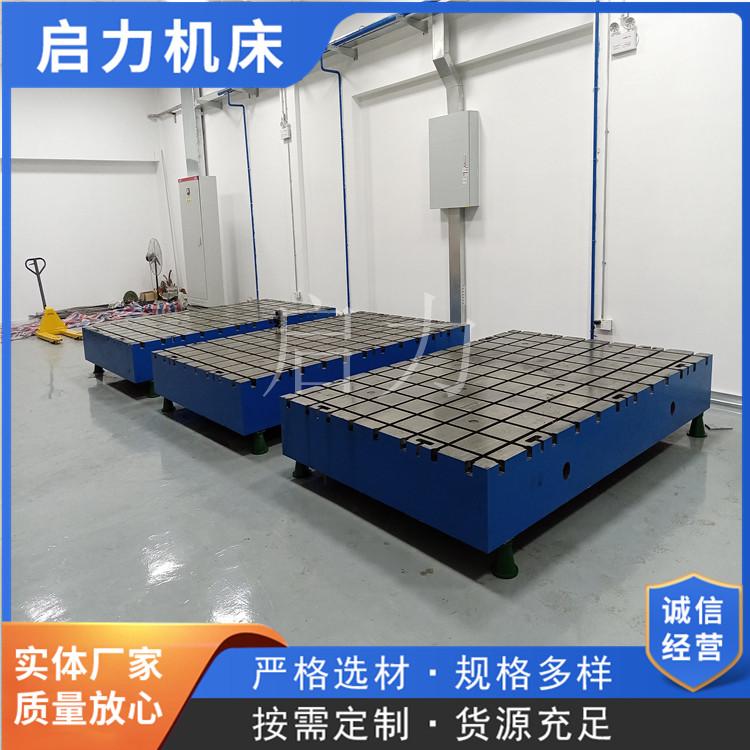 system position is inappropriate, such as directly facing the sand core, or if the gate is too small, the high冲刷 force of the molten iron can easily damage the local sand mold, leading to sand inclusion formation. Therefore, we need to reasonably select the position and size of the gating system to avoid direct冲刷 of the sand core by the molten iron. Additionally, the quality of the mold structure design is also a significant factor affecting sand inclusion formation. A well-designed mold structure can reduce the occurrence of sticking, thereby lowering the possibility of sand inclusion formation.
The measurement units for cast iron test platforms and all accessories全部 adopt standard units. Cast iron test platforms require two artificial aging treatments. The first aging treatment is performed before rough machining to relieve casting stresses. The second artificial aging treatment is conducted after rough machining to relieve stresses generated during rough machining. The machined surfaces of cast iron test platforms are coated with anti-rust oil, while non-machined surfaces are coated with anti-rust paint and topcoat. The appearance and surface quality of cast iron test platforms are ensured. To minimize the impact of the self-weight of the cast iron test platform on its accuracy during handling and lifting, all platform lifting hole designs comply with the Bessel support point principle. The design and manufacturing of cast iron test platforms must meet the standards for cast iron surface plates. Cast iron test platforms must be free from rust,滑痕, and other appearance issues that affect usability, and must not have casting defects such as sand inclusions, blowholes, cracks, etc., that severely impact performance. To enhance the anti-deformation capability of cast iron test platforms, based on material mechanics strength theory, a box-rib structure is adopted, with the cross-section using a semi-enclosed box-type design, making both the longitudinal and transverse sections of the platform exhibit an "I"-beam structure. All cast iron test platforms are adjusted using adjustable leveling feet, facilitating platform adjustment and reducing the procurement costs for the buyer.
In addition to blowholes and sand inclusions, issues such as shrinkage cavities and mold wall movement are also potential adverse factors during the casting of cast iron test platforms. The key to preventing these problems lies in controlling factors such as the working temperature of the mold, coating selection, the design of the casting's position in the mold, and the pouring temperature. By reasonably controlling these factors, we can reduce the occurrence of issues like shrinkage cavities and mold wall movement.
Ms. Xie from Qili Machine Tool 13785751790
| Industry Category | Hardware & Tools/Castings/Iron Castings |
|---|---|
| Product Category | |
| Brand: | 泊头启力机床 |
| Spec: | 2000*5000 |
| Manufacturer: | 泊头启力机床 |
| Origin: | 111309 |


