


Ultra-Large Carbon Fiber Five-Axis Machining Center for Processing Composite Components in Rail Transit
Contact Info
- Add:李沧区瑞金路29-2号, Zip:
- Contact: 苏俊杰
- Tel:15264219292
- Email:594587899@qq.com
Other Products


I. Core Concept Analysis
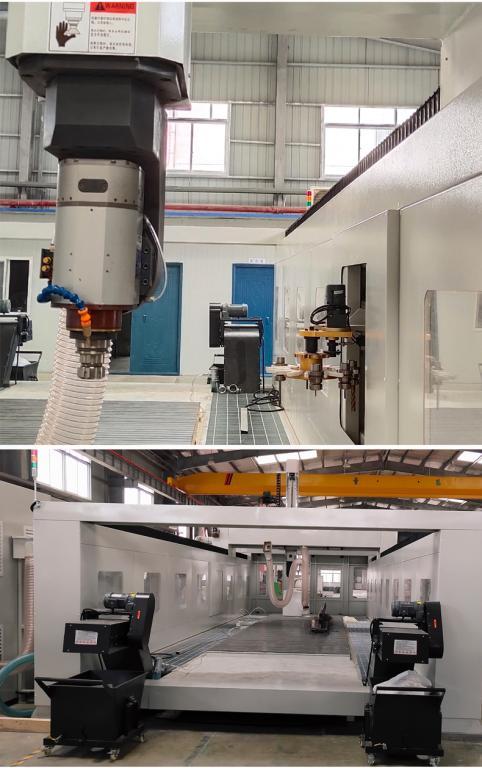
Ultra-Large Carbon Fiber Five-Axis Machining Center
Ultra-Large: Refers to worktable travel, load capacity, and machining space far exceeding those of conventional machine tools. Typically used for machining massive workpieces such as aircraft wings, wind turbine blades, and high-speed train noses, which can be tens of meters long and several meters wide and high.
Carbon Fiber: Primarily refers to the machining of carbon fiber composite materials, but also implies that the machine tool itself may incorporate carbon fiber-reinforced structural components to achieve high rigidity and lightweight design.
Five-Axis Machining Center: A high-end CNC machine tool that, in addition to the traditional X, Y, and Z linear axes, includes two rotational axes (e.g., two of the A/B/C axes). This allows the tool to move in five degrees of freedom, enabling the machining of complex curved parts from multiple angles in a single setup without the need for repositioning.
Rail Transit Composite Components
Materials: Primarily carbon fiber-reinforced composites, but may also include glass fiber, aramid fiber, etc. They offer advantages such as lightweight and high strength, fatigue resistance, corrosion resistance, and strong design flexibility.
Typical Components:
Body Components: Nose cone, driver's cabin, roof, sidewalls, floor, etc.
Interior Components: Equipment compartments, deflectors, interior panels, etc.
Load-Bearing Structural Components: Bogie components (e.g., frames), equipment beams, etc. (These require extremely high performance and processing standards).
II. Why Are Ultra-Large Five-Axis Machining Centers Necessary?
For rail transit composite components, especially large structural parts, the use of five-axis machining centers is an inevitable choice for the following reasons:
Precision Machining Needs After "Integrated Molding":
Large composite components are typically manufactured using processes such as Automated Tape Laying (ATL)/Automated Fiber Placement (AFP) or Resin Transfer Molding (RTM) to create near-net-shape "blanks." These blanks require precision machining, including drilling, trimming, milling, and window cutting, to meet assembly requirements. Five-axis machining can efficiently and accurately complete these tasks.Ensuring Machining Accuracy for Complex Curved Surfaces:
Components like high-speed train noses and deflectors feature complex aerodynamic surfaces. Five-axis simultaneous machining ensures the tool remains perpendicular to the machining surface, guaranteeing consistency and high surface finish while avoiding the "stair-step" residues common in three-axis machining.Achieving "One Setup, Complete Machining":
Repositioning ultra-large workpieces is extremely difficult and time-consuming. Five-axis technology allows machining of all five faces in a single setup, significantly reducing positioning errors and improving overall machining accuracy and efficiency.Addressing Challenges in Composite Machining:
Anisotropy and Delamination Risks: Carbon fiber composites have low interlayer strength, and traditional machining methods can easily cause delamination, burrs, and tearing. Five-axis machine tools can utilize specialized diamond-coated tools and optimized tool paths and cutting parameters (e.g., climb milling) to achieve "shear-type" cutting, minimizing machining damage.
High Abrasiveness: Carbon fiber is highly abrasive to tools. The high rigidity and stability of five-axis machine tools ensure precision is maintained during prolonged machining, while specialized tool systems extend tool life.
III. Key Technical Features of Ultra-Large Five-Axis Machining Centers
For rail transit composite machining, these machine tools typically feature the following:
High-Rigidity Bed and Motion Structure: Ensures the machine tool does not deform under gravity or cutting forces when machining large workpieces, maintaining precision. May use mineral casting or optimized steel structures.
High-Precision Five-Axis Simultaneous CNC System: Systems like Siemens 840D or Heidenhain TNC series, capable of handling complex tool path planning and achieving nanometer-level smooth interpolation motion.
Dedicated Vacuum Adsorption System: The worktable is typically equipped with vacuum suction holes to securely hold porous, sheet-like composite workpieces, preventing movement during machining.
Efficient Dust Extraction and Cooling Systems:
Dust Extraction: Carbon fiber dust is conductive and hazardous to health. High-power, high-sealing dust collection systems are essential to remove dust at the source, protecting both equipment and operators.
Cooling: Typically employs "dry" or "minimum quantity lubrication" machining to avoid coolant contamination of composites or interference with subsequent bonding processes.
On-Machine Measurement System: Integrated probes or laser scanners for workpiece positioning, coordinate system alignment before machining, and precision inspection after machining, enabling closed-loop manufacturing.
Intelligence and Automation: Can integrate with robots or AGVs for automatic loading and unloading of workpieces, enabling unmanned or minimally manned smart production lines.
IV. Application Process Example (Using a High-Speed Train Nose Cone as an Example)
Data Import: Import the CAD 3D model of the nose cone into the machine tool's CNC system.
Workpiece Clamping: Hoist the large composite nose cone blank onto the machine tool worktable and secure it firmly with vacuum chucks.
On-Machine Measurement: Use a probe to scan the actual position of the workpiece, with the system automatically compensating the machining coordinate system.
CAM Programming and Machining:
Rough Machining: Quickly remove excess boundary material.
Finish Machining: Five-axis simultaneous machining to precision mill the outer contour surfaces and inner surfaces.
Drilling/Tapping: Precisely machine all mounting holes for connection to the train body.
Edge Trimming: Cut the blank edges to the final dimensions.
Quality Inspection: After machining, use the on-machine measurement system to recheck key dimensions.
Unloading and Cleaning: Release the vacuum, hoist the workpiece away, clean it, and prepare it for the next assembly step.
V. Market Prospects and Challenges
Prospects:
Lightweighting is a perpetual theme in rail transit, and the use of composites will continue to increase.
China's "High-Speed Rail Going Global" strategy and the development of urban rail transit worldwide provide a huge market for high-end composite machining equipment.
As technology matures and costs decrease, composites will expand from non-load-bearing parts to secondary and primary load-bearing parts, driving greater demand for machining equipment.
Challenges:
High Initial Investment: Ultra-large five-axis machining centers are capital-intensive equipment.
High Technical Barriers: Requires interdisciplinary talent proficient in composite processes, CNC programming, and machine tool operation.
Process Database Accumulation: Establishing comprehensive cutting parameter databases for composites with different formulations and layering methods requires extensive process testing and experience accumulation.
Summary
Ultra-large carbon fiber five-axis machining centers are core equipment for achieving high-quality, high-efficiency, and high-precision batch manufacturing of composite components in the rail transit sector. They are not merely "cutting" tools but critical bridges connecting "material design-structural forming-precision assembly," serving as "national key assets" that drive rail transit equipment toward lighter, faster, safer, and more environmentally friendly development. For enterprises aiming to establish a foothold in high-end rail transit manufacturing, investing in and applying such equipment is an inevitable strategic choice.
| Industry Category | Chemicals/Chemical Intermediates/Intermediate Compounds |
|---|---|
| Product Category | |
| Brand: | 青岛速霸 |
| Spec: | SUBACNC-2040 |
| Stock: | 1 |
| Manufacturer: | 青岛速霸数控科技有限公司 |
| Origin: | 113702 |


