


AT-SL300 Three-in-One Sensor
Contact Info
- Add:西安市翠华南路60号, Zip: 710061
- Contact: 仵小玲
- Tel:13891834587
- Email:704151787@qq.com
Other Products


Indoor Air Quality Monitoring System for Public Buildings
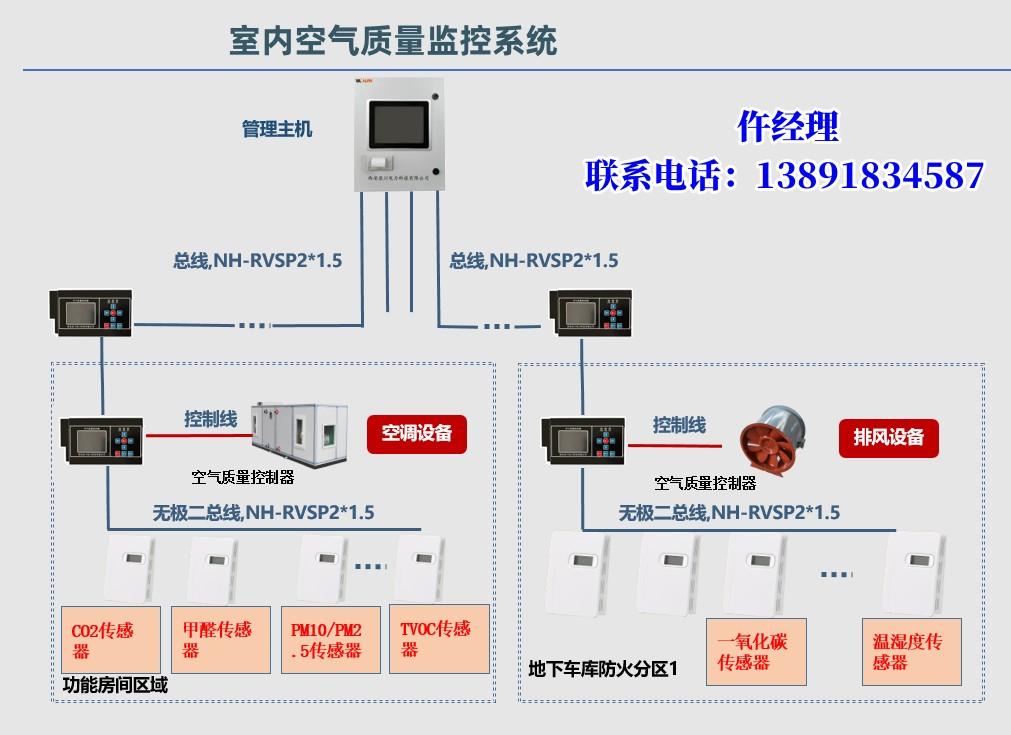
The Indoor Air Quality Monitoring System for public buildings utilizes Ethernet as the network transmission medium, with the monitoring center at its core, enabling networked supervision of indoor air quality in buildings. From the bottom up, it can be divided into three layers: the field layer, transmission network, and monitoring center. The monitoring center communicates with field devices via the transmission network. One or more sets of gas online monitoring sensors are connected to an independent data acquisition and transmission unit. The monitoring center communicates with the data acquisition unit through the transmission network. The system offers advantages such as intelligence, networking, openness, and high stability. The air quality monitoring system operates independently of other internal building networks and can be independently networked using various forms such as 4G/WIFI. Administrators can query, statistics, and report air quality information via the internet.
The indoor air quality monitoring system is generally divided into three layers: management layer, network layer, and field layer.
I. Management Layer
The management layer is designed for administrators and constitutes the top part of the system. It mainly consists of system software and necessary hardware equipment, such as servers, uninterruptible power supplies, etc. The air quality monitoring system software features a user-friendly interface, performing calculations, analysis, and processing of various types of collected field data, and reflecting energy consumption through graphics, numerical displays, etc.
Indoor Air Quality Monitoring Software Platform for Public Buildings
The building indoor air quality monitoring system software platform comprehensively showcases the achievements of the air quality monitoring platform in the form of a BS web page. It embeds various monitoring function modules, has a friendly login page, and integrates rich data display, data analysis, management, and air quality regulation and control functions. At the same time, the software platform opens ports, allowing for the expansion of end-monitored buildings, the integration of other environmental monitoring devices, and the uploading of monitoring data to higher-level environmental protection departments, or incorporating it into the local building energy consumption monitoring system for unified management.
For more product information, performance, and pricing, please call our company.
Contact: Manager Wu
Phone: 13891834587 (also WeChat)
QQ: 704151787
Email: 704151787@qq.com
We are dedicated to providing you with professional configuration solutions!!!
(1) Real-time monitoring: Includes networked real-time monitoring data of harmful gases or dust such as indoor PM10, PM2.5, TVOC, formaldehyde, CO2, temperature, relative humidity, CO, etc., enabling supervision and management such as early warning alarms for exceeding standard levels of harmful gases.
(2) Data statistics: Includes air quality statistics and comparisons by department, building partition, time, etc., including year-on-year and month-on-month comparisons.
(3) Air quality level evaluation: According to national standards for air quality level evaluation, classified statistics of monitoring data are performed, and the statistical results are scored according to evaluation standards.
(4) Air quality public display system: Real-time public display of air quality monitoring results by setting up large screens at main entrances and exits.
II. Network Layer
The network layer mainly consists of intelligent data acquisition units and bus networks. This layer serves as a bridge for data information exchange, enabling real-time transmission of field instrument monitoring data and communication with the central server.
Network Controller (Gateway/Data Collector)
The intelligent data collector is the core acquisition device for indoor air quality monitoring. It connects upward to the monitoring center via Ethernet protocol and downward to end control sensors via industrial bus protocol. It has the following functional features:
(1) Communication protocols: Intelligent instrument protocol/Environmental monitoring protocol/Modbus protocol/SQL database/MQTT/HTTP/Platform integration
(2) Customizable acquisition parameters: Device data address and data type can be freely configured
(3) Power-off resume: Caches data when the network is abnormal and automatically resumes transmission after network recovery
(4) Device communication: Communication between multiple devices, protocol conversion, supports cross-network segments
III. Field Layer
The field layer mainly consists of various end air quality detectors, including inhalable particulate matter PM10 sensors, fine particulate matter PM2.5 sensors, total volatile organic compounds (TVOC), formaldehyde HCHO, carbon dioxide (CO2), temperature, relative humidity, carbon monoxide CO, etc. The detectors are connected via on-site two-wire bus, aggregated to the intelligent data acquisition unit, and upload indoor air quality data to the monitoring center in real time.
Air quality detector selection:
YC-CMW: CO carbon monoxide detector
YC-CDW: CO2 carbon dioxide detector
YC-THI: Temperature and humidity detector
YC-CPW: PM2.5 sensor
YC-DPW multi-function detector: Carbon dioxide, temperature and humidity, formaldehyde, PM2.5, TVOC sensor (LCD display)
YC-DPW multi-function detector: Carbon dioxide, temperature and humidity, formaldehyde HCHO, and total volatile organic compounds TVOC sensor (LCD display)
YK-CSW all-in-one sensor
AT-SL300 three-in-one sensor
RX-PM2.5 sensor
RXXF PM2.5 sensor
RXXF-HOCO formaldehyde
RXXF-VOC sensor
Multi-function sensors can be combined for various gases
| Industry Category | Instruments & Meters/Specialized Instruments/Other Specialized Instruments |
|---|---|
| Product Category | |
| Brand: | 亚川科技 |
| Spec: | AT-SL300 |
| Origin: | 116101 |


