


Principle and Application of Laser Cladding Repair Technology for Alloy Sleeves
Contact Info
- Add:西安市国家民用航天产业基地航天基地299号西安建工科技创业基地十号楼4层, Zip:
- Contact: 段纯
- Tel:17392761868
- Email:gsjgkj@163.com
Other Products


With the rapid development of modern industrial technology, various high-performance alloy materials have been widely used in fields such as aviation, aerospace, automotive, and energy. However, these alloy materials often suffer from surface damage due to friction, corrosion, wear, and other reasons during use, severely affecting their performance and service life. To address this issue, alloy sleeve laser cladding repair technology has emerged as an important surface treatment technique.
I. Principle of Alloy Sleeve Laser Cladding Repair Technology
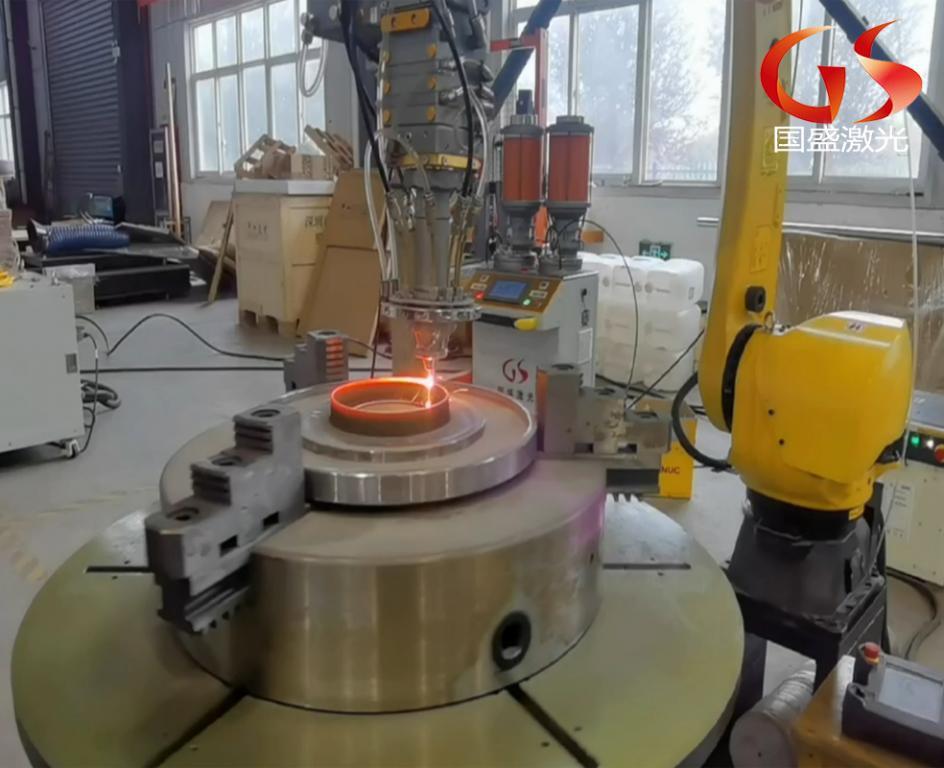
Alloy sleeve laser cladding repair technology is a technique that uses a high-energy laser beam to perform cladding treatment on material surfaces. Its basic principle is: under the action of the laser beam, the pre-placed or synchronously fed alloy powder and the substrate surface are rapidly heated and melted, forming a surface coating that is metallurgically bonded to the substrate material. Due to the high energy density and rapid heating and cooling characteristics of the laser beam, the cladding layer features a fine microstructure, low dilution rate, and strong bonding force, thereby significantly improving the wear resistance, corrosion resistance, heat resistance, and other properties of the substrate surface.
II. Characteristics of Alloy Sleeve Laser Cladding Repair Technology
Alloy sleeve laser cladding repair technology has the following notable characteristics:
1. The cladding layer is firmly bonded to the substrate, with extremely high bonding strength;
2. The thickness of the cladding layer is controllable and can be precisely adjusted according to actual needs;
3. The cladding process is fast and efficient, enabling automated production and improving production efficiency;
4. The cladding layer has a fine microstructure and excellent performance, significantly enhancing the substrate's wear resistance, corrosion resistance, high-temperature resistance, and other properties;
5. It can be used to repair and remanufacture worn-out parts, achieving resource recycling and reducing production costs.
III. Applications of Alloy Sleeve Laser Cladding Repair Technology
1. Aerospace Field: In the aerospace field, alloy sleeve laser cladding repair technology can be applied to surface strengthening of critical components such as gas turbine blades, nozzles, and turbine disks. Through laser cladding technology, a coating with excellent performance can be formed on the surface of these components, significantly improving their service life and reliability.
2. Automotive Manufacturing Field: In the automotive manufacturing field, laser cladding technology can be used to enhance the surface performance of important components such as engine valves, connecting rods, and camshafts. Through laser cladding treatment, the wear resistance and corrosion resistance of these components are significantly improved, helping to reduce maintenance frequency and the overall lifecycle cost of automobiles.
3. Metallurgical Industry Field: In the metallurgical industry, laser cladding technology can achieve various functions such as surface repair and protection, component repair and remanufacturing, and surface alloying treatment. For example, during steel smelting, laser cladding technology can be used to repair damaged furnace linings and bottoms, improving smelting efficiency and extending equipment service life.

IV. Development Prospects of Alloy Sleeve Laser Cladding Repair Technology
With the continuous advancement of technology and the growing industrial demands, alloy sleeve laser cladding repair technology will embrace broader development prospects. First, with the continuous improvement and innovation of laser technology, the performance and stability of laser cladding equipment will be further enhanced, making the laser cladding process more efficient, precise, and reliable. Second, with the emergence of new materials and processes, laser cladding technology will continue to expand its application fields and scope. For example, combining laser cladding technology with additive manufacturing technology can enable the rapid manufacturing and repair of complex structural parts. Additionally, with the continuous development of intelligent and automated technologies, laser cladding technology will achieve a higher degree of automation and intelligence, further improving production efficiency and reducing costs.
In summary, as an important surface treatment technology, alloy sleeve laser cladding repair technology has broad application prospects in fields such as aerospace, automotive manufacturing, and the metallurgical industry. With continuous technological progress and innovation, laser cladding technology will play an increasingly important role in improving product quality, reducing production costs, and extending equipment service life, making greater contributions to the development of modern industry.
| Industry Category | Others |
|---|---|
| Product Category | |
| Brand: | 国盛激光 |
| Spec: | |
| Manufacturer: | 西安国盛激光 |
| Origin: | 116101 |


