


Characteristics of Laser Quenching Technology and Its Application in Steel Heat Treatment
Contact Info
- Add:西安市国家民用航天产业基地航天基地299号西安建工科技创业基地十号楼4层, Zip:
- Contact: 段纯
- Tel:17392761868
- Email:gsjgkj@163.com
Other Products


Cost reduction and efficiency improvement are the ultimate goals pursued by enterprises. Looking at many major technological breakthroughs in the history of the steel industry, such as converter steelmaking, continuous casting, and continuous rolling, their primary motivation has been to reduce costs. Today, with metallurgical technology being quite mature, using remanufacturing technology to extend the service life of core components in metallurgical production lines can not only enhance the performance of new products but also repair worn-out products, prolong product lifespan, while effectively reducing equipment maintenance and downtime, thereby improving productivity.
I. Basic Principles of Laser Quenching
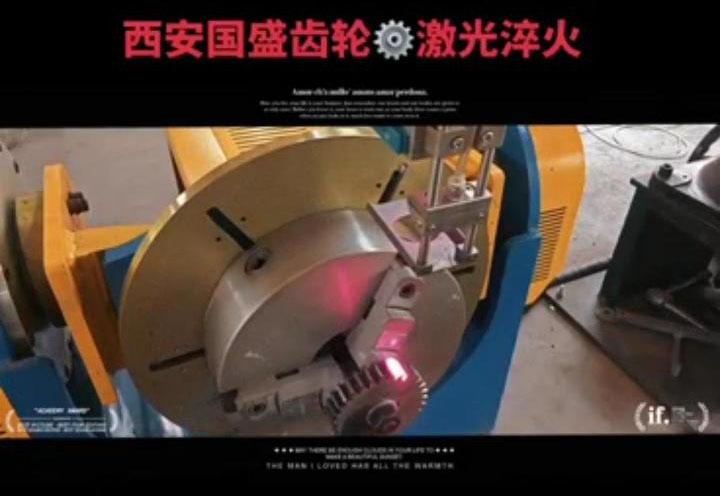
Laser quenching technology utilizes a focused laser beam as a heat source to irradiate the surface of the workpiece being treated, causing the temperature of the hardened part to rise sharply in an instant, forming austenite, which is then rapidly cooled to obtain a hardened layer of martensite or other fine-grained structures through heat treatment.
II. Technical Characteristics of Laser Surface Quenching
1. High power density, fast heating speed, minimal part deformation
The heat treatment process can control deformation, and the treated workpiece does not require grinding, making it suitable as the final finishing step for parts.
2. Applicable to complex-shaped components
Such as blind holes, inner holes, small grooves, thin-walled parts, etc. It can be applied fully or partially, and different treatments can be performed on different sections of the same part as needed. It overcomes the limitations of high-frequency quenching, which struggles with surface hardening of complex-shaped parts due to inductor constraints, difficulty in controlling heating areas, and the tendency for thin-walled parts to crack during quenching. In chemical heat treatment processes like carburizing and quenching, large parts can be processed without being restricted by furnace size.
3. Universality
The deep focus of the laser imposes no strict limitations on the size, dimensions, or surface of parts during the quenching process. In contrast, existing medium and high-frequency quenching methods require the production of specific inductors for various parts.
4. No restrictions
For certain stainless steel parts with high quenching temperatures, where the quenching temperature is very close to the melting point, using an inductor for localized surface quenching can easily cause burning at corners or irregular parts, leading to part scrapping. However, laser surface quenching is not subject to this limitation.
5. No cooling required
Laser quenching is a clean, efficient, and environmentally friendly quenching process with a fast cooling rate, eliminating the need for cooling media such as water or oil.
6. Meets hardening requirements
The surface hardened layer has a fine microstructure, high hardness, and good wear resistance, meeting the requirements for products with shallow surface hardening depths (typically 0.3–2.0 mm).
III. Application Examples of Laser Quenching Technology in the Steel Industry
1. Laser alloying of rolls
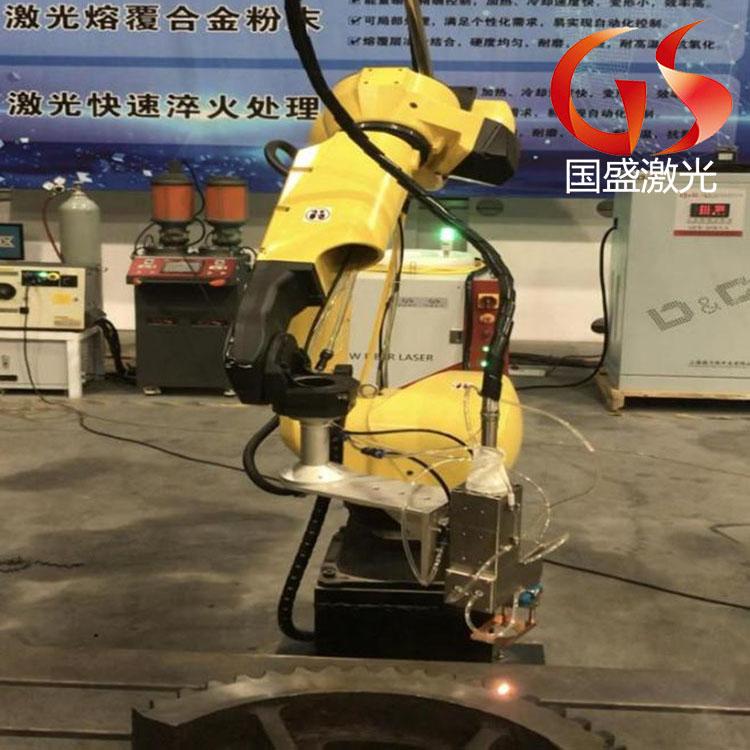
Rolls are the main working components and tools in rolling mills that produce continuous plastic deformation of metal. Long-term harsh working conditions can lead to surface peeling, cracking, or even fracture. Laser alloying of rolls can effectively extend their service life. Through laser alloying treatment, rolls become deformation-resistant, high-temperature resistant, and corrosion-resistant, significantly improving steel throughput.
2. Roller hearth laser quenching
As a medium for high-temperature slab transmission, furnace hearth rollers work for extended periods in high-temperature environments filled with corrosive gases. The roller rings in direct contact with high-temperature slabs are prone to issues such as steel sticking, nodulation, oxidation, corrosion, wear, and high-temperature creep. Quality defects like pitting, scratches, and double skin on the lower surface of slabs, caused particularly by steel sticking and nodulation, are especially prominent in soft steels such as silicon steel and cold-rolled raw materials. Applying a layer of high-temperature resistant, oxidation-resistant, and wear-resistant new material to the roller ring surface via laser quenching can prevent surface nodulation or loose, peeling oxide scale during the roller's service life, which could affect the subsequent rolling quality of steel plates and billets, thereby effectively enhancing the economic benefits of the production line. Laser quenching technology can be used to strengthen the surfaces of various guides, large gears, journals, cylinder inner walls, molds, shock absorbers, friction wheels, rollers, and roller parts. Applicable materials include medium and high-carbon steels, cast iron, etc.
| Industry Category | Machinery & Equipment/Electric Heating Equipment/Annealing Furnaces |
|---|---|
| Product Category | |
| Brand: | 国盛激光 |
| Spec: | |
| Manufacturer: | 西安国盛激光 |
| Origin: | 116101 |


