


Application of Laser Cladding Technology in Ship Repair
Contact Info
- Add:西安市国家民用航天产业基地航天基地299号西安建工科技创业基地十号楼4层, Zip:
- Contact: 段纯
- Tel:17392761868
- Email:gsjgkj@163.com
Other Products


Many large equipment on ships, if damaged, often results in significant economic losses and hazards. For example, the rotor shaft in critical parts of a generator, due to its high operational precision and high rotational speed, once damaged, its output power will be affected, and the entire unit may weaken or even become paralyzed. For insurance purposes, damaged components are usually replaced directly. However, components in the shipbuilding industry are typically expensive and have long order cycles, which cannot meet the needs of ship repairs. Therefore, the ship repair industry faces an urgent problem: developing a new, cost-effective, fast, and highly reliable ship repair technology.
Common traditional repair technologies mainly include ordinary electrode surfacing, spraying, and electroplating. For less critical components, these traditional technologies can solve the problem, but for important components, these traditional technologies have various degrees of defects. For example, surfacing and welding are prone to excessive deformation and can only be used in less critical areas; while spraying and electroplating methods do not cause deformation, their repairable thickness is limited, and the bonding strength between the repair layer and the base material is not strong, making them unsuitable for high-speed, impact, or heavy-load applications.
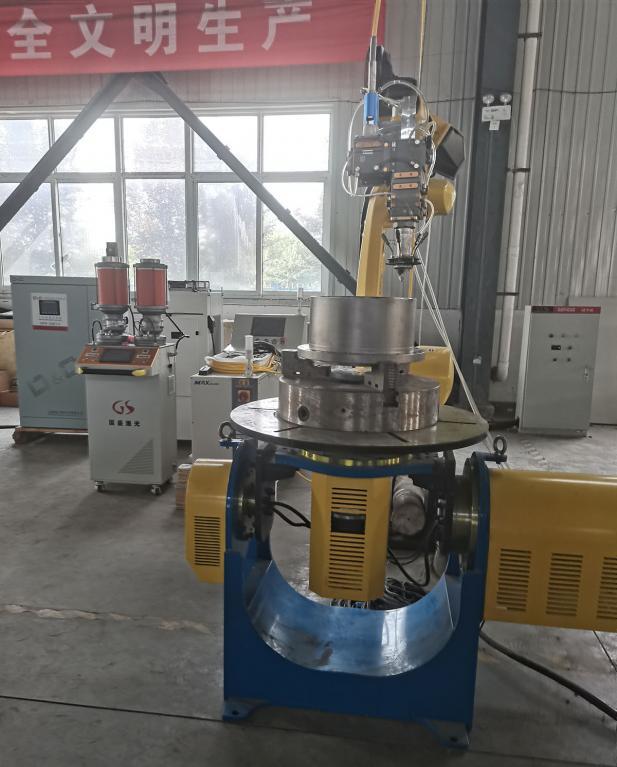
Laser cladding uses a high-energy laser beam to irradiate the metal surface, rapidly melting, expanding, solidifying, and cooling, thereby cladding a layer of material with special physical, chemical, or mechanical properties on the substrate surface. This forms a composite material to compensate for the shortcomings of the base material's performance. Depending on the working conditions of the workpiece, surface coatings with heat resistance, wear resistance, corrosion resistance, oxidation resistance, fatigue resistance, or optical, electrical, or magnetic properties can be applied.
Advantages of Laser Cladding:
1. The cladding layer forms a metallurgical bond with the substrate, resulting in a dense structure and high bonding strength, making it less prone to detachment;
2. When altering or restoring the geometric shape of a workpiece, surface strengthening is achieved while maintaining dimensions;
3. The use of functional materials allows for customization of the workpiece's surface properties, such as wear resistance, high-temperature resistance, and corrosion resistance;
4. The heat-affected zone and thermal deformation in the repaired area are small, and the workpiece substrate remains unchanged;
5. The repair process is automatically controlled by machines, ensuring workpiece quality;
6. High repair efficiency and short repair time;
7. Workpieces made of various materials can be repaired; the hardness of the cladding layer ranges from HRC20 to HRC60 and can be selected based on application requirements.
Since the repair layer produced by laser cladding repair technology forms a metallurgical bond, its structure is dense, with high bonding strength and low risk of detachment. It has gradually become one of the best repair processes for ships. Combining the characteristics and advantages of laser cladding repair technology, various steel, cast iron, and stainless steel components on ships that have experienced wear can be repaired using laser cladding technology. The overall performance after repair can reach or even exceed that of a new workpiece.
For repair problems that have previously troubled technicians in the ship repair industry, laser cladding repair technology demonstrates its uniqueness. For example, in the repair of shafts, laser cladding repair technology can control deformation within 0.01–0.02 mm, and even larger shafts may experience no deformation. For the repair of cast iron and stainless steel workpieces, laser cladding repair technology can also solve the problem effectively, with significant results and no cracks. Complex-shaped workpieces can be repaired accurately and efficiently. Most importantly, laser cladding repair technology uses a wide range of cladding materials. Materials similar to the substrate can be used to achieve dimensional repair, or superior alloy materials with better performance can be used for surface modification. These problems are often difficult to solve with traditional repair technologies.
As a new process, laser cladding repair technology, with its unique advantages, brings the possibility of repairing critical components in the ship repair industry. As mentioned above, the various characteristics of laser cladding repair technology determine that lasers must have broad application prospects in the ship repair industry. With the widespread application of laser cladding technology in the ship repair industry, it will bring considerable benefits to shipyards and shipowners. At the same time, since it saves material consumption and reduces waste, the remanufacturing and repair of damaged workpieces align with national industrial development policies and also have significant social benefits, making it worthy of active promotion and application.
| Industry Category | Others |
|---|---|
| Product Category | |
| Brand: | 国盛激光 |
| Spec: | |
| Manufacturer: | 西安国盛激光 |
| Origin: | 116101 |


