


Laser Surface Hardening Process and Characteristics
Contact Info
- Add:西安市国家民用航天产业基地航天基地299号西安建工科技创业基地十号楼4层, Zip:
- Contact: 段纯
- Tel:17392761868
- Email:gsjgkj@163.com
Other Products


The principle of laser surface quenching is the same as that of conventional heat treatment, but the heating time is very short (within the range of a few thousandths to a few tenths of a second), the area is small, and the cooling time is short. That is, the laser is used as a heat source to rapidly heat a small area of the metal surface, causing it to austenitize, and then quench to strengthen. Both theory and practice have confirmed that the surface temperature and thermal penetration depth are proportional to the square root of the laser irradiation duration. Therefore, the surface temperature and thermal penetration depth can be controlled by appropriately adjusting the spot size, scanning speed, and laser power. When the laser beam leaves the heated surface, the heat there quickly transfers to the rest of the cold surface, equivalent to self-cooling quenching, without the need for other rapid cooling measures. During laser beam scanning, the power density can also be adjusted by changing the amplitude and frequency of the beam oscillation, thereby controlling the depth and coverage of the quenching layer.
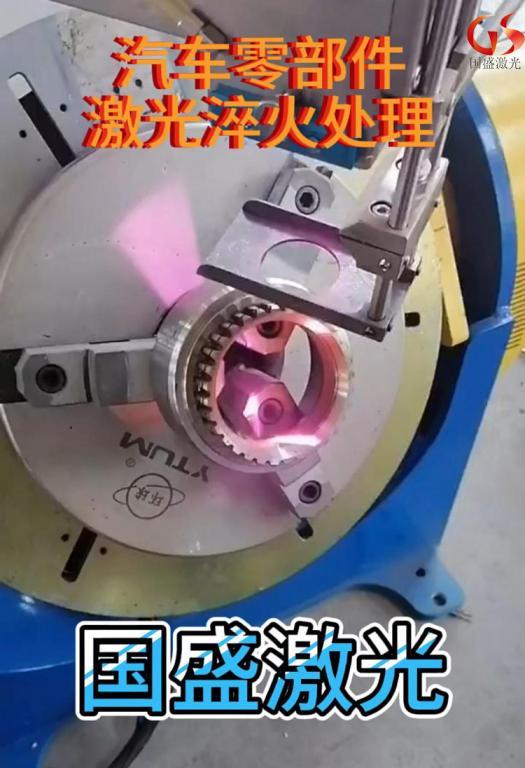
Due to the small size of the laser spot or the amplitude of beam oscillation, heating can only be achieved by scanning the beam one by one on the surface of the part. To prevent the quenched portion of the previous scan strip from being tempered and softened by the heat at the edge of the subsequent scan strip, efforts should be made to make the energy distribution at the edge of the beam or oscillating surface as steep as possible, which can also be achieved using gratings.
Similar to induction heating surface quenching, the microstructure of general steel materials after laser surface quenching is also divided into the surface fully quenched zone, the sublayer incompletely quenched zone (transition zone), and the unquenched core zone.
Compared with conventional heat treatment, laser quenching technology has the following characteristics.
1. Extremely fast heating speed, minimal thermal deformation of the workpiece. Due to the high power density of the laser, the heating rate can reach 10^10 °C/s, the heat-affected zone is small, and the thermal deformation of the workpiece is minimal.
2. Very fast cooling speed. Provided the workpiece has sufficient mass, the cooling rate can reach 10^23 °C/s; no cooling medium is required, as self-cooling quenching is achieved through heat conduction from the surface to the interior.
3. After laser quenching, the workpiece surface obtains a fine martensitic structure, with high surface hardness (15% to 20% higher than conventional quenching hardness values) and high fatigue strength (the surface has residual compressive stress above 4000 MPa).
4. Due to the small scanning (heating) area of the laser beam, it can process workpieces with complex shapes (such as small grooves, blind holes, small holes, thin-walled parts, etc.) or perform very precise local processing. It can also perform different treatments on different parts of the same component as needed.
5. No heating medium is required, and no gas is emitted to pollute the environment, which is beneficial for environmental protection.
6. Energy-saving, and the workpiece surface is clean, requiring no polishing after treatment, making it suitable as the final finishing process for workpieces.
The biggest disadvantage of laser surface quenching is the high cost of laser generators.
Due to the above advantages of laser surface quenching, although the development time is short, progress has been rapid, and it has been successfully applied to the production of some mechanical products, such as gearbox gears, engine cylinder liners, bearing rings, and rails, etc.
| Industry Category | Others |
|---|---|
| Product Category | |
| Brand: | 国盛激光 |
| Spec: | |
| Manufacturer: | 西安国盛激光 |
| Origin: | 116101 |


