


Tail Beam Piston Rod Laser Cladding Repair Processing
Contact Info
- Add:西安市国家民用航天产业基地航天基地299号西安建工科技创业基地十号楼4层, Zip:
- Contact: 段纯
- Tel:17392761868
- Email:gsjgkj@163.com
Other Products


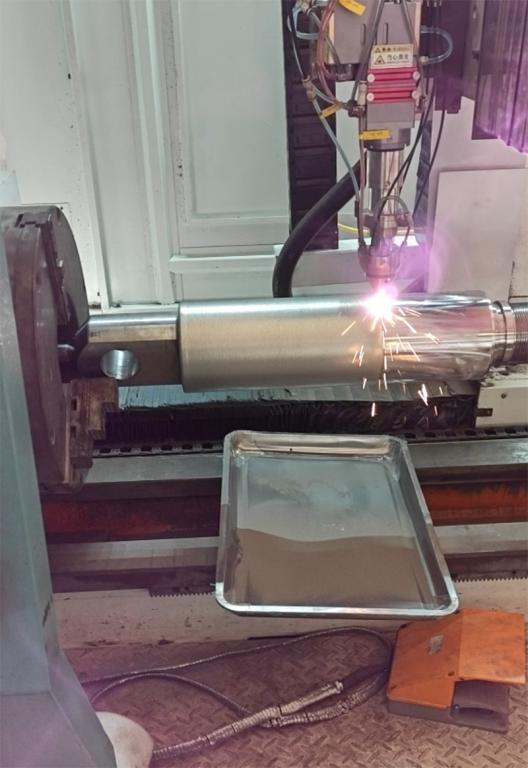
Laser cladding technology, as an advanced surface repair process, demonstrates significant advantages in the field of repairing critical components of industrial equipment. Taking the tail beam piston rod as an example, such core components of engineering machinery are subjected to long-term high pressure, friction, and corrosion. Traditional repair methods like electroplating and thermal spraying suffer from issues such as insufficient bonding strength and large heat-affected zones. In contrast, laser cladding technology, through the synergistic effect of high-energy laser beams and metal powder, achieves metallurgical bonding between the substrate and the cladding layer, providing an innovative solution for piston rod repair.
I. Principles and Process Advantages of Laser Cladding Technology
The core of laser cladding repair for tail beam piston rods lies in using a high-power-density laser beam to form a molten pool on the substrate surface, while simultaneously delivering alloy powder that rapidly melts and solidifies in the pool. This process has three notable characteristics: first, the extremely fast cooling rate forms a fine-grained structure, increasing the hardness of the repair layer by 20%-30%; second, the heat-affected zone is controlled within 0.1-0.5mm, effectively preventing substrate deformation; third, by adjusting parameters such as laser power, scanning speed, and powder feed rate, precise repairs with thicknesses of 0.3-2mm can be achieved.
Compared with traditional electroplating processes, the interfacial bonding strength of laser cladding can reach over 400MPa, far exceeding the 70-100MPa of electroplated layers. Data from an engineering machinery company shows that the wear resistance of laser-repaired piston rods increases by 3-5 times, with their service life extended to over 90% of that of new components. Additionally, this technology enables multi-material composite repairs, such as stainless steel and nickel-based alloys, meeting the demands of various working conditions.
II. Damage Characteristics and Repair Challenges of Tail Beam Piston Rods
(1) Common failure modes of piston rods include:
1. Surface wear: Uniform wear of 0.1-0.8mm in the sealing section due to reciprocating friction.
2. Local scratches: Groove-like damage with depths of 0.5-3mm caused by the intrusion of hard particles.
3. Corrosion pits: Point-like corrosion with diameters of 1-5mm caused by acidification of hydraulic oil.
4. Fatigue microcracks: Axial microcracks generated under alternating loads.
(2) Three major technical challenges must be overcome during the repair process:
1. Deformation control: The large length-to-diameter ratio of the rod makes it prone to straightness deviation with heat input above 200°C.
2. Metallurgical defects: Rapid solidification may cause pores (qualified if pore size <50μm) and lack of fusion.
3. Dimensional accuracy: Post-repair diameter tolerance must be within ±0.05mm, with surface roughness Ra ≤0.8μm.
III. Laser Cladding Repair Process Flow
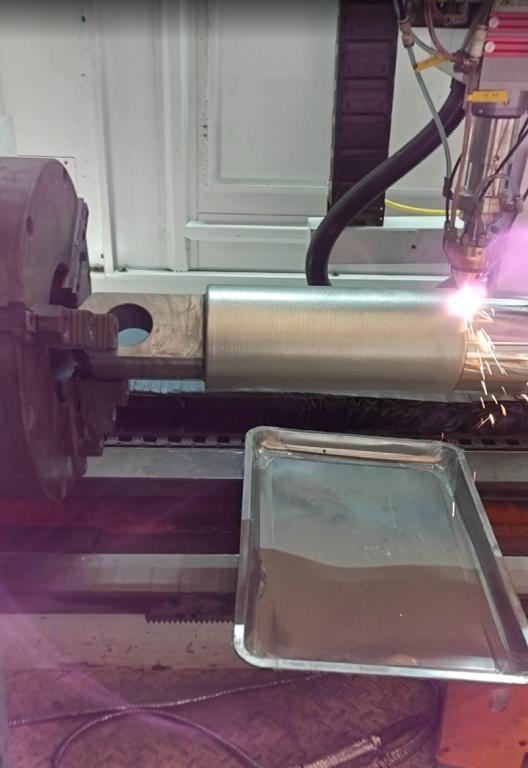
The complete repair process consists of six key steps:
1. Pre-treatment stage
- Use magnetic particle inspection to detect surface cracks; perform groove machining for defects deeper than 1mm.
- Ultrasonic cleaning to remove oil; sandblasting to achieve surface roughness.
- Pre-set anti-deformation to compensate for thermal deformation.
2. Cladding parameter optimization
- Recommended parameters for 45 steel substrate: laser power, spot diameter, overlap rate.
- Oxygen content and particle size distribution of nickel-based alloy powder.
- Inert gas protection to prevent oxidation.
3. Online monitoring system
- Infrared thermometer for real-time monitoring of molten pool temperature.
- CCD vision system to detect clad track morphology and automatically adjust powder feed rate.
- Acoustic emission sensors to capture crack initiation signals.
4. Post-treatment process
- Stress relief annealing to reduce residual stress.
- CNC grinding to ensure dimensional accuracy.
- Superfinishing to achieve a mirror-like surface.
5. Quality inspection standards
- Ultrasonic testing to detect fusion surface defects.
- Microhardness testing.
- Salt spray test: no red rust after 96 hours indicates corrosion resistance compliance.
IV. Technological Development Trends
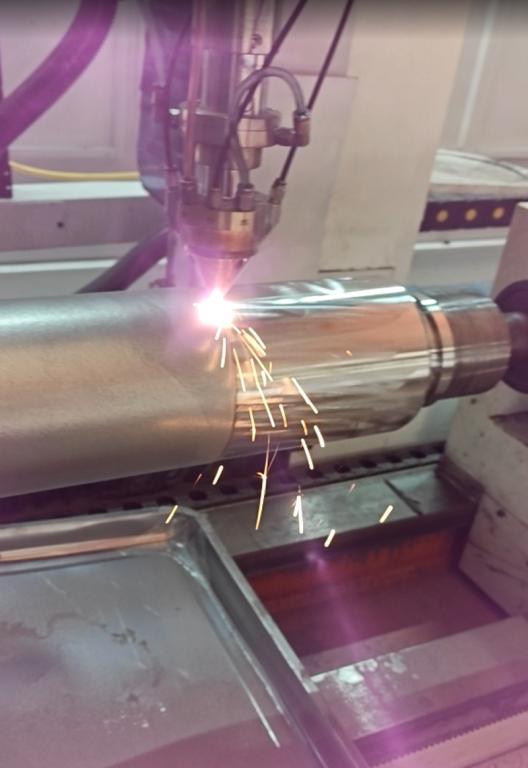
As the manufacturing industry continues to demand higher precision and performance in component repairs, laser cladding repair technology for tail beam piston rods is also evolving. On one hand, intelligent technologies are gradually being applied to the laser cladding process. By monitoring parameters such as molten pool temperature, shape, and composition in real time, laser power and powder feed rates can be automatically adjusted to achieve precise control and improve the stability of repair quality. On the other hand, the continuous development of new high-performance alloy powders and composite powder materials, such as nano-composite powders, will further enhance the comprehensive performance of cladding layers to meet the demands of more complex working conditions. Additionally, interdisciplinary integration, combined with simulation technology, allows for the prediction of cladding layer performance and quality before processing, optimizing process plans and shortening R&D and production cycles.
| Industry Category | Others |
|---|---|
| Product Category | |
| Brand: | 国盛激光 |
| Spec: | |
| Manufacturer: | 国盛激光 |
| Origin: | 116101 |


