


Laser Cladding Repair Processing of the Pull-Back Piston Rod
Contact Info
- Add:西安市国家民用航天产业基地航天基地299号西安建工科技创业基地十号楼4层, Zip:
- Contact: 段纯
- Tel:17392761868
- Email:gsjgkj@163.com
Other Products


The pull-back piston rod, as a critical component in mechanical equipment, has its performance and lifespan directly impacting the overall operational efficiency and maintenance costs of the equipment. With technological advancements, laser cladding repair technology, as an efficient and environmentally friendly method for metal surface restoration, is gradually being applied to the repair of pull-back piston rods.
I. Overview of Pull-Back Piston Rods
The pull-back piston rod, as a key component in mechanical equipment for transmitting power and bearing loads, is widely used in fields such as engineering machinery, petrochemicals, and metallurgy. Its primary function is to achieve energy conversion and transmission through the reciprocating motion of the piston. However, due to long-term exposure to high pressure, high speed, and complex working conditions, the piston rod surface is prone to wear, corrosion, cracks, and other defects, severely affecting its service life and performance. Therefore, timely and effective repair of piston rods is of great significance for ensuring stable equipment operation and reducing maintenance costs.
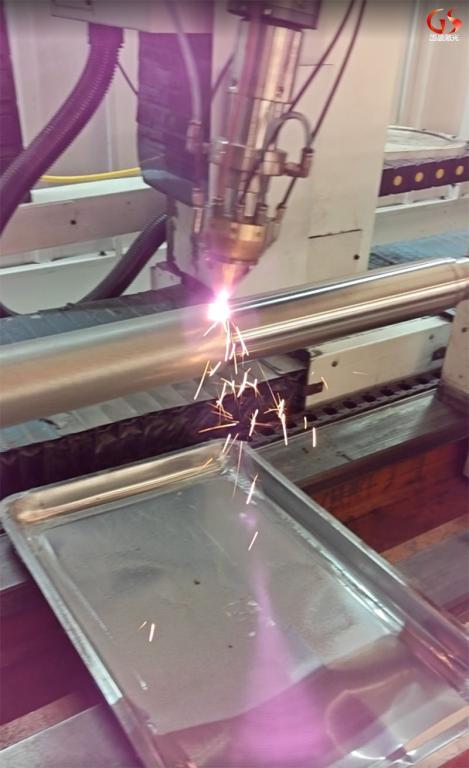
II. Laser Cladding Repair Process for Pull-Back Piston Rods
1. Piston Rod Preprocessing
Surface Cleaning: Use methods such as chemical cleaning and ultrasonic cleaning to thoroughly remove oil stains, rust, impurities, etc., from the surface to be repaired, ensuring surface cleanliness and providing a good foundation for subsequent repair work.
Damage Detection: Employ non-destructive testing techniques, such as ultrasonic testing and magnetic particle testing, to comprehensively detect and evaluate the type, extent, and range of damage on the piston rod surface, determining the repair plan and the thickness requirements of the cladding layer.
Pre-Machining Treatment: For piston rods with deformation, straightening treatment is required; remove existing electroplating layers, oxide layers, etc., from the cladding area, and use machining methods such as turning and grinding to achieve a certain level of flatness and roughness on the surface to be repaired, ensuring uniform energy absorption during the laser cladding process and the quality of the cladding layer.
2. Laser Cladding Operation
Equipment Debugging: Based on the material, dimensions, and selected alloy powder of the piston rod, debug the laser cladding equipment, including optimizing key parameters such as laser power, scanning speed, powder feed rate, and spot diameter, ensuring stable equipment operation and meeting the repair process requirements.
Alloy Powder Selection: Choose the appropriate alloy powder based on the working environment and performance requirements of the piston rod. For example, in high-wear environments, alloy powders containing high-hardness carbide particles, such as WC-reinforced nickel-based alloy powders, can be used; in environments with corrosive media, stainless steel-based alloy powders or nickel-based corrosion-resistant alloy powders with good corrosion resistance can be selected.
Cladding Process Control: Install the preprocessed piston rod on the worktable of the laser cladding equipment, precisely control the scanning path and speed of the laser beam through the CNC system, and simultaneously activate the powder feeder to uniformly deliver the alloy powder into the laser melt pool. During the cladding process, monitor the state of the melt pool, such as temperature and shape, in real-time, and adjust process parameters promptly to ensure the cladding layer is uniform, dense, and free from defects such as pores and cracks.
3. Post-Processing Steps
Surface Finishing: The surface roughness of the piston rod after laser cladding is relatively high, requiring finishing treatment. Typically, an external cylindrical grinder is used to grind the surface of the cladding layer, precisely controlling dimensional accuracy and surface roughness to meet the usage requirements of the piston rod and restore its original fit accuracy and surface quality.
Quality Inspection: Use various inspection methods to conduct a comprehensive quality inspection of the repaired piston rod. Perform hardness testing to check if the hardness of the cladding layer meets design requirements; use metallographic analysis to observe the microstructure and metallurgical bonding of the cladding layer; employ non-destructive testing to check for internal defects in the cladding layer; and conduct performance tests such as wear resistance and corrosion resistance to ensure the repaired piston rod can meet performance requirements under actual working conditions.
Protective Treatment: Apply protective measures to the qualified piston rod, such as coating with anti-rust paint or installing protective sleeves, to prevent corrosion and damage during transportation, storage, and use, further extending the service life of the piston rod.
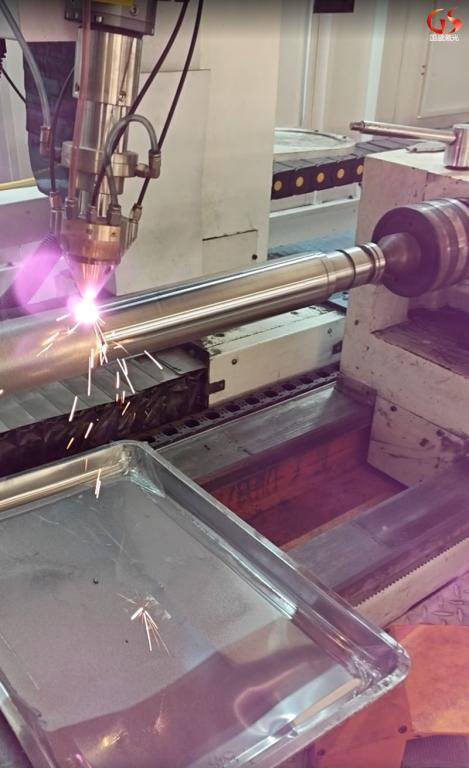
III. Technical Advantages of Laser Cladding Repair for Pull-Back Piston Rods
1. High Efficiency and Energy Savings
Laser cladding repair technology is characterized by high efficiency and energy savings. Compared to traditional repair methods such as thermal spraying and welding, laser cladding achieves higher energy utilization and more precise control of the cladding layer, thereby reducing energy consumption and material waste.
2. High-Performance Repair
The laser cladding repair layer forms a metallurgical bond with the base metal, providing excellent mechanical properties and corrosion resistance. This enables the repaired piston rod to withstand higher working pressures and harsher working environments, extending its service life.
3. Environmentally Friendly and Pollution-Free
The laser cladding repair process does not require the use of large amounts of chemical reagents and auxiliary materials, reducing environmental pollution and waste emissions. Additionally, the precise control of the laser beam avoids issues such as excessive heat input and heat-affected zones that may occur in traditional repair methods, minimizing damage to the base metal.
4. Ease of Automation and Intelligence
Laser cladding repair technology can easily be integrated with automated and intelligent equipment, enabling precise control and real-time monitoring of the repair process. This not only improves repair efficiency and quality but also reduces labor costs and operational difficulty.
IV. Application Case
A pull-back piston rod in a key piece of equipment at a petroleum extraction enterprise was damaged due to long-term wear, severely affecting the normal operation of the equipment. The enterprise used laser cladding repair technology to repair the piston rod. After steps such as preprocessing, fixture installation and heating, alloy powder delivery, laser cladding, and post-processing, a uniform and dense coating was formed on the piston rod surface. After inspection and testing, the performance of the repaired piston rod met the design requirements, and its service life was significantly extended. This case fully demonstrates the broad application prospects and great potential of laser cladding repair technology in the field of pull-back piston rod repair.
Additionally, laser cladding repair technology is widely used in the repair of other types of piston rods, such as steam turbine synchronizer piston rods and plungers. These application cases further prove the reliability and practicality of laser cladding repair technology.
V. Future Outlook
With the continuous development and improvement of laser technology, the application of laser cladding repair technology in the field of pull-back piston rod repair will become more extensive and in-depth. In the future, we can expect developments in the following areas:
1. Intelligence: By introducing intelligent control systems and sensor technology, achieve automation and intelligent control of the laser cladding repair process, improving repair efficiency and precision.
2. Diversification: Develop more types of alloy powders and coating materials to meet the needs of different industries and application scenarios.
3. Environmental Sustainability: Further optimize the laser cladding repair process to reduce energy consumption and waste emissions, achieving a more environmentally friendly repair process.
4. Standardization: Establish and improve relevant standards and specifications for laser cladding repair technology, promoting the standardization and规范化 development of the technology.
In summary, laser cladding repair technology for pull-back piston rods, with its advantages of high efficiency, precision, and environmental friendliness, has broad application prospects and great development potential in the field of piston rod repair. With the continuous advancement of technology and the expansion of application areas, we have reason to believe that laser cladding repair technology will provide higher-quality and more efficient solutions for equipment maintenance and upgrades in more industries.
| Industry Category | Others |
|---|---|
| Product Category | |
| Brand: | 国盛激光 |
| Spec: | |
| Manufacturer: | 国盛激光 |
| Origin: | 116101 |


