


Laser Cladding Repair Processing of Hydraulic Supports for Mining Machinery
Contact Info
- Add:西安市国家民用航天产业基地航天基地299号西安建工科技创业基地十号楼4层, Zip:
- Contact: 段纯
- Tel:17392761868
- Email:gsjgkj@163.com
Other Products


As a core component of mining machinery equipment, the hydraulic support of mining machines operates in harsh and demanding working environments. Long-term operation in acidic and alkaline corrosive media, coupled with immense pressure and wear, makes the surface of hydraulic supports highly susceptible to corrosion, wear, and even cracks, severely impacting their service life and operational efficiency. In recent years, with the rapid development of laser technology, laser cladding repair technology has gradually become an effective solution to this challenge.
I. Addressing the repair needs of mining machine hydraulic supports, laser cladding technology demonstrates multiple advantages.
1. The laser cladding layer can utilize alloy powders with high hardness and excellent corrosion resistance as needed, significantly enhancing the wear and corrosion resistance of hydraulic supports and extending their service life. The surface performance of hydraulic supports directly affects the overall performance and lifespan of the equipment. Therefore, improving wear and corrosion resistance is a major highlight of laser cladding technology. By selecting appropriate alloy powders and process parameters, a cladding layer with excellent wear and corrosion resistance can be prepared, thereby significantly improving the operational efficiency and service life of hydraulic supports.
2. During the laser cladding process, the heat-affected zone of the base material is extremely small, generally controlled between 0.1-0.5mm, effectively avoiding performance degradation and deformation of the base material caused by high temperatures. This characteristic gives laser cladding a significant advantage in repairing high-precision components. Given the harsh working environment of mining machine hydraulic supports and the extremely high requirements for component precision and stability, minimizing the heat-affected zone is a major advantage of laser cladding technology. By precisely controlling parameters such as laser beam energy density and scanning speed, the heat-affected zone can be effectively controlled, ensuring excellent dimensional stability and performance reliability of the repaired hydraulic supports.
3. Laser cladding technology enables precise repair. The high energy density and precise controllability of the laser beam allow the repair process to achieve accuracy down to millimeters or even smaller, meeting the repair needs of complex shapes and fine structures. The structure of mining machine hydraulic supports is complex, with diverse surface shapes, making it difficult for traditional repair methods to achieve precise repairs. Laser cladding technology, however, can achieve precise repairs of complex shapes and fine structures by accurately controlling parameters such as the laser beam's scanning path and energy density, ensuring excellent surface quality and performance reliability of the repaired hydraulic supports.
4. Laser cladding technology also features environmental friendliness and energy efficiency. The laser cladding process does not require the use of large amounts of chemical agents and solvents, reducing environmental pollution and energy consumption, aligning with the development trend of green manufacturing. As environmental awareness continues to grow, green manufacturing has become an important direction for the manufacturing industry. As an environmentally friendly and energy-efficient surface treatment technology, laser cladding technology has broad application prospects. By adopting laser cladding technology, efficient and environmentally friendly repair of mining machine hydraulic supports can be achieved, reducing energy consumption and environmental pollution during the repair process, and creating greater economic and social benefits for enterprises.
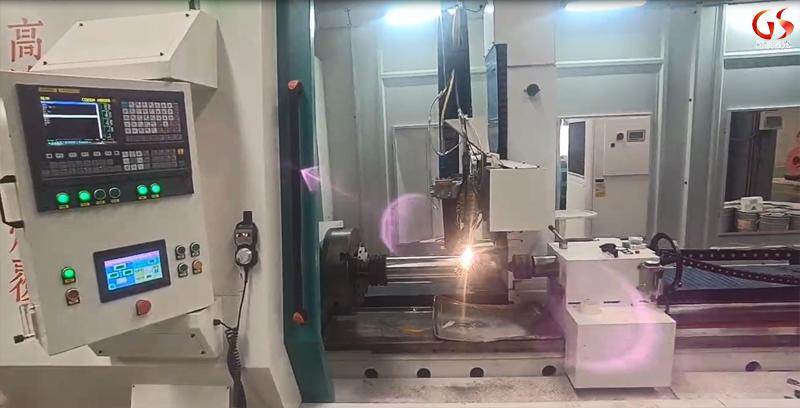
II. The application process of laser cladding repair for mining machine hydraulic supports can generally be divided into the following steps.
1. Pre-repair inspection for laser cladding: Conduct a detailed inspection of the surface to be repaired on the hydraulic support, including the damage condition of the original electroplated layer and the amount of deformation. If the workpiece is deformed, correction is required. Then, remove the original electroplated layer in the cladding area and perform necessary turning to ensure the surface flatness and circular runout of the cladding area meet requirements. This step is a critical prerequisite for laser cladding repair, directly affecting the quality and performance of the subsequent cladding layer.
2. Pre-repair preparation for laser cladding: Mount the turned hydraulic support onto a specialized rotating device and perform rust and oil removal treatment on the cladding area. Simultaneously, clean the laser lens to ensure the focusing effect of the laser beam. The purpose of this step is to ensure the cleanliness of the cladding area surface and the focusing effect of the laser beam, thereby ensuring the quality and performance of the cladding layer.
3. Laser cladding repair process: Set the scanning speed, overlap amount, and other parameters through a three-axis motion device and rotating device. At the same time, adjust the powder feed rate of the powder feeder to achieve the predetermined cladding thickness. During the cladding process, closely monitor changes in cladding thickness and the uniformity of powder feeding to ensure the quality and performance of the cladding layer. This step is the core of laser cladding repair, directly related to the quality and performance of the cladding layer. By precisely controlling parameters such as the laser beam's scanning path and energy density, as well as the powder feed rate of the powder feeder, precise control and optimization of the cladding layer can be achieved, ensuring excellent performance reliability of the repaired hydraulic support.
4. Post-repair treatment and inspection after laser cladding: The surface roughness of the cladded hydraulic support is relatively high, requiring precision machining. Typically, an external cylindrical grinder is used for grinding to meet surface roughness requirements and restore the original dimensions. Simultaneously, use equipment such as scanning electron microscopes, hardness testers, wear testers, and salt spray testers to test and analyze the performance of the cladding layer, ensuring it meets usage requirements. This step is an important guarantee for laser cladding repair. Through precision machining and performance testing, excellent surface quality and performance reliability of the repaired hydraulic support can be ensured.
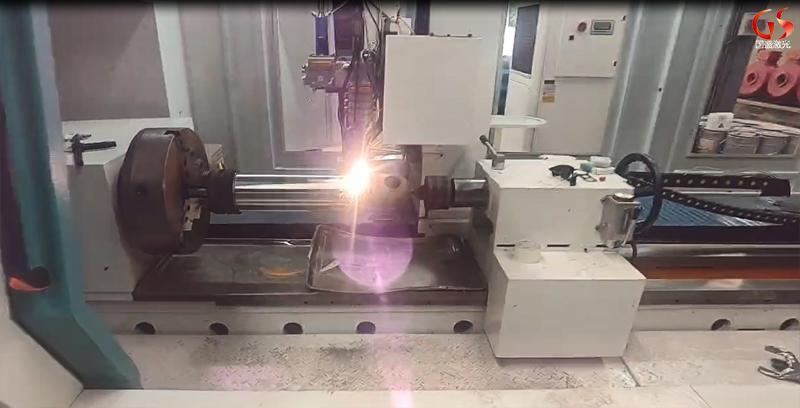
After laser cladding repair, the mining machine hydraulic support forms a dense and high-performance cladding layer on its surface. This cladding layer not only has excellent wear and corrosion resistance but also high microhardness and shear strength. Experimental results show that the service life of the repaired hydraulic support is significantly improved under the same working conditions. Additionally, laser cladding repair technology enables precise and rapid repair of hydraulic supports, greatly reducing repair costs and downtime, providing strong support for the safe production and efficient operation of coal mining enterprises.
In summary, laser cladding repair technology for mining machine hydraulic supports, with its unique advantages and significant practical results, demonstrates broad application prospects in the field of coal mining machinery maintenance. Compared to traditional surface treatment technologies such as electroplating and spraying, laser cladding technology offers significant advantages, including a small heat-affected zone, controllable cladding layer performance, high bonding strength, and high repair precision. By adopting laser cladding technology, efficient and environmentally friendly repair of mining machine hydraulic supports can be achieved, extending their service life, reducing repair costs, and improving the economic and social benefits of enterprises.
With the continuous development and refinement of laser technology, it is believed that laser cladding technology will be more widely applied and promoted in the future. It can not only be used for the repair of mining machine hydraulic supports but also widely applied to the repair of key components in industries such as petroleum, chemical, shipbuilding, and locomotives. Through laser cladding technology, high-precision repair of these components can be achieved, improving their performance and service life, and creating greater economic and social benefits for enterprises. At the same time, laser cladding technology also features environmental friendliness and process flexibility, contributing to the formation of a circular economy model and promoting the transformation and upgrading of the manufacturing industry. In the future, laser cladding technology will play an even more important role in the manufacturing industry, providing strong support for the sustainable development of enterprises.
| Industry Category | Others |
|---|---|
| Product Category | |
| Brand: | 国盛激光 |
| Spec: | |
| Manufacturer: | 国盛激光 |
| Origin: | 116101 |


