


Laser Cladding Repair Processing of Titanium Alloy Shaft
Contact Info
- Add:西安市国家民用航天产业基地航天基地299号西安建工科技创业基地十号楼4层, Zip:
- Contact: 段纯
- Tel:17392761868
- Email:gsjgkj@163.com
Other Products


In the fields of modern industrial manufacturing and remanufacturing, titanium alloy has become an indispensable key material for numerous high-end equipment due to its excellent physical properties and broad application prospects. However, the high wear resistance, high strength, and tendency to undergo work hardening of titanium alloys make their processing and repair particularly complex. This article delves into the laser cladding repair processing technology for titanium alloy shafts, providing a comprehensive analysis of the charm and potential of this cutting-edge technology, covering its principles, process optimization, application examples, and future development.
I. Overview of Laser Cladding Technology
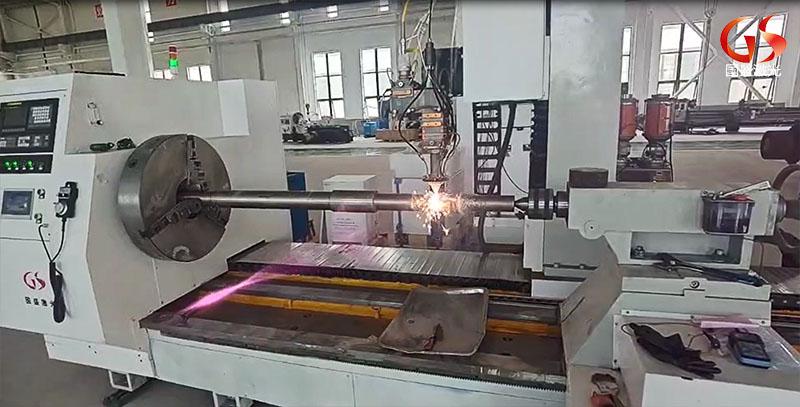
As an advanced surface engineering technology, laser cladding utilizes a high-energy-density laser beam to rapidly melt specific alloy powder and fuse it with the surface of the base material, forming a metallurgically bonded layer with excellent properties. This technology offers advantages such as a small heat-affected zone, low dilution rate, and high bonding strength between the coating and the base material, making it particularly suitable for the repair and strengthening of difficult-to-process materials like titanium alloys.
II. Laser Cladding Repair Process for Titanium Alloy Shafts
1. Preliminary Preparation
Before laser cladding repair of titanium alloy shafts, the damaged area must undergo thorough cleaning and pretreatment to remove oil stains, oxides, and impurities, ensuring a strong bond between the cladding layer and the base material. Additionally, based on the specific dimensions, shape, and extent of damage of the shaft, a reasonable cladding path and parameters must be designed.
2. Material Selection and Ratio
The laser cladding materials for titanium alloy shafts must be carefully selected according to the operating environment and performance requirements. Common cladding materials include Ti/Cr2O3 composite powder, Ni-based alloy powder, etc., which offer excellent wear resistance, corrosion resistance, and high-temperature performance. When determining the ratio, factors such as the particle size distribution, chemical composition, and compatibility with the base material must be considered to ensure the quality of the cladding layer.
3. Process Parameter Optimization
Laser cladding process parameters include laser power, scanning speed, spot diameter, powder feed rate, etc., which directly affect the morphology, dilution rate, and metallurgical bonding quality of the cladding layer. Through extensive experimentation and data analysis, optimized parameter combinations, such as a laser power of 1.8 kW and a scanning speed of 6 mm/s, can yield a high-quality cladding layer that is continuous, uniform, and free of cracks and pores.
4. Process Control
During processing, strict control must be maintained over the stability of the laser beam, the uniformity of powder feeding, and the temperature and humidity of the processing environment to avoid defects such as thermal stress, pores, and cracks. Simultaneously, liquid cooling and spray devices are used to provide real-time cooling of the processing area, preventing material overheating and deformation.
III. Application Examples
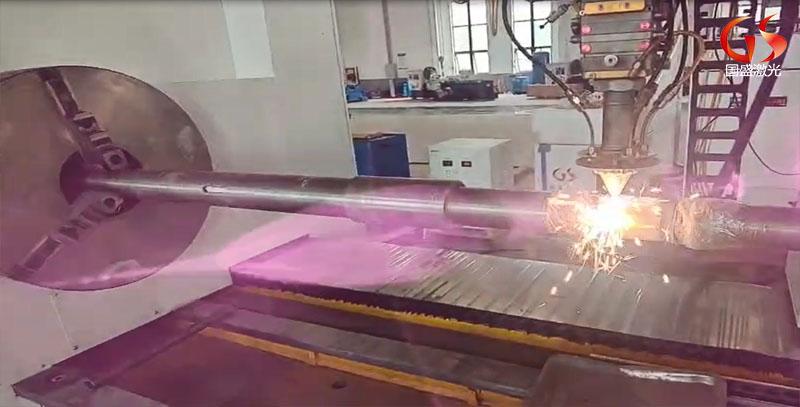
Taking the repair of a titanium alloy compressor blade in an aircraft engine as an example, traditional repair methods struggle to address issues related to complex curved surfaces and large-thickness damage. Using laser cladding technology, by precisely controlling laser parameters and cladding material ratios, a continuous, uniform, and defect-free Ti/Cr2O3 composite coating was successfully applied to the blade surface. The repaired blade not only restored its original dimensional accuracy and mechanical properties but also significantly improved its wear resistance and corrosion resistance, extending its service life.
IV. Future Development Trends
With the continuous advancement of laser technology and the growing industrial demand, the laser cladding repair processing technology for titanium alloy shafts will embrace broader development prospects. In the future, breakthroughs are expected in the following areas:
1. High Precision and High Automation: By integrating advanced robotics and intelligent control systems, high precision and high automation in laser cladding processing will be achieved, improving production efficiency and processing quality.
2. New Materials and New Processes: Exploring more new materials and processes suitable for titanium alloy laser cladding, such as nano-powders, composite powders, and multi-pass cladding techniques, to further enhance the performance and reliability of the cladding layer.
3. Environmental Protection and Green Manufacturing: Emphasizing environmental concerns during processing by adopting low-energy-consumption, low-emission processing methods to promote the development of green manufacturing.
4. Intelligence and Remote Monitoring: Combining IoT, big data, and artificial intelligence technologies to achieve intelligent control and remote monitoring of the laser cladding process, enhancing the level and efficiency of production management.
In summary, as an important component of modern industrial manufacturing and remanufacturing, the laser cladding repair processing technology for titanium alloy shafts is providing robust technical support for the repair and strengthening of high-end equipment with its unique advantages and broad application prospects. With continuous technological progress and innovation, it is believed that this field will usher in an even brighter future.
| Industry Category | Metallurgy & Minerals/Non-Ferrous Alloys/Titanium Alloys |
|---|---|
| Product Category | |
| Brand: | 国盛激光 |
| Spec: | |
| Manufacturer: | 西安国盛激光 |
| Origin: | 116101 |


